Grannies and Grandpas

Three DOs, Three DONTs, and Three WAYS to make up for all those mistakes.

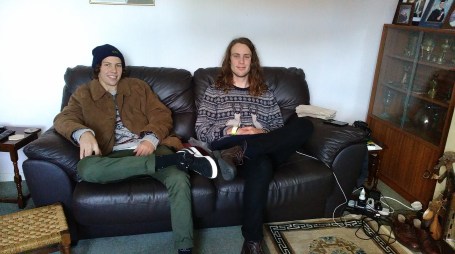
IMG_0718

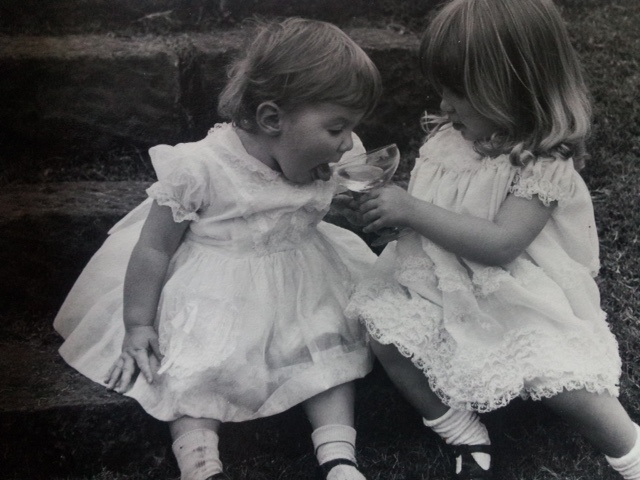
Aren’t they adorable? They are somebody’s grandchildren.

The most important roles in life are undertaken by people with the least training. No prizes for guessing these are parents – and grandparents. Here’s a little bit of advice on grandchildren from someone who has had experience.

THREE DOs 

Encourage all their endeavours. That should be easy and natural.

Baby-sit. This will gain you brownie points with the parents, and provide an opportunity to get to know the children.

Be there from the beginning. To all you women – I cannot begin to describe how wonderful it is to be a granny for the first time. And you won’t experience the absolute pleasure unless you’re there to help from the start. That is when your advice (“it is only wind”) will be most appreciated. That is when you will be allowed to take control. And that is when you can hand the baby back in the knowledge that when all is said and done, it isn’t your responsibility.

THREE DONTs

Don’t chastise your grandchild. It’s not up to you. One of them was being particularly obnoxious, and I made the mistake of saying: “Why are you such a horrible little boy –” There was a shocked gasp, and everybody looked at me as if I were an ogre… until I sort-of redeemed myself by adding “to your mother?”

Neither should you spoil them. You won’t be forgiven, and it doesn’t help anyway.

And never have a favourite – or if you do, keep it secret. You’re only human after all.

I’ve forgiven my mother, I truly have. But that doesn’t mean I can’t use her as an example NOT to follow…

My mother’s confessed favourite was my eldest daughter, and she made no bones about it. My daughter was taken out for treats, and given the biggest and the best presents without shame. When money was dished out for birthdays and Christmases, she always got the most, with the excuse that the amount was based on the age of the grandchild. Nothing I could say or do made the slightest difference to my mother. This caused untold misery and embarrassment as my daughter suffered the sorrowful envy of her siblings. But it did serve to strengthen her character – and when she reached her teens, she put her foot down and refused to take anymore.

THREE WAYS TO MAKE UP FOR ALL THOSE MISTAKES

Be there for them. Keep in touch, even when they’ve grown up.

Set up a Travel Fund. I haven’t always been around for birthdays and Christmases, but my travel fund has already been enjoyed in their late teens by five of my seven grandkids. And I’ve seen more of them as a result.

Don’t wait until you die before handing over their inheritance. One Christmas I distributed my jewellery to the grandchildren (I never wear it, and it looks much better on the young). Over the years I have collected brass. It’s been a pain to clean. I distributed appropriate pieces among them. And do you know, my eldest grandson told me the best way of cleaning them was with tomato sauce.

Those two adorable little girls are now approaching their fifties. It was my mother who not only placed a Stuart Crystal glass in the hand of one, but filled it with champagne and encouraged the other to take a sip, while granddad stood by with a camera. I was HORRIFIED – and jumped to rescue the glass before it was too late.

Posted in Thoughts | Tagged , , , , , | 4 Comments

Places which Ended Up in my Novels

Welcome again to Cathie Dunn, whose novels are a delight to read, and as all good historical novels should, hers have a very special sense of place.

Cathie Dunn

First of all, thank you to Jane for hosting me today. I’m delighted to be here. It’s always a pleasure to re-visit places I’ve been to and loved – and which ended up in my novels.

Today, I’m going to chat about the inspiration for my first big writing project, Dark Deceit. As a writer of historical adventure, I have to combine the locations I choose with real events. Or vice versa!

Dark Deceit is set in mainly rural Gloucestershire and Normandy. The year is 1141, a time of uncertainty when two sides were claiming the English throne: the Empress Matilda, daughter of King Henry I and his designated heir (a woman no less!), and Stephen of Blois, her cousin and son of Henry’s sister Adela. Following Henry’s death in 1135, Stephen sped to London and usurped the throne, whilst Matilda remained in Normandy, supposedly safe in the knowledge of becoming queen. Thus ensued two decades of unrelenting civil war in England and Normandy. “Christ wept,” they said about those years.

Dark Deceit began to take shape after a day trip to the lush Gloucestershire countryside from our then home in south Wales back in 2004. Driving through softly rolling hills and walking through rustic old villages with its beautiful churches inspired the setting for the manor of Bellac, the home of Alleyne de Bellac. Imagine a medieval manor, with a moat, drawbridge, an inner courtyard and a solid two-storey stone building – one of the early ones at the time. A walkway at the top inside its solid outer walls completes the manor of Bellac. Looking out from the walkway over the forests and fields, any approach by strangers would have been spotted. Then, of course, there is the imaginary small village with its church close by.

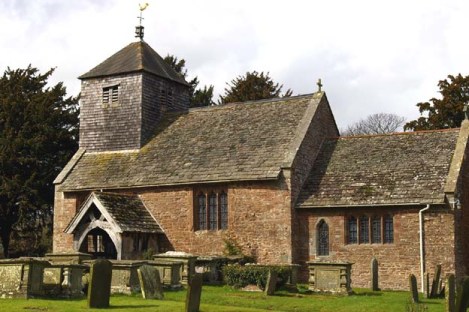
The small church of St Michaels in Brampton Abbots, Herefordshire, inspired the church in the Bellac. It was a beautiful place to visit, very inspiring.

Brampton Abbotts church© http://herefordshirepast.co.uk/churches/st-michael-all-angels-church-3

With that area in mind, I created my hero, Geoffrey de Mortagne, under-sheriff of Gloucestershire. Miles, the real sheriff of the county, is by 1141 on Matilda’s side (very handy), and Geoffrey is their spy.

Geoffrey’s own family home, however, lies in the upper hills of the county of Perche, in southern Normandy. Again, it was inspired by a visit to the area. I love the Normandy countryside. It’s so varied. You have the gorgeous beaches, endless fields, ancient forests and rolling hills in the national park. With its fascinating medieval history, it is the perfect setting for Geoffrey’s home, although he had not returned for many years. You’ll find out why in the novel…   Although it was meant to be a holiday in Normandy, we visited many heritage sites. I’m thrilled to share photos from a few:

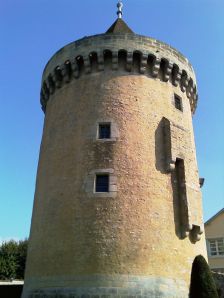
We stayed in Argentan, a town that was founded at the time. Only Matilda and her daughter-in-law Eleanor of Aquitaine would have passed it. I had goosebumps when I stood in front of it!

Tour Marguerite1

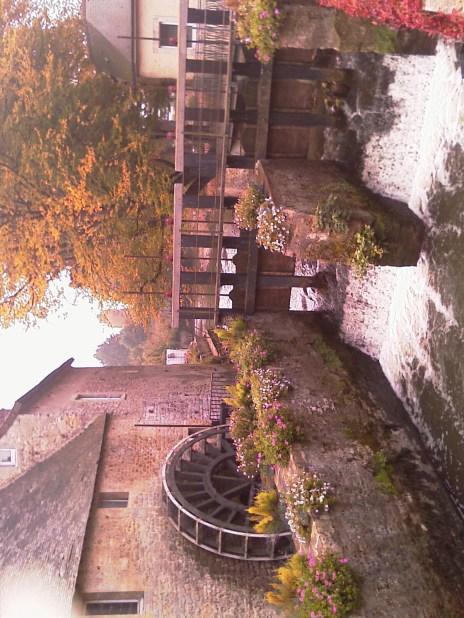
Falaise, including its derelict castle which was added to and turned into an incredible interactive museum about the dukes of Normandy

Falaise

Bayeux, with the famous tapestry and old, cobbled streets

Bayeux

Our car developed a fault during our drive to Mortagne-au-Perche, Geoffrey’s home, and we seemed to have forgotten to take any photos! It was a beautiful area, though, with many forests and rolling hills.

The sequel to Dark Deceit will take place mainly in Normandy, although Geoffrey will also return to England now and then. He is a spy after all…

On his return from battle at Lincoln, Geoffrey de Mortagne, undersheriff of Gloucester and spy for the Empress Matilda, assists a dying knight caught in an ambush. Promising to look after the welfare of the knight’s only daughter, Geoffrey stays at her manor, investigating the murder. Keen to join the Empress on her progress through England, he is torn between his oath and his duty.

Left to defend her manor following her father’s death, Alleyne de Bellac reluctantly accepts Geoffrey’s support. As she doesn’t trust the taciturn stranger, she asks Will d’Arques, an old friend, for help. But loyalties change. Her life in danger and her inheritance at stake, Alleyne must decide which man to trust. 

Discover England and Normandy divided by a brutal civil war, where vows are broken as allegiances waver.

About Cathie Dunn:

Cathie Dunn writes romantic suspense & adventure set in Scotland, England and Normandy. A hobby historian, her focus is on medieval and Jacobite eras.

She has two historical novels published: Highland Arms, a Scottish romance, and Dark Deceit, a historical adventure with romantic elements.

Cathie also self-published Silent Deception, a romantic paranormal novella set in Victorian Cornwall. All her titles are available on Amazon.

Cathie currently lives in Scotland with her husband and two cats.

Links:

http://www.cathiedunn.com/

https://www.facebook.com/cathie.dunn1

https://twitter.com/cathiedunn


Posted in Authors | Tagged , , , , , , , , | 2 Comments

DO PEOPLE MATTER?

CHARITY –    begins at home – or does it … should it?

Do people matter, really and truly – Or is it just ME that matters?  I am the centre of my own universe, after all, and isn’t it all down to me in the end.

One day about three years ago – I was in my office on a murky winter morning, waiting for a client, when a man came in off the street; he was dishevelled, distraught, angry and disturbed. Out of his mind. He shouted at me in his anger, as if I were the cause of it.

He did not have two pennies to rub together, he said. He desperately needed just a few pounds, so that he could put some petrol into his Jaguar and take it to meet a customer who wanted to buy it. With money from the sale, he could pursue his business and all his troubles would be over.

How could I help him?

All he wanted was a few pounds – didn’t I understand? He roared at me at the top of his voice. I asked him about his business. That wasn’t his problem – he knew all about his own business, he didn’t need that sort of advice. He – just – needed – a – few – pounds.

He sat there and glared at me.

It just didn’t add up. A man with a Jaguar in a spate over a few pounds?

It was my turn to feel desperate.

“Can’t you ask the buyer to come to you?”

“How can I ask him, when I haven’t even got any money on my mobile phone?”

He delved into the inside pocket of his filthy jacket and brought out a gleaming i-phone, switching it on.

An uncharitable thought flashed through my mind. He could sell that phone, for starters! I could also offer to let him use our office phone, but somehow I knew that wasn’t the point.

“I’m an artist,” he said, switching it on. “This is one of my paintings.”

I gasped. I’m no connoisseur, but this was an amazing picture. He scrolled down, each painting equally astonishing in its perfection and the sheer life it conveyed.

I was impressed. I looked at him with new eyes, praising his talent. I opened my office door, inviting the receptionist to take a look. We whole-heartedly admired the pictures. He calmed down, thanked us, and stepped out of the office.

And we breathed joint sighs of relief.

A few months ago I prepared to see an old client. The name on the file didn’t mean anything to me, but when he came in, my heart fell. He was calmer this time; not so dishevelled, and he wanted me to help him with his business.

“We’ve seen each other before,” I said. “Do you remember?” He nodded. I refrained from asking about his Jaguar, and I was able to start him on a business plan. His journey is still on-going; and his art is still astonishing.

And I know why I am a volunteer client adviser for People Matter, a local charity with a big heart for people who need to earn a living.

Posted in Charity, Thoughts | Tagged , , | 4 Comments

A Key West Reunion and Union

I’ve caught him! A warm welcome to my virtual friend of many years, and faithful supporter and encourager of struggling authors. It is a privilege hosting master story-teller Tom Winton today, a man who writes with his pen dipped in his soul – and I leave him to speak for himself…


Three years after my first trip to the Florida Keys, my parents decided to leave Fort Lauderdale and move us back to New York. I was not happy, but as always I had nothing to say about it. In my fourteen years on the planet, I’d already hung my hat in ten different apartments, duplexes, and houses—all but two of them rentals.

Nevertheless, I got used to living in Queens, New York, and for the next eleven years, I actually had the time of my life. The cracked sidewalks; bustling traffic; relentless city noise; never having much jingle in my pockets—none of it mattered. Coming of age in New York during the 1960s and 70s was an incredible experience. Day in and day I out I felt like l was living in the center of the universe. But then on a cold night in January of 1974, one month before my twenty-sixth birthday, my life took a sharp turn in a different direction—a southerly direction.

I had been dating my girlfriend Blanche for just eighty-nine days, which for me was a record of sorts. After all, I hadn’t been what you might call a one-girl kind of guy. Nevertheless, with Blanche’s parents out for the evening and the two of us sitting on the sofa watching TV, she turned to me and asked point blank, “Tom, what do you say we drive down to Florida tomorrow and get married?”

Talk about getting hit with the proverbial ton of bricks! I loved Blanche very much but was not ready for this.

“Florida!” I blurted as if the word was a question, “I…er, what do you mean Florida … and get married? Are you serious?”

“Sure,” she said, pivoting on the sofa, looking deeper into my eyes. “You’ve told me more than once how you liked living down there when you were a kid. Why not take a trip? Come on! Let’s go to Key West and tie the knot! You love me, right? You’ve told me that plenty of times.”

“Well sure. But I, ah …”

I paused right there and studied her hope-filled hazel eyes and kind, beautiful face. Then, a somewhat long moment later, I said with my head bobbing ever so slowly, “You’ve got me there. And you know what? What the heck … let’s do it.”

Later that night I drove my beat-up Plymouth back to my apartment. And in the pre-dawn darkness the following morning, Blanche picked me up in her canary-yellow Chevy Vega. With the temperature only sixteen degrees, and a blizzard quickly bearing down on the city, I threw my hastily-packed suitcase into the trunk and we raced out of New York.

Around noon two days later, both of us road weary as long-distance truckers, we pulled into the marl parking lot at The Ranch House Motel in Marathon. Despite being tired we were both still riding an excitement high, and when we climbed out of Blanche’s car, the weather was absolutely perfect. The Florida sun was bright as can be, and a pleasant breeze was rattling the palm fronds in front of the motel’s office. Looking back now, I’m sure the local Chamber of Commerce was full of smiling faces that January day in 1974.

All these years later I can’t recall a single thing we did after we arrived at the motel that day, but I certainly remember the next afternoon when we marched into nearby Fisherman’s Hospital to get our blood tests. As I swung the entrance door open to the then tiny hospital, and my bride-to-be stepped inside before me, a stray cat whisked its way in between us. The only humans in the waiting room were two nurses sitting behind a small counter. As we approached one of them scooted after the cat and the other rose to her feet. Neither of them had shoes on.

With a ceiling fan turning slowly overhead like a scene from Casablanca, the nurse behind the Formica counter asked us in a sing-song tone, “Hi! What can I do for you today?”

“Well, um … tomorrow we’re getting married in Key West, and we need to get blood tests,” I said.

“Oh, wow, that’s terrific. You just wait here and I’ll go tell the doctor.”

She then opened the door behind her, stepped inside, and told the doctor what we needed.

“They’re getting married tomorrow?” he said, as if it was the best news he’d heard since freshwater had been piped into the Keys, “Well send them right in! And don’t charge them anything for the blood tests.”

With that accomplished we drove down to Key West the following morning to a 10 o’clock appointment with the justice of the peace.

Like all the rest of the Keys, Cayo Hueso was a totally different place back in ’74. Many Conchs still lived and worked on the seven-square-mile island; it was almost devoid of traffic; the pace was slow and easy. As Blanche and I motored slowly beneath the sleepy town’s towering Poinciana trees and gently swaying palms, we felt like we had arrived at the birthplace of absolute contentment. When we pulled in front of the then new Monroe County Courthouse, there wasn’t a single car alongside the block-long row of parking meters.

After we stepped inside the building, we were directed to the Justice of Peace’s office. And when we got there I was more than a little surprised to see a lady sitting behind the desk.

“Good morning,” she said with a wide, cheery smile on her face. Then, shifting her eyes to a piece of paper on the desk, she added, “You must be Tom Winton and Blanche Nielson.”

“Yes mam, that’s us,” I answered.

“Well, have a seat.” she said, extending an upturned palm toward two chairs across the desk from her. The words had barely left her mouth before another woman appeared in the open doorway.

“Martha,” she said to the Justice, “I’m going downstairs for an ice cream cone. Want one?”

“Why sure, Sandy. I’ll have chocolate.”

Looking back at us over her bifocals then, Martha asked, “How ‘bout you kids? Would you like a cone?”

The fact that it was 10 AM had nothing to do with why Blanche and I passed on her kind offer. We were as nervous as two children on their very first day of school, maybe more so. But the “ceremony” was quick and painless. So quick, that by the time Sandy came back to the office with two half-melted cones of ice cream, we had both said, “I do.”

Four sunny days later, when we were crossing over the Jewfish Creek Bridge on our way back to New York, my new bride turned to me saying, “Tom, I feel like we’re leaving home. It’s so nice down here.”

That was it. We had gotten what they call “sand in our shoes.” We were enamored by the Sunshine State. And three short months later, after tying up all our loose ends, we packed up what little we had and moved to Sarasota, Florida. And for most of the next forty years we remained in the Sunshine State—taking more than our share of trips back down to that enchanting string of islands they call “The Florida Keys.”

Tom’s Amazon Author page:

http://www.amazon.com/Tom-Winton/e/B005H2T7AA/ref=dp_byline_cont_pop_ebooks_1

Two of the six bestselling novels he has written take place in the Keys.  You can read my review of “Hemingway’s Ghost” HERE.

Four Days with Hemingway’s Ghost: Amazon US – http://www.amazon.com/Four-Days-Hemingways-Ghost-Winton-ebook/dp/B008FBXENQ/ref=cm_cr_pr_product_top?ie=UTF8

Amazon UK – http://www.amazon.co.uk/dp/B008FBXENQ

A Second Chance in Paradise: Amazon US – http://amzn.com/B00GM2IR64

Amazon UK – http://www.amazon.co.uk/dp/B00GM2IR64
 

Posted in Authors | Tagged , , , , | 6 Comments

Always a Dreamer

As a child, I would curl up in a corner of the window seat, looking out onto our glorious African garden in the Highlands of Kenya – I was always a dreamer…

Flamingo cormorants

Beyond the fence of our twelve acre plot lay the Great Rift Valley. And Lake Nakuru – famous for the flamingos, which fringed its shores – nestled just out of sight behind a fold of hill.

I suppose I got food for dreaming from the books I read – I was a complete and utter bookworm.

As a child, my head was always in the clouds. I would dream myself to sleep, fantasising – building castles in the air – being swept off my feet by a handsome stranger. Sometimes I’d have a REAL dream, wake up, and if it were powerful, significant in any way, I would grab a pen and write it down while I remembered it.

But I also had constructive dreams, which can make a big difference in your life if you go about it the right way.

Twelve years ago, after living 55 years in Kenya, where I went to school, and brought up my family, I found myself in a place I did not want to be, due to circumstances beyond my control. Forgive me – here, in Eastbourne.

Tigoni House

I didn’t know how we were going to survive – we could only afford to buy a tiny flat after living in a mansion on top of the world, enjoying the vast spaces of Africa around us. Then I was challenged to write a wish list. I was told that if I didn’t know where I wanted to go, I would never get there.

Was this person crazy?

But for want of anything better to do, I complied. And found the exercise astonishingly stimulating.

I wanted to travel – that was easy – I wanted to go to China, Russia, (thinking of shades of Dr. Zhivago, and War & Peace) – and when I got really old and doddery, I’d tackle Europe. I’m nearing that time now…

I dreamt of setting up a Granny travel fund for my seven grandkids – all in Australia. That was indeed building castles in the air. And do you know, five of them have already claimed from that fund, which has grown 100% even in these economic times. Here are two cool dudes overwhelming our flat as I speak.

Tim & Rowan.jpg

I wanted to write a book, and have it published by a real publisher. Now that was far-fetched. But it had been my dream ever since I’d learned to read. I would write it my way – it would be full of romance, and tingly love scenes.

I devour books – novels, life stories, inspirational books, entertaining books, even educational ones. I feel bereft if I haven’t got a book in my hand. You can lose yourself in a fantasy world; you can forget your frightening surroundings.

And you can write – pour out your soul as a catharsis when you’re caught in a place you never wanted to be.

That’s what I did. I wallowed in nostalgia while I dug out old letters and diaries, and researched the history of Kenya…

Dreams DO come true – Two books have been published by Crooked Cat, and the third is racing to the end of its first draft!

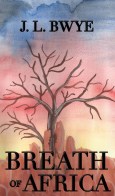
cover1 (419x640)Breath of Africa cover pic

My website: http://janebwye.com/

My Amazon Author page:

Crooked Cat.tiff

Posted in Thoughts | Tagged , , , , , , | 1 Comment

Giving The Tower its Moment

… Ghosts – And the Beating Heart of Things.

Happy New Year! – and a warm welcome to Crooked Cat author, Jennifer Wilson, who has an original take on our Tower of London as the setting for her debut novel, Kindred Spirits. I can’t wait to read it.

Hello, and thank you, Jane, for hosting me today.
Over the past couple of months, I’ve become a bit obsessed with some characters in my debut novel, Kindred Spirits: Tower of London, largely thanks to the situation re Richard III’s funeral, but in the middle of it, there’s one major ‘character’ I’ve barely mentioned – the Tower itself. Having read your blog, a lot of pieces give a real sense of travel and place, and so I thought I should give the Tower its moment!
TowerOfLondon
The Tower of London is a key location in English and British history, and the fact that we still use the phrase of being “sent to the Tower” says a lot about its place in our collective psyche. Despite this, I’d never been overly interested in the Tower, other than knowing how it crossed the paths of the historical characters I enjoyed reading about.
In February 2013, the chance of a week in London came up, and having now read so much, I felt it was a great opportunity to explore some of our great historical buildings. In that week, I got through Hampton Court Palace, Banqueting House, parts of Westminster Abbey, the Jewel Tower and Horse Guards’ Parade. But it was my day in the Tower which really stood out.
As soon as you step through the gates, the history lessons start flooding back. Tales of missing princes, daring escapes and, of course, those infamous executions. I’d had ideas fizzing around my head for a while, and finally, they started to formulate into something more solid. With so many of our great and good (and not so good) having passed through these walls, it was seductive to think of the friendships which could be struck up, the conversations in darkened alcoves, and the odd alliances, should they all be present at the same time. All those ghosts together: it was far too good to resist! And at the heart of it: the Tower itself.
People automatically think of the White Tower, the beating heart of things, but the Tower complex is just that – complex. You get a real sense of the community which grew up around the central buildings. This has been a fortress, a safe haven, a royal palace and, as we all know, a prison.
Once given free rein, and a good atmosphere to play in, the vague idea of a collective of ghosts (a haunting?) really got going. What would they actually talk about, these ghosts? And which ones would I even want to focus on? Given its long history, the choices are almost endless, and even now, I’m torn between diving into any new history book featuring the Tower, or shying away, worried I’ll ‘meet’ another ghost I missed out on, and wish I’d discovered more about them before finishing the manuscript.
I’m currently working on moving the same concept north of the border, into Edinburgh, and am having the same trouble – so many buildings with so much history. There’s one thing about historical fiction – you will never, ever run out of research to keep you out of trouble…
Thanks for the chance to join you on the blog today, Jane – it’s always good to talk about writing!
KS-ToL-HighResCover
A King, three Queens, a handful of nobles and a host of former courtiers…
In the Tower of London, the dead outnumber the living, with the likes of Tudor Queens Anne Boleyn and Katherine Howard rubbing shoulders with one man who has made his way back from his place of death at Bosworth Field to discover the truth about the disappearance of his famous nephews. Amidst the chaos of daily life, with political and personal tensions running high, Richard III takes control, as each ghostly resident looks for their own peace in the former palace – where privacy was always a limited luxury.


Posted in Authors | Tagged , , , , | 5 Comments

2015 in review

Happy New Year everybody!

And very many thanks to my faithful supporters, especially Karen Charlton of Authonomy days, who kicked off the Author Countdown in April to help make my blog such a success in 2015.

Thanks also to Jeff Gardiner for all his comments, and to those who hosted me on their blogs through the past year:

Ailsa Abraham,                    Lauren Salisbury,                   Cathie Dunn,        Fiona McVie,                       Yvonne Marjot                         Nancy Jardine.

The WordPress.com stats helper monkeys prepared this 2015 annual report for my blog.

Here’s an excerpt:

The concert hall at the Sydney Opera House holds 2,700 people. This blog was viewed about 9,100 times in 2015. If it were a concert at Sydney Opera House, it would take about 3 sold-out performances for that many people to see it.

Click here to see the complete report.

Posted in Author Countdown, Authors | Tagged , , , , , , , , | 5 Comments

My Most Favourite Place to Be

It is refreshing to read about a place where I’ve never been, and Angela Wren, whom I’ve just “met” has convinced me more than anyone else that I  must go to France before I get too old and doddery. And I never knew they had bull fighting there. I hope you, too, will be drawn by Angela’s refreshing enthusiasm – and read her debut novel.

Angela Wren

A discussion on facebook the other day got me thinking about my most favourite place to be, which is France, and it’s incredibly varied and very long history.  In no time at all, I was back in Provence and travelling down the RN7 to Orange on the first occasion I had visited that beautiful city.  In my mind’s eye I could see the long, quiet road snaking through the sentinel planes with their vast pale green canopies shading us from the sun.  I wasn’t driving and had no say in where we went or how long we stayed in any location.  On that very first visit I remember being mostly silent, observing, reading anything – from road signs to advertising boards – and everything.  But most of all I remember being amazed by the vastness of what had once been a part of the Roman Empire.

OLYMPUS DIGITAL CAMERA

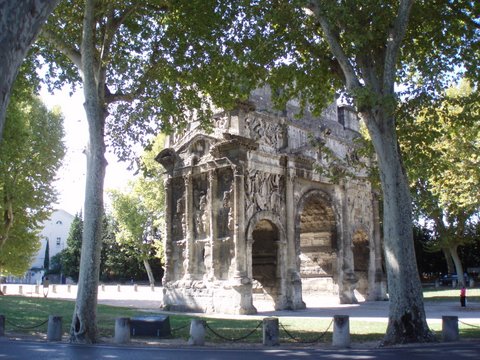
Some years later I returned, this time as an independent traveller who could please herself, and Orange was the first place I went to.  I even retraced my steps and found myself as disappointed as Lawrence Durrell was when he wrote ‘Caesar’s Vast Ghost’.  The RN7 was no longer a single ribbon of tarmac but a dual carriageway and the plane trees had mostly surrendered themselves to industry and commerce.  I had my copy of Durrell’s book with me and used it unashamedly as my tour guide.  And as I strolled into the old part of Orange and towards the Triumphal Arch I was relieved to see that little else had changed.  The RN7 still passes through the centre of the arch but the traffic is now diverted around it.

OLYMPUS DIGITAL CAMERA

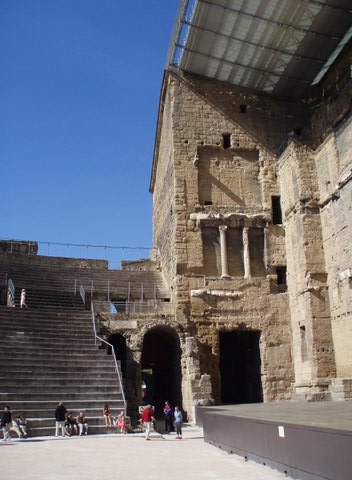
Having rediscovered the arch I made my way to the roman theatre.  There is a large visitor centre there now and you can hire audio guides.  Of course, once inside, I had to take centre stage and imagine myself in a previous role performing before an audience.  If you must know, it was A Midsummer Night’s Dream and my role as Puck.  Well, at an all-girls school, someone has to take the boy’s roles!

OLYMPUS DIGITAL CAMERA

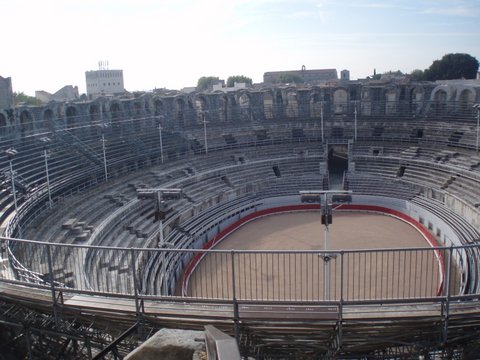
A few days later I was in Arles – another town where ancient and modern seem to thrive in complete harmony.  The roman arena is still used today, unfortunately for something that I find particularly cruel – bull fighting.  But this isn’t always the Spanish version of the sport and the bullfighters are not clad in the sequinned and bejewelled costumes of the corrida.  Neither are the animals the large, muscled Iberian bulls, but the much smaller animals from the Camargue.  These little guys are feisty and fast and their opponents, the razeteurs, are lithe young men clad in white who taunt them and then race for, and jump the barricade to safety.  The Camargue bull lives to fight another day, unlike his Spanish counterparts.

OLYMPUS DIGITAL CAMERA

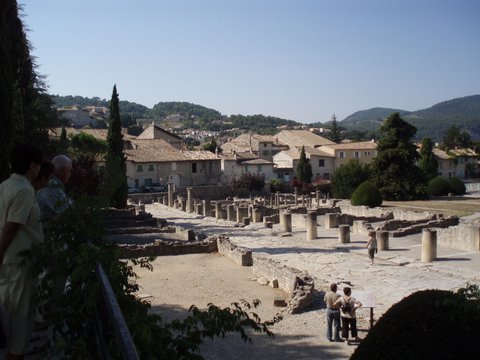
My next port of call was Vaison le Romaine, another old roman town.  It was here, one morning in September 1992, that the river Ouvèze became a raging torrent as a result of a vast thunderstorm overnight.  I remember that storm well.  At three in the morning I was sat in my mountain hideaway in the Cévennes watching the ever-changing colours in the sky as the thunder and lightning roared across the valley.  What I didn’t know, until after I had returned to the UK four days later, was that Vaison suffered the loss of 37 lives, 150 houses and the whole of its industrial estate, but only the parapet of the old roman bridge was damaged.

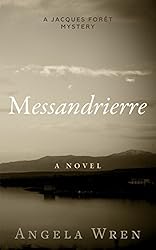
And it is this amazing history, the varied culture, the vast and ever-changing scenery that makes me write about France and all things French.  It matters not to me whether I’m scribbling odd little anecdotes or travel info on my own blog (www.jamesetmoi.blogspot.com) or creating a whole book such as Messandrierre, my recently published novel.  What is important is that I have seen and experienced many things whilst in France and I’m still learning and I can not think of a better qualification for a scribbler.   And it’s true what they say, you know.  The light in Provence is different.

Angela’s website: http://angelawren.co.uk/

Angela’s Amazon author page: http://www.amazon.co.uk/Angela-Wren/e/B01924M7DC/

Messandrierre

Posted in Authors | Tagged , , , , , , , | 3 Comments

Angel in a Thornbush

It’s hibernation time – to shed tasks, responsibilities and even pleasures and curl up under the blanket until winter is past. The body aches all over, the mind is tired and all you want to do is sleep… or let the telly beaver away in the background… or read.

For the past few days I’ve been reading a remarkable book by a remarkable man, Rob Fynn. Every person who has ever been to Africa should read this unabashed story of his life, which started in Rhodesia / Zimbabwe. Hare-brained escapades around the world follow, and a remarkable land journey southwards through the Sahara back to his home. His love of Africa and its wildlife shine through, and his ability to live life to the full – even though he fails to think through to the consequences – adds to the charm of his book. He breaks away with his ailing wife to the US, he follows her to New Zealand when they part, and he returns home, to Africa.

I have finished Angel in a Thornbush and there’s a tear in my eye. I dont know why, for Rob, being the man he is, will stand up, dust himself off, and try again… and again. His heart and faith are in the right place.

There are so many of us who have been battered and bruised by life and here is an example of sheer doggedness, you can only wonder at the survival instincts of mankind.

I no longer feel low, or off-colour. I return to my home in Africa from time to time and drink in the beauty of its wide open spaces. Winter only lasts a few months, and then I can uncurl like a hedgehog and let the sun’s warmth penetrate my body into rejuvenation.

Rob Fynn, I salute you!

And Christmas is coming! May  you all enjoy a peaceful and happy season of refreshment, whatever your faith.

But dont forget to check out this book. You can see the cover is not dissimilar to the new look of mine…

Product Details

Product Details

Angel in a Thornbush Amazon link HERE:                                             Breath of Africa  Amazon link  HERE:

And perhaps after you’ve read Angel in a Thornbush, you might like to dip into this one, which also deals with the thorny problem of sickness in a relationship.
cover1 (419x640)

ILUME Amazon link HERE:

Posted in Authors | Tagged , , , , , , , | 1 Comment

Dictators in History – Idi Amin

Historian, Tim Taylor is no stranger to my blog, and today I’m privileged to host the first in his new series. In my honour he’s decided to feature one of Africa’s most unpleasant and notorious villains, a dubious honour. But like all men, Idi Amin did not start as a monster. In fact, a member of my family played rugby against him in the past…

tim

Hello Jane, many thanks for hosting me today!

My novel Revolution Day follows a year in the life of Latin American dictator Carlos Almanzor.  Carlos is a fictional figure and is not based upon any particular individual. Nevertheless, his life and career share many elements with those of real dictators and in some cases I consciously drew on historical events in writing the novel.

I thought it would be interesting to explore, in a series of blog posts, the lives of some real-life dictators, and to look for similarities and differences between their careers and characters and those of my own fictional dictator.  In the first of this series I’m looking at Idi Amin of Uganda.

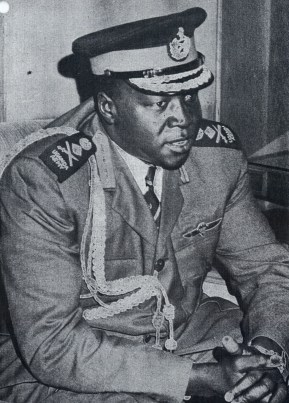
Idi_Amin_-Archives_New_Zealand_AAWV_23583,_KIRK1,_5(B),_R23930288

Details of his early life are sketchy, but Amin was born about 1925, probably in Kokobo in north-western Uganda, then part of the British Empire.  In 1946 he joined the King’s African Rifles, a colonial regiment of the British Army, and quickly rose through the ranks, becoming one of the first two Ugandans to be commissioned as an officer in 1961. He was a successful sportsman during his early military career, excelling at rugby, swimming and in particular boxing, becoming light heavyweight boxing champion of Uganda in 1951, a title he held until 1960.

Following Ugandan independence in 1962, Amin continued to rise in the new Ugandan army, becoming its commander in 1965.  In this role he would lead a successful operation against King Mutesa (a former Ugandan President) of the semi-autonomous Kingdom of Buganda in the south of Uganda, forcing him into exile. Amin was at this time close to President Milton Obote, but relations between the two soured, and on 25 January 1971, having learned that Obote planned to have him arrested, Amin sent his troops into the capital, Kampala, while Obote was abroad at a commonwealth Summit, and a week later declared himself President of Uganda.

Once in power, Amin ruthlessly eliminated potential threats to his regime. Soldiers from the Acholi and Lango tribes, loyal to Obote, were massacred in their barracks in July 1971. An abortive coup attempt by Obote supporters in 1972 was followed by a purge of the Army. Killings of ethnic groups and individuals considered hostile, including journalists, religious leaders, bureaucrats and foreign nationals, continued throughout his eight years in power: total deaths have been estimated at some 300,000, in a country of 10 million.

In August 1972, declaring an ‘economic war’, Amin expelled some 60,000 Ugandan Asians, who were forced to settle in the UK and elsewhere. Their departure, together with the handing over of their businesses to Amin’s supporters, had a disastrous effect on the Ugandan economy.  Amin defended his ethnic policy on the grounds of transferring economic control of Uganda into the hands of Ugandans. In practice, however, most positions of power were given to the small minority of Ugandans who, like Amin, were Muslim and of the Kakwa tribe.

Amin’s Uganda had difficult relations and territorial disputes with its neighbours Kenya and in particular Tanzania, whose leader Julius Nyrere had given sanctuary to Obote. This, together with the alienation of many of his former supporters, eventually led to Amin’s downfall. In November 1978, after some Ugandan troops mutinied and fled to Tanzania, Amin invaded Tanzania and annexed part of the Kagera region. Nyrere mobilised the Tanzanian army, which counter-attacked

together with Ugandan exiles. Despite Libyan support, the Ugandan army was forced to retreat, and in April 1979 the Tanzanians entered Kampala. Amin fled, first to Libya and subsequently securing asylum in Saudi Arabia, where he lived until his death in 2003.

Carlos and Amin.  Although the life and career of my dictator, Carlos, share many features with a number of historical dictators, he has relatively little in common with Amin.  One thing they do share is their shifting pattern of international alignment. Initially on good terms with Britain and other Western nations, which saw him as preferable to the left-leaning Obote; after the expulsion of the Ugandan Asians, Amin turned instead towards the Soviet Union, East Germany and Libya. Carlos, on the other hand, is initially closely aligned to the Soviets, but when their economic support falters he initiates a pragmatic rapprochement with the USA, only to break with the Americans once again a few years later.

Both men also partake in the cult of personality so often favoured by dictators: thus Carlos appoints himself an Admiral despite his lack of any military career, and his rise to power is celebrated each year and mythologised in numerous bad films.  Amin took this kind of megalomania to an absurd level, styling himself “His Excellency, President for Life, Field Marshal Al Hadji Doctor Idi Amin Dada, VC, DSO, MC, Lord of All the Beasts of the Earth and Fishes of the Seas and Conqueror of the British Empire in Africa in General and Uganda in Particular” and even more bizarrely, King of Scotland!

As men, however, the two are very different.  Carlos, for all his many faults, retains the core of his humanity: he clings to power in the delusion that he alone is qualified to wield it rather than craving it for its own sake.  Amin, however, had no such scruples. Though eccentric in his behaviour and often portrayed as a buffoon, he was brutal, volatile and egotistical, and once in power showed himself to be an authentic monster.  In the words of his Guardian obituary by Patrick Keatley, “Amin brought bloody tragedy and economic ruin to his country, during a selfish life that had no redeeming qualities.”

5bMany thanks for hosting me, Jane.  If your readers found this post interesting, they might like to know that Revolution Day is currently on special offer for Christmas at 99p/$0.99!

Information about the book and excerpts can be found on the Revolution Day page on my website: http://www.tetaylor.co.uk/#!revday/cwpf.

(I enjoyed reading REVOLUTION DAY – you can read my review of Tim’s book HERE)

Other Links:

Facebook author page:  https://www.facebook.com/timtaylornovels

Website:  http://www.tetaylor.co.uk/

Twitter:  https://twitter.com/timetaylor1

Revolution Day on Amazon.co.uk:  http://www.amazon.co.uk/Revolution-Day-T-E-Taylor-ebook/dp/B0106GALR4/ref=sr_1_1?s=digital-text&ie=UTF8&qid=1435449288&sr=1-1&keywords=Revolution+Day

Bio

Tim was born in 1960 in Stoke-on-Trent. He studied Classics at Pembroke College, Oxford (and later Philosophy at Birkbeck, University of London). After a couple of years playing in a rock band, he joined the Civil Service, eventually leaving in 2011 to spend more time writing.

Tim now lives in Yorkshire with his wife and daughter and divides his time between creative writing, academic research and part-time teaching and other work for Leeds and Huddersfield Universities.

Tim’s first novel, Zeus of Ithome, a historical novel about the struggle of the ancient Messenians to free themselves from Sparta, was published by Crooked Cat in November 2013; his second, Revolution Day in June 2015.  Tim also writes poetry and the occasional short story, plays guitar, and likes to walk up hills.


Posted in Authors | Tagged , , , , , , , | 5 Comments