Want a Dash of Passion – Or The Quiet Life?

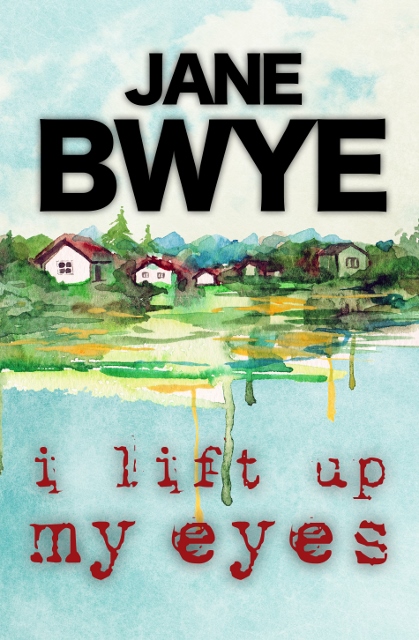
I’m over at Cathie Dunn’s place, revealing why I wrote my second book. You can check out her website by clicking HERE.

iLUME crop (1024x546)

And here’s a taster for you:

The quiet life….

His cottage nestled among a profusion of flowerbeds beside a sleepy stream in the countryside, where he would fish for hours on a weekend; no matter that he seldom caught anything worth keeping. She would linger after delivering a mid-morning thermos of tea, and listen to the soft lapping of the waters beneath the overhanging willow. The peaceful plop of a fish coming up for air, or a gentle tug on his line occasionally disturbed the nod of his sleep.

Ann would potter in the kitchen, preparing the roast while the children played in the garden. She had to keep them away from Robert, who fiercely protected his privacy if anybody came within twenty yards of the stream.

“You’ll disturb the fish – and they won’t bite!” he’d complain.

Ann suspected that Robert was more concerned about his own peace.

Or a dash of passion…

As autumn progressed, it felt natural to share a lunchtime salad in his flat on her half days. Each time she visited, he would meet her at the top of the stairs, walking without crutches on the familiar ground. As soon as she entered the flat, he would close the door, wedge himself against the wall to prevent overbalancing, and open his arms. She gave herself up totally to his kisses, each one more fully than the last, surrendering to his hands as they explored her breasts and hips. Where was this leading? She savoured the wonderful feeling of being loved and didn’t want it to end.

He pulled away, gasping for air.

“If it were anyone else, we’d be in there on the bed by now!”

But she didn’t let herself respond. She just wanted the kisses to go on and on. Her head told her not to let him go too far, but her feelings of guilt were diminishing dangerously.

Want to learn what happens? – it’s very short, and you can read it on your e-book, i-pad or even your phone, if you have one of those new-fangled things!

Go on … ! Click here to go to AMAZON.

cover1 (419x640)

Posted in Authors, I Lift Up My Eyes | Tagged , , , , | 1 Comment

Roast Turkey, Masked Boobies and Rough Rides

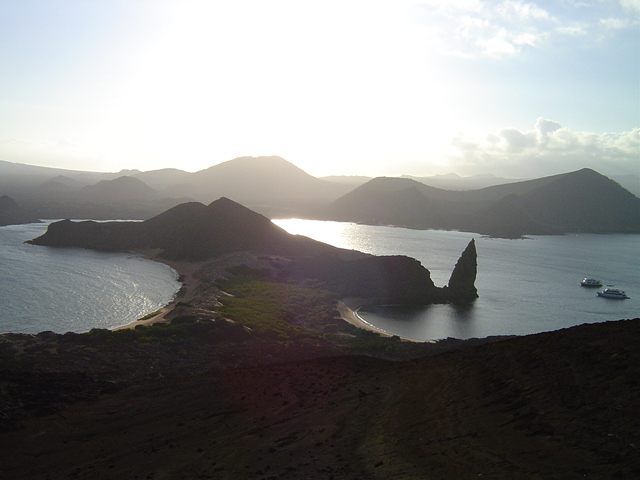
Galapagos Diaries 2. Christmas Eve – in the late morning we boat round Santiago Island to Bartolome. The seas are rough, and we sit grimly on deck most of the way, clinging on for dear life amid tumbled chairs and tables. Everyone suffers from sea-sickness. Lunch is served in calmer waters, and we are allowed a siesta before taking a short trip to an idyllic sandy beach, dominated by Pinnacle rock.

EMRabida Is

Only two other groups are with us. Some of us rest on the sand, and some wander while others snorkel among the penguins and sea lions. Then Billie takes us to a dry landing for a trail of wooden planks and steps over dusty crumbly lava, to the summit on the eastern part of the island. The view from the top is panoramic, looking down over the waist of Bartolome for a different angle on the Pinnacle, and other islands are visible in the distance.

image026

We stop halfway down for another of Billie’s talks, sitting on the sharp edged rocks while he explains the different types of lava in vivid fashion.  He points out the distinctive “hornitos” cones, like miniature volcanoes caused by gas trapped in the lava flow. A former boat boy and fisherman, he taught himself English, and the guides here get less than a year’s training, so under the circumstances he is doing a remarkable job.

Back to the boat for showers and a change, then champagne and a roast turkey Christmas Eve dinner. Six boats gather in the bay, and a dinghy load of revellers does the rounds, singing carols in exchange for sweets. At 10.30 pm our engines start up again and we are warned it will be rough, so we retire early. I find it a bit easier getting up onto the top bunk this time, but I have to keep myself near the wall, as there are no rails to prevent me from falling off as the boat rocks and bucks over the waves.

At 6 o’clock on Christmas morning we anchor off the lava cliffs of Genovesa, and an hour later we are herded into dinghies for an exploration round the cliffs.  Frigate birds whirl overhead; red-billed tropicbirds trail their slender white tails; stormy petrels keep pace with the dinghy, dancing on the water. Beautiful swallow tailed gulls sit high up on the rocks, and cosy fur seals nestle into the ledges.  Some masked boobies fly in, and I spot a yellow crested night heron in all the excitement.  We have a “dry landing”; up the slippery Prince Philip steps into another world.

EM masked booby

Young masked boobies are dotted all over the place, patiently left behind on their nests while the parents go foraging. We can approach within feet of them, and they don’t turn a feather. I take far too many photos. We trudge along a lava ridge, searching in vain for the rare Short Eared Owl, but hundreds of petrels swirl overhead and small lizards scurry into crevices.  We retrace our steps along the ridge to the boat for quick refreshments before changing into swimming costumes in preparation for a “wet landing” on Darwin beach. This means putting on trainers or sandals and riding in the dinghy as far as the waves will allow, then sitting in pairs on each side of the boat, swinging our legs over and into the sea and making our way onto the beach. Then we have to doff the trainers and don our walking boots for a short walk on crusty lava past red-footed boobies this time, and more frigate birds. Billie shows us some very smart boobies in the rare pied stage.  It is here that I discover my memory stick is full, and I have left the spare behind in Guayaquil. No problem: I merely delete dozens of mediocre photos and carry on. It is now mid-morning, and extremely hot. The other groups dont follow us on this second landing.  We have a peaceful dip in the sea, side-stepping a couple of sea lions, before embarking again for lunch followed by another long ride to Seymour Island.

Posted in Travels | Tagged , , , , , , , , | 2 Comments

It Felt Thrilling and Deliciously Naughty

A very warm welcome to Ruth Geldard writer extraordinaire today, a fascinating multi-talented lady who tells us how she discovered herself. She was originally from a professional art background … but I will let Ruth tell her own story. Her paintings are amazing: I strongly advise you to follow the links!
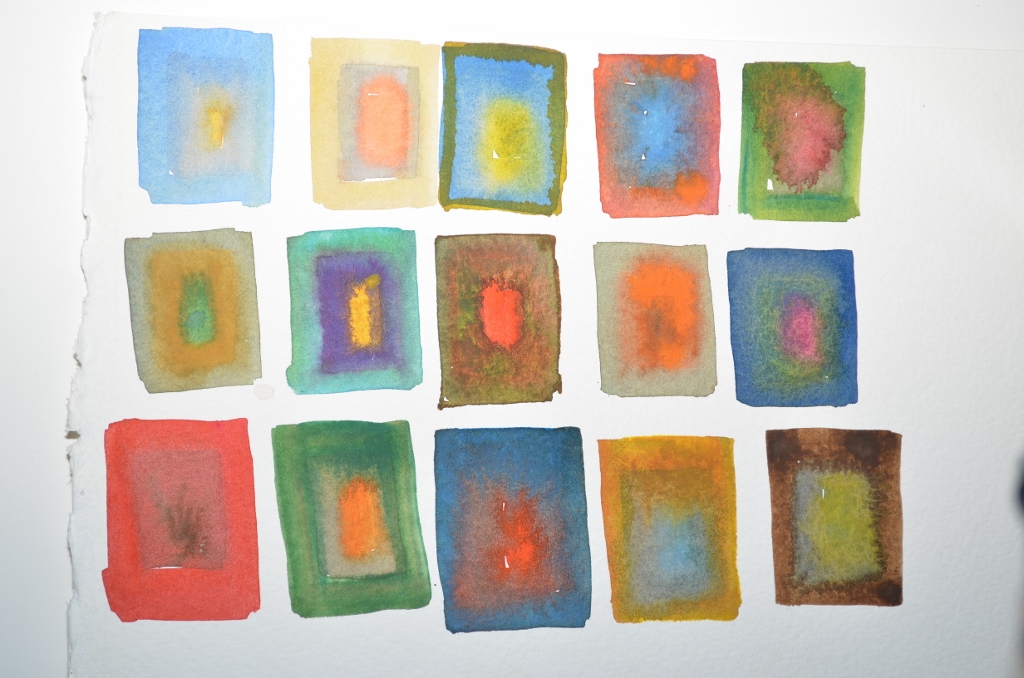
sex 002 (1024x678)The first time it happened, I was sitting on a beach on a Greek island. I was inspired to paint and instinctively reached for my painting gear, only it wasn’t there, I had left it behind. But I did have a tiny notebook and biro and so decided to write a painting instead. It felt thrilling and deliciously naughty, as though it was something I was not supposed to be doing. It was a break-through, cross-over moment. The words below still elicit a strong visual memory, and I could mix those colours right now.

***

A Word Drawing

The sky is the colour of mouthwash and out of the still sea, mountains rise like the backs of dinosaurs, the shallows are oily flat and edged with turquoise.

Nearby a man sits high on terracotta rocks cleaning fish, a large bird stands at a respectful distance. The man’s hands move in an easy repeating rhythm, broken only to throw fish guts into the sea which boils in anticipation. Occasionally he tosses a small silver fish to the bird, careful not to make eye contact. The bird, grateful for this cross-species generosity, hops warily from one foot to the other and is held back by an invisible force-field.

The man’s body is the same colour as the rocks, his olive shorts sun-dried and salt-stiff. If you didn’t know he was there you wouldn’t see him as so perfectly does he assimilate into the landscape.

***

I come from a painting background and for many years regularly exhibited work in London. Teaching drawing and painting to adults paid the bills. Eventually I gave up teaching to concentrate on painting, but as I packed away my teaching notes, I thought it a shame to hide them in a drawer, so I took a risk and sent them to the editor of a painting magazine. This wise and generous woman phoned me and coaxed me into writing, for which I am indebted to her. For the next ten years, I worked for the top painting companies, demonstrating, road-testing and writing about it all.

During this time I carried on painting commercially and was eventually asked to apply for membership of a hallowed and prestigious watercolour institution. However the first question on the form was, “Where did you study towards your degree?” This sent me back to university where I fast-tracked a BA Hons and an MFA. Of course this changed everything, I spent a lot of time writing creatively, so that mentally and academically the two worlds of art and creative writing began to collide.

After university I began a blog about my painting progress. During this regular,
experimental writing, ideas for short stories began to surface and two have now been published along with a flash fiction. Another pivotal, piece of writing at this time, was a vignette about the father/daughter relationship, Lemon Yellow, and the nearest I have come to  Concrete Poetry, a proper cross-pollination of words and image and also where I discovered the emotional memory and resonance held within the act of colour-mixing.  http://dev.a-n.co.uk/blogs/artist-without-portfolio/post/5240306

RG_2011_034 (731x1024)

And now, my WIP, a novel, set in India, about a timid artist who uses extreme colour-mixing as a weapon to confront fear, is underpinned with a lot of colour-mixing from memory, which although invisible, elicits words and imbues them with an artistic authority.

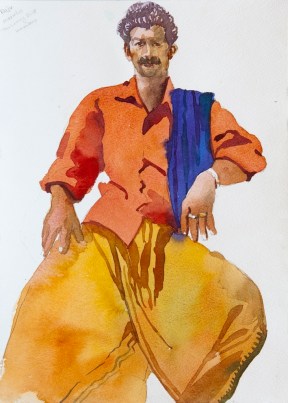
One thing that is an absolute and remained a constant in my life, is the drawing and painting of people. Always from life, these often accidental, pop-up studio sessions, on my travels, create a small window, through which I can begin to process and understand another culture. These intimate and sometimes revealing encounters also generate words.

http://www.ruthgeldard.com/travel-portraits/watercolour-sketchbook/

So I still draw and paint, although words now dominate, (this is the first time I have acknowledged this) but sometimes during a long writing spell, my hands will become homesick for a paintbrush. Then I stop and make abstract, repetitive marks with ink or paint, I call these meditative daubs, comfort marks, and they do just that, when my confidence flags, they prop me up, refresh me and guide me gently back to writing.

***

Ruth Geldard is an unusual artist/writer hybrid, originally from a professional art background with exhibitions in London and the South East and demonstrations for and painting videos for the paint company, Daler-Rowney. She has appeared on BBC Radio 4’s Home Truths, painting the first ever, on-air portrait of actor Timothy Spall’s mother.

She has written numerous magazine feature-articles and book contributions for publishers that include; Dorling Kindersly, Collins, Medici Fine Art Publishing and Watson and Guptil.

Study towards an MFA, saw a move towards creative writing and she has since kept a blog on Artist’s Newsletter, an international online artist’s forum, hits in excess of 60,000.

Her first short story, An Uncertain State, was shortlisted for the Fish International Short Story Prize 2014. Her first published story, The Parrot Dress, was included in an anthology by Labello Press, 2014. The Parrot Dress, has also received the Sapphire Award for, Excellence in Contemporary Narrative and been nominated for a Pushcart Prize. The Ghost Cow was published in the Momaya 2014 Review, and The Saving of the Shrew, was shortlisted for the Gem Street Awards 2015 also by Labello Press. Her flash fiction Here It Comes was recently published online by Spelk Fiction.

Ruth lives on the coast with her partner and Woolfie the dog, where she writes and paints looking at the sea.

You can see her artwork on her website: www.ruthgeldard.com

Twitter:@ruthrandom

Follow her blog: https://www.a-n.co.uk/blogs/all-kinds-of-everything-2 or here: https://ruthgeldard.wordpress.com/ .

Posted in Authors | Tagged , , , , , , , , , , | Comments Off on It Felt Thrilling and Deliciously Naughty

Galapagos – Here I Come!

Thursday 23rd December, 2004. We arrive on Baltra island, whose call to fame in the Galapagos Islands is the fact that it has an airport.  Tourists are everywhere, going in numerous different directions, while the locals hang around in the intense heat.  There is no rest for Billie our guide who is busy seeing off his previous group.  He finally transfers us to a bus for the five-minute ride to the ferry for Santa Cruz, the hub of the archipelago.

There is an unseemly scramble amid the tourist groups for luggage and buses. My heart falls as I discover we are last in line, then a plush coach appears and transports us across the island through tropical bush and lush pastures, down to Ayora and the harbour.  Amid a frenzy of bobbing dinghies and swooping frigate birds, we board the Guatenamara, eight cabins and six crew, our base for the next week.  The frigates are like eerie black etchings come to life with bat-like wings and forked tails opening, closing or twisting according to speed and direction.  Brown pelicans fly ponderously about, or perch on empty dinghies, waiting patiently for leftovers.

Billie summons us for a quick briefing in front of the whiteboard on deck.  He relays several do’s and don’ts, circulates a sheet on safety, and gives us an overview of our program for the rest of the day.  We are offered fruit refreshments, and bundled back into two outboards and onto our bus again for a ride inland to hunt for tortoises. He leads us through two barbed wire fences on what is obviously private farmland for a close look at some monsters wallowing in mud or humping between enormous green tussocks. I have my first sighting of the beautiful yellow warbler, a little golden bird with bright orange front patch and orange streaks down its breast, which I will see on practically every island we visit.  We keep away from the cows, who aren’t amused to have us there.

Then we probe inside a dark lava tunnel, before travelling back to the boat for supper. I clamber clumsily onto the top bunk. I haven’t done that since my teenage years. I don’t dare think how I am going to get down again.  At midnight, the engines start and we set off on rough seas for the island of Rabida.  There is no air conditioning, and the cabin is stifling.

It is quite a clumsy business climbing down from my bunk the following morning.

EMRabida Is

Rabida Island, and a lovely red curved beach await us after breakfast. The place is a hive of activity as sea lion females and cubs honk and flop in our path.  Blue-footed boobies perform synchronised dives, arrow-like into shallow waters, and iguanas slither among the rocks.  There are seven other boats in the bay, and the beach is crowded with tourists.

They guard their heritage well in the Galapagos Islands. Tourists can only tread certain paths, and never venture off the beaten track. Only a certain number of people can visit a place at any one time. I come to understand that the same group of eight boats travel to the same islands on the same days, and the guides congregate daily to discuss timetables.

We are herded into our groups and led on an inland circular walk for the view over a lagoon. The far side of the island is barren except for dead-looking scrub bushes which Billie identifies as “incense trees”.  He tells us that once rain falls, they break into green buds and tiny flowers. We are allowed some “quiet time” on the beach amid the crowds.  Several people snorkel within a strictly demarcated line below an overhanging cliff.

iguana01264  We wander back along the sands, watching the sea lions and spotting birds and lizards.

Posted in Travels | Tagged , , , , , , , , , | 1 Comment

The Devil’s Nose Switchback

Ecuador, 2005. We have to be at the station by 6 am to claim the best seats on a special tourist train journey to the Devil’s Nose, and there is a fierce scramble for them.  Five of us climb onto the carriage roof, with cushions to guard against corrugations; two make a beeline for the engine; and the remainder pack into the last carriage, which has conventional seats.  As the time for the 7am start approaches, more and more people crowd on, and we appreciate Diego’s foresight.

EMdevilsnosetrain

Spectacular views of Mt. Chimboraozo, through the deep valleys and steep hills.  I doze awhile, then rock to the back of the train and stand on the platform watching the rails enfold behind me, admiring the amazing scenery, and taking far too many useless photographs.  The three freight trucks in the middle of the train are topped with tourists, who throw handfuls of sweets down to wayside children, scrabbling beside the track.

We stop at a station, and there is an immediate queue for the toilets, a communal affair.  An enterprising local lady stands at the entrance for the 25c fee, for which she hands out paper.  Ladies to the left in cubicles, gents to the right against the wall.  When you finish, a cheerful youth is there with his bucket of water for flushing.

Toilet protocol throughout Ecuador is standard:  you discard soiled paper into a nearby bucket, NOT the toilet, or it will be forever blocked.  Water is usually available, and most places are clean and tidy.  In one ladies’ room, two of us stand up simultaneously in our low-walled cubicles to pull up our pants, and those waiting in the queue are treated to a comic sight as faces suddenly appear over the wall.

EMswitchback lookover

After the short stop, I decide to try the roof.  The engine emits its exhaust directly into my face, but at least it is warm, while others further back huddle into their jackets against the biting wind.  It is quite a party up here, with people rocking precariously on the corrugated roof, and some brave souls standing up. I am able to take a classic tourist picture.

When the train stops before the descent of the Devil’s Nose switchback, I join the engine-driver.

EMrailway

The spectacular scenery cannot be appreciated from mere photographs.  There are new deep valleys and steep mountains at every turn.  The little train trundles along the ancient tracks, some almost embedded in the sand.  Mini landfalls are created at intervals.  Derailments are frequent, we are told, but never serious.  We stop once or twice beside track-side workers.

EMswitchingback

We wind round and round and round, and eventually with a screech of brakes, come to a dead end at the tip of the Devil’s Nose. A valley spreads out far below.  Then the brakes are released and the train coasts backwards along the track.  Back and back.  And there is a frown of intense concentration on the face of the engine driver beside me.  Down and down we go; then we stop. A second track appears beside us. The guard steps down and switches the rails.  We go forwards again, slowly, to the bottom of the valley, where with a series of intricate manoeuvres and shuntings, the carriages are switched round and the engine ends up again at the front of the train for the long haul back up to the station.

Now, I believe I sort-of understand how a switchback works ….  The whole journey takes over six hours and goes like a flash.

Posted in Travels | Tagged , , , | 3 Comments

Antidote to Ebook rip offs

Very well said, Kim – I couldnt agree more!

kimmwalker's avatarNuts and Crisps

kindle I love my Kindle. It’s small and light, easily fitting in my handbag, yet can hold zillions (OK, slight exaggeration) of books. It doesn’t slam shut while I eat my breakfast. The wind can’t ruffle the pages while I walk my dog. My new Kindle (I wore out my first) is illuminated so I can read in bed or the car, without disturbing my partner.

Until recently, ebooks were significantly cheaper than their paper siblings. For someone who reads in excess of 50 books a year, that’s important. **Note: I do support my library when possible but it’s not always practical. Recently, several ebooks by my favourite authors have been as expensive (or even more) than the paperback of the same title.

The outrageous fact that we have to pay VAT on ebooks but not paper or hardbacks doesn’t account for this because, of course, it’s based on the asking…

View original post 345 more words

Posted in Authors | Comments Off on Antidote to Ebook rip offs

BREAKING NEWS!!

Award-nominated contemporary novel

BREATH OF AFRICA

And thought-provoking romantic novella

I LIFT UP MY EYES

For sale at 99p each, limited period only

2bookpic

See my website for further details about these two books.

http://janebwye.com/mybooks/breath-of-africa

http://janebwye.com/mybooks/i-lift-up-my-eyes

Posted in Authors, Breath of Africa, I Lift Up My Eyes | Tagged , , , , , | 3 Comments

SIX TIPS ON BEING AN AUTHOR

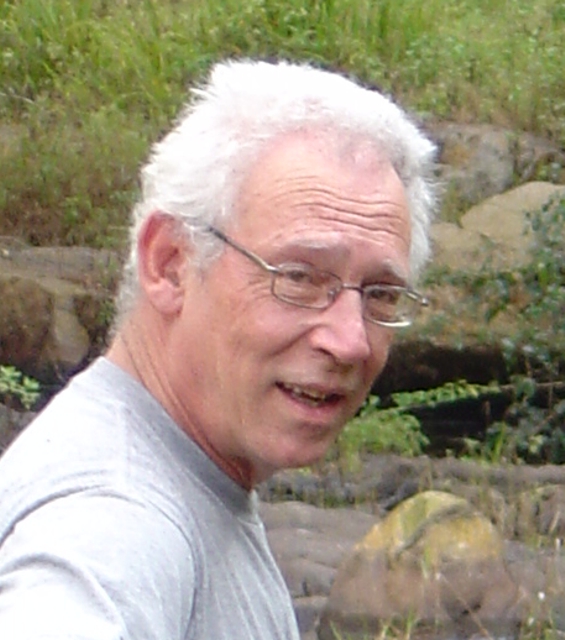
My Author Countdown continues into its fifth month with this contribution from seasoned YA author and friend, Richard Hardie.

RH photo

  1. Be absolutely certain you want to be an author; it’s a hard slog and statistically only one book gets properly published for every 1,500 that are written. Terrible odds! Mind you, a lot of really awful books are written and even some of those get published. Some people write books just for the thrill of typing the two words “The End” and don’t mind not seeing their work in print. They may even vanity publish and pay for the privilege which can be terribly expensive and guarantees nothing, except that your book will physically exist on your own shelf, if on no one else’s.
  1. In your first book, write about a subject / location / person that REALLY interests you passionately. It’ll be obvious in your writing, because enthusiasm, like laughing, is contagious. Also make sure you’re writing for the reader and not yourself. Ensure your plot, characters and subject have a universal appeal and not just a personal attraction. Know and understand the age group and genre you’re targeting. If you’re writing as a YA in the 1st person, make sure you’re “voice” is consistent. In my current series the books are narrated in the 1st person by a mid-teenage girl and I frequently reread the previous books to make sure she doesn’t change the way she talks and thinks, except through evolution as she gets older.
  1. Don’t ramble, or go off at plot tangents. You may know what you’re doing and it may be fun, but your readers will be lost very quickly. Remember the letters  G.O.W.T.S. They stand for Get On With The Story and it’s the best piece of advice I ever received. J K Rawling was told much the same on her first three Harry Potter books. She rambled and as a result, what she presented to her agent were 500 page books. She was eventually persuaded to cut them down to 250 pages and the rest was history. However after book three she was powerful enough to dictate how long her books would be and she became a rambler again.
  1. Get your manuscript professionally proof read, edited and critiqued before presenting it to an agent, or publisher. Remember that any good agent receives between 5 and 8 submissions a day. To have any chance you have to grab their attention within seconds…. and keep it! Agents read the first few lines of the synopsis and 99% of submissions are rejected at that point. Most agents only take on 2 to 3 new clients every year.
  1. Sometimes it’s good to write a superb beginning and an excellent end before even starting on the middle. Frequently the middle part of the plot will finalise itself as a matter of course, but nothing can beat storyboarding the entire book before putting finger to keyboard.
  1. Remember that agents and publishers like authors who write series (e.g. Harry Potter). JK had the entire series of Harry Potter books fully mapped out before she submitted to her agent. It shows forward thinking and commitment. No agent, or publisher likes a one-hit-pony, because the first book is there to trail blaze and hopefully create some sort of interest, whereas the sequels are there to make money!

Thank you for these wise words, Richard!

You can find Richard’s books – an intriguing mixture of YA and a detective series – on amazon

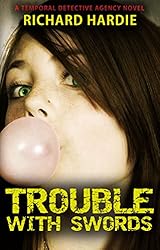
Leap of FaithTrouble with Swords

I love the covers!

Posted in Author Countdown, Authors | Tagged , , , , | 31 Comments

Nokuthula – No Place of Peace?

Brian Connell, conservationist, ethologist and author, is a person who has learned to follow his dreams, and I am honoured to host him today. His most recent blog gives a measured view of what has been in the news recently concerning a lion called Cecil, and here he shares with me his experiences as a writer and a thinker.

BCNokuthula – Place of Peace – How I envy you your haven in the wilds of Southern Africa. Do you still live there, and will you always?

Unfortunately no. Due to circumstances that are explained in Msomi and Me, I had to leave Nokuthula. It was a terrible episode in my life, but if that hadn’t happened, yes I would still be there.

You are deservedly proud of your self-published “real” books, which people can hold, smell and pass on. Be truthful now – what is the proportion of your real books sold, to those sold as e-books?

I became a bit disenchanted with the e-book system. I found the distributors to be very heavy-handed and dictatorial, with authors not being nurtured and looked after, as they should be. Consequently, I decided to go for a “real” book and self-publish. My efforts are now firmly with hard-copy books and I do minimal, if any, marketing of the one e-book still available. But to answer the question, real books outnumber e-books by about 60 to 1.

Would you go with a publisher if one found you, and why? Have you any advice on marketing your books, and what problems have you faced?

The initial approaches to established publishers were not successful. I was an unknown and they were reluctant. When asked how I would get known, they responded: “get published”! I left it there as it was a total Catch-22 situation. However, if a publisher approached me and came up with a reasonable deal, I might consider it, it could definitely help with potential sales.

As far as marketing goes – it’s an uphill battle to get known and to let people know that the books are good. I know that sounds immodest, but my large number of unsolicited reviews speak for themselves. I use social media extensively and have a few very special friends in other countries who give me a huge amount of help in raising awareness of what the books are all about.

The problems? Getting people to read! In this modern totally electronic world, books don’t have the same attraction as they used to, which is a dreadful shame as they really don’t know what they’re missing.

What is an ethologist? I’ve read an account of the talk you gave to a school in South Africa. Do you deliver many talks?

Ethology is the study of natural animal behaviour in the wild, with as little intrusion into the animals’ territory as possible. A fascinating branch of animal behaviour studies, and far removed from captive observations.

I give as many talks as I can to the schools. Education is important. If I can touch the emotions and consciousness of just one of my audience, the talk is worthwhile. The favourite talk is one about elephants, with lots of Ah Ha moments and brilliant questions from eager and inquiring young minds.

What made you write those wonderful stories – especially in “Msomi and Me”? Have you ever thought of writing a novel?

When I had to leave Nokuthula, I was in the depths of depression. A dark place that I was battling to get out of. A special young friend of mine suggested that I write it all down to get it out of my system. Oddly, none of the bad stuff appeared on the pages, only the good times, the fun times and the wonders of living in the bush. She also set me on the self-publishing path. I owe her a great deal.

A novel? I don’t think so, Jane. I don’t have the sort of imagination to come up with a handful of distinct characters with different personalities, speech patterns and so on. I have the utmost admiration for novelists and often wonder what it must be like to live inside their heads for a while.

I was fascinated by your sensible blog post on why a leopard was not at fault for attacking a tourist guide in Kruger National Park. Do you have a similar story from your own experiences?

Leopard-1

Yes. Also with a leopard. We had inadvertently driven between her and her cubs. She threatened us with fearsome aggression, advancing on us, driving us back with much snarling and baring of formidable teeth. She was relentless, keeping us in retreat for some considerable distance. I, and Msomi, were justifiably terrified and were convinced that we were about to be attacked. We had no idea at the time what had prompted the threat, but when we had been forced far enough away and she called to the cubs, all became clear. She immediately calmed down, gave us look that clearly said “don’t ever do that again”, and headed back into the bush, two jaunty cubs following.

We both share a love of Africa as a whole. 30% of proceeds of your books go to support Wildlife Rangers. All royalties of my Africa novel go towards micro-finance in a tiny Kenyan village. Many in Africa struggle with the question of why benefactors prefer to help animals rather than people. Would you care to address this question?

This is an interesting question, and one I can only respond to from personal experience. Taking the animals first. They are being wiped out by external influences – China, Vietnam, Yemen and so on who drive the market for animal parts. The poaching MUST stop, and stop now. I do not donate money to the rangers, I purchase equipment and supplies, from bootlaces and clothing to GPS units and two-way radios.
I also try to get local groups involved in donating clothing, sewing machines, soccer boots, bicycles, pots and pans – anything really, that can be taken to the communities that border wildlife regions. We get some of the benefactors to travel to these areas not only to distribute the goodies, but also to teach people how to use, for instance, sewing machines and get a small business started. It’s still early days, but inroads are being made and local communities are seeing the benefits of self-sufficiency and no longer support the poaching syndicates.

The other problem with ostensibly helping people, though, is that a lot of the money raised is by questionable charities who actually do little to distribute donations to the right places. Corruption is rife here, and most of the cash raised never ever gets to the intended recipients.

One of your readers has written: “Thank you for all you have done, and still do for Africa. I salute you for being who you are and standing so strongly by your beliefs.” Please tell us the story of your life.

Jane – this could be a book in itself! So in a nutshell ……

I was born in England. My dad was a career army officer giving me extensive experience of a lot of the world’s trouble-spots. When he retired, we moved to Kenya and I came into contact with many of the wildlife greats of the age: Alan and Joan Root, Des and Jen Bartlett, David and Daphne Sheldrick, Armand and Michaela Denis and a number of others. That gave birth to my interest and fascination with wildlife. I did as much as I could in Kenya to travel with and learn from these icons. I vowed then that one day I would live in the wild. It took a long time and required many new beginnings as Africa was a very volatile place in those days, forcing relocations regularly. After working and travelling over most of East, Central and Southern Africa, helping out with ethological research wherever I could, I finally acquired Nokuthula and a dream I had for many years came true. Follow your dreams – it doesn’t matter how long it takes to realise them, stay on track! I now write books and try to raise awareness about wildlife in general, give talks, and raise funds to allow me to help the rangers on the ground. The unsung heroes.

And might you describe – in a nutshell – your beliefs?

I believe that we are here to share the planet, to live in harmony with each other and with every living thing. I do not believe that money solves problems, it simply creates new ones. I believe that only when an individual has truly experienced wilderness, regardless of where it is in the world, only then can he or she realise the splendour around us, the wonder of the world and the fact that their soul shares, at some primal level, the souls of the other inhabitants of our wonderful world.

Thank you Brian for joining me today, it has been a privilege to have you.
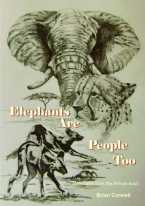
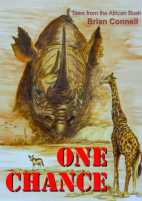
Msomi_CoverEAPT_CoverCover-10colour me coverThe cover price of Brian’s books, in South African currency:
Nokuthula series – R180.00 each.
Colour Me – R120.00

They can be purchased directly from Brian. All he needs is an email from purchasers. The email address is: msomi@nici.co.za

Msomi and Me can be purchased as an e-book from amazon HERE, where you can read the many glowing reviews – including mine!

Website: www.nici.co.za

Blog: http://msomisite.wordpress.com/

Facebook: https://www.facebook.com/pages/Tales-from-the-African-bush/429328593862084?fref=ts
Posted in Authors | Tagged , , , , , , , , , | 3 Comments

Chimboraozo Mountain – Pudding Topped with Snow

Ecuador 4. We are granted a lie-in on our first day at Misahualii (800ft above sea level), but I get up early to spot birds – plenty of calls, tantalising in the dense foliage. After breakfast Diego takes us on a three hour walk in the secondary forest round the lodge. He insists we wear gumboots which hurt my feet. He is full of information; stopping every so often to point out a particular tree, fungi or insect. We squeeze through a labyrinth of limestone rock, enjoying the welcome cool after a sweaty climb. We stop to examine the palm from which Panama hats are made – they originate from Ecuador. They can cost up to $1,000 depending on the fineness of the weave. I paid only $6 for mine in the market.

A late lunch at the lodge – they feed you well here, and they give me guava cheese every day for breakfast. I love it.

My feet and legs are sore so I opt out of the afternoon outing to a nearby village and enjoy quality time on my own. I have a sore throat and dose myself before going to bed.

Sunday. On with the horrid gum boots again, and we collect rain ponchos for a wonderful hour’s ride down river in two motorised canoes. We prepare for a walk into dense primary forest. But a tropical rainstorm pelts down, peppering the trees and saturating us in minutes. On with the steamy ponchos.

I turn back after an hour, not wanting to suffer sore feet again, and I am feeling below par. From the quiet shade of a thatched open rondavel I spot two black caracaras across the river, and glimpse a hummingbird which flits away before I can reach for my binoculars. The forest is full of birdsong.

The others arrive back for lunch after two hours, an excellent hot picnic of rice, pulses and chicken, and we embark again for the upstream return journey. We stop to pan for gold, and at a small village a woman demonstrates how to prepare a local brew.

I suppose we have the early start the following day to spend enough time acclimatising… we bus to Banos for lunch, and then kill four long hours wandering round the town. I visit the church for some quiet contemplation – very ornate with crude pictures of miracles which have been performed locally. Then I spend an hour on the internet, and go to the supermarket to buy a picnic lunch for the following day. We return to Potate for the night, but this time Tungurahua is not visible.

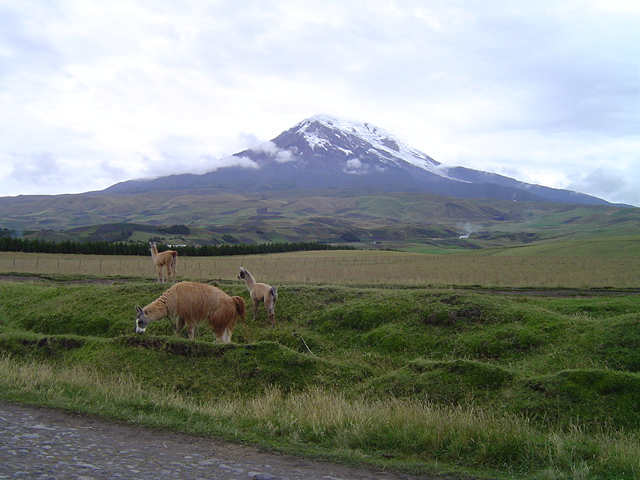
Alpacas in front of Mt. Chimbaraozo

Alpacas in front of Mt. Chimbaraozo

Another early start and a journey with a break for a forty minute walk up the road for further acclimatisation. We are heading for Chimboraozo Mountain: pudding topped with snow, much like Mt. Kilimanjaro in profile. At  20,564 ft it is slightly higher than Mt. Kilimanjaro. We see one-hundred-year-old thatched huts, plaited against the wind and we pass rabbits, guinea pigs and llamas. Three people remain at Riobamba because of altitude sickness, while the rest of us ride back up Chimbaraozo on the west side, where we visit a school and deliver the 90 gumboots we collected earlier. The tour company has built a community centre and a school, and the children enthusiastically demonstrate their appreciation of our contributions. We dance and jig and hand out gifts like Father Christmas; we play cat’s cradle and football. The village is tiny. Alpacas and llamas are farmed here, and we go further up the mountain to spot vicunas. But it starts raining and I am glad we have an excuse not to walk. On the return journey my head begins to ache.

The hotel in Riobamba is unprepared for our 4.30am start the next day, but we have a special treat prepared.

Posted in Travels | Tagged , , , , , , , , , | Comments Off on Chimboraozo Mountain – Pudding Topped with Snow