I’d Like to Talk About Magic

I always enjoy having author Ailsa Abraham​ to stay. Welcome for another week, Ailsa – we love your magical meanderings.

Near or Far, it’s similar.

I’m very grateful to Jane for inviting me back to follow up on my previous post here. Today I’d like to talk about magic, both in Africa and elsewhere.

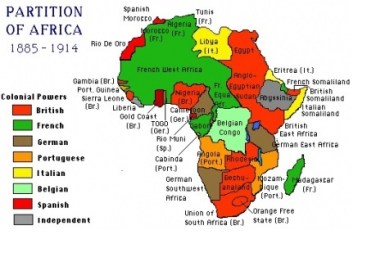
When working in Ghana, my aunt (well, maybe she is a bit of a witch) became pals with the local ju-ju man who was not only the witch-doctor but the “godfather”. His word was law. Any plan by the mining company for which my uncle worked had to receive his approval (subject, of course, to the usual gift of whisky or cigarettes). As a practitioner myself I find it hard to believe that Mama-Earth would agree to any group wanting to rip her apart to steal her treasures, but that’s just me. Nothing from job hunting, a wedding to local planning took place without his say-so, rather like the mayor in a French village. I have no reason to believe that anything has changed but would welcome comments from anyone currently living there.

desinvoutementMagic functions on belief. The more the consultant or recipient believes, the stronger the effect. That is a fact and in Africa everyone believes in it. Even here in France I regularly see advertisements in the local paper (or internet pages see above) for “desenvoutement” which is the removing of evil spells and the practitioner is almost always someone of African extraction.

Like Britain, France has (or had) many dependencies there so a large number of AfricansFrench Africa can call France “home”. It is a testament to how strong the belief in magic is, if  these adverts can be posted quite seriously in the hope of attracting customers. Are we any different? If we believe that walking under ladders, spilling salt or breaking a mirror can attract bad luck, why not believe that it is down to someone wishing you ill?  In my own family, nobody would ever hand you a knife or the salt cellar. We would place them on the table in front of you and if giving a gift that cuts we would expect a coin in return.
In my last piece I touched on the subject of good v. evil as in Jane’s book Breath of Africa. Recently I have come up against this myself. I’m no ju-ju man but have a certain reputation locally and among my friends of being able to “help out” a bit. They believe I can, I think I can try, often it works. When it concerns something with no two sides to it, I’m fine. My friend’s child is looking for work? Great, I’ll send courage, hope and whatever good luck I can.

The problem comes when I am faced with someone behaving wickedly. If I am privy to the wickedness myself I will take the decision and ask for justice. I’ll take any come-back on myself if it is not called for. Cruelty to animals is a case in point. I see no reason to ever hurt an animal so I will send back equal measure to the perpetrator.

duuh
I am in a real quandry when a very good friend asks for help and tells me of harm done to them by a third party. Ju-ju men dont’ seem to have this problem as they believe whoever is paying them (cynical me!) which makes life easier. What I have to do is pray for guidance.

As my old mother used to say “Don’t wish harm to those who do it to you, they will bring it on themselves.”

No, I do not take on unknown clients and no, I do not take money. I’m just a village healer, not a ju-ju woman.
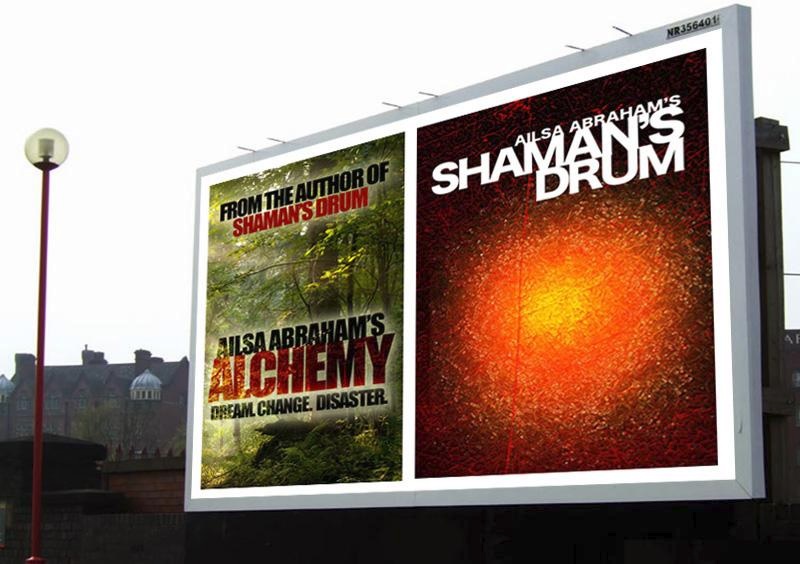
Ailsa’s books:

Gary SD and Alchemy

Bio and links

Ailsa Abraham writes under two names and is the author of six novels. Alchemy is the prequel to Shaman’s Drum, published by Crooked Cat in January 2014. Both are best-sellers in their genres on Amazon. She also writes gay male romance under her brother’s name, Cameron Lawton.

She has lived in France for over twenty years and enjoys knitting and crochet and until recently was the oldest Hell’s Angel in town . Her interests include campaigning for animal rights, experimenting with different genres of writing and trips back to the UK to visit friends and family. She runs an orphanage for homeless teddy bears and contributes a lot of work to Knit for Africa. She is also addicted to dressing up, saying that she is old enough to know better but too wise to care. Rumours that she is a witch may or may not be true.

Web-page

Amazon. UK

Amazon.  com

Twitter

Facebook

Linked-In

Posted in Authors | Tagged , , , , , , , | 4 Comments

Should You Give Up Writing?

I cant think of any better advice…

jorobinson176's avatarLit World Interviews

I’ve always found the different ways that we scribblers describe our experiences with writer’s block very interesting. Also the different ways the seasoned writers suggest getting over it. Some suggestions are to work around your block, or force yourself to write through it, even if what you write is rubbish. Other advice is to write something completely different. We won’t mention those rather hurtful cries of, “Stop being such a wussy. Adorn yourself in adult underwear! Plumbers don’t get plumbers block!” All of these things can work with a bit of effort and confidence, but one bit of advice that you seldom see is to take a break from writing completely. As if a week away from writing anything will totally strip you of the ability to write at all. It is true that if you don’t do something for a good long while, you could get a little rusty…

View original post 484 more words

Posted in Authors | Tagged | 2 Comments

Down, Down – and Down…

Ecuador 2004 – part 3. We enter high altitude Cotopaxi Park through the back way driving between several alternative tracks, and are flagged down by anxious wardens who make us purchase tickets. We stop to walk round a glacial lagoon, Limpiopungo donning waterproof coats, trousers and hats, and catch a fantastic view of a young predator: a caracara which fearlessly poses for us for several minutes.

The lake surrounds are flat, the land sparse and stony with the occasional big boulder flung out at the last eruption. We pass some wild horses, then leave the Park via the main gate and stop at an ornate Hacienda for lunch. An attractive place, the driveway flanked by 100 year-old gum trees with enormous trunks, some perilously leaning against others. A crowded patio with a noisy pipe and drum band entertains us as we dine, looking onto a garden courtyard. To one side a chapel exudes an aura of peace and quiet.

Down the mountain side we drive, through sleazy civilisation. Houses with flat roofs, some tin; many in varying stages of erection. Plastic and bottles and rubbish everywhere. The “mastizos” are an attractive people (Inca-Spanish mix).

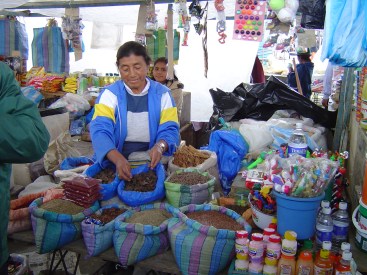
The spice lady

Into Saquisili and another half hour walk with Diego guiding us through three different markets. The produce is much the same as in Kenya, but the markets more varied as herbs, spices, vegetables, fruit, meat and clothes are all offered. Filthy floors, people everywhere, even though a brief cloudburst causes many buyers to leave early. A couple of our party happily snap pictures of the market scenes, but I watch the faces of those photographed and am glad I have only taken one picture of Diego’s friend, the spice lady, with her permission.

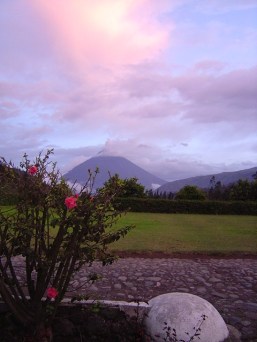
EMTungurahuaAnother lengthy bus ride southwards and a visit to Diego’s family home – an impressive new abode in an upper middle-class area – to collect 90 pairs of gumboots; more of that anon. A diversion to Potate because Banos is off limits to Brits in case Mt. Tungurahua erupts. We arrive at sunset at our lodge in the depths of a valley surrounded by maize and pile out of the bus to view the volcano, vapour rising into a high pink cloud. What a sight. Accommodation is fantastic. Zara and I have a bedroom each in our cottage! Corn-on-the-cob and cheese, then pork chops for supper.
I am up early to spot more birds, and then we head for the tourist town of Banos in the shadow of Mt. Tungurahua, stopping for a picnic. Diego shows us a sugar cane market stall and we sample the drink. I buy guava cheese which enhances my lunch. We drive steadily downhill to a lookout point and ride a cable car swung across a river and for a fun dollar. Then a more serious walk into the canyon to view Pailon del Diablo waterfall from a swing bridge in the spray. A refreshing drink, Tabaco, at a café where I buy a painting of an orchid done by Diego’s girlfriend. The trudge back up to the bus makes me puff and sweat.

Down and down past the cloud forest and into the rain forest, stopping to spot birds; in Puya I buy balsa wood trinkets. The road is rough and stony but we make good speed and arrive at Misahualii (800ft above sea level) before dark. Lovely humid weather, and it feels just like home as I look out at the bougainvillea. We’re here in the jungle for three nights, thank goodness.

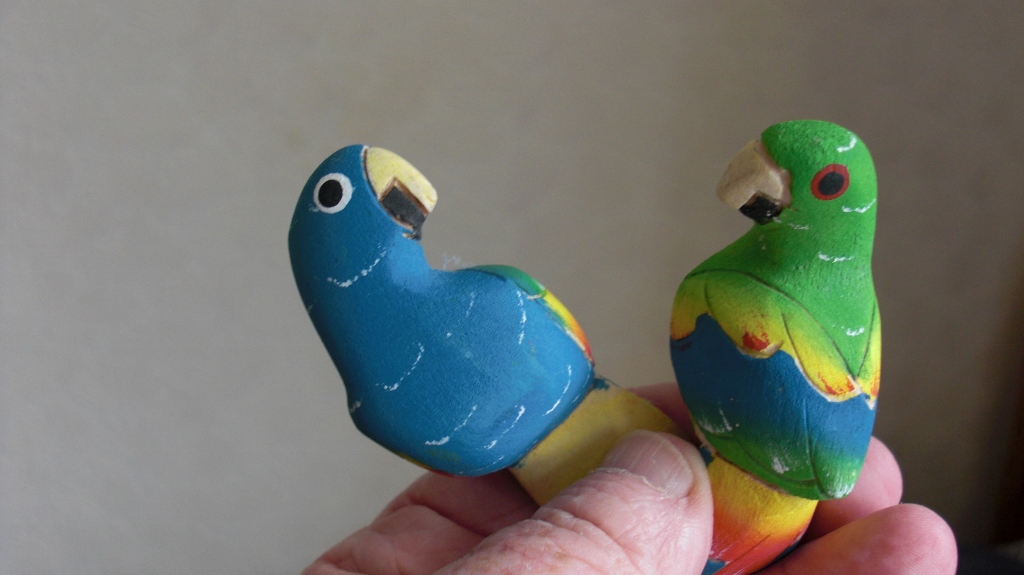
balsa birds

I bought a couple of balsa wood birds

PS Has anyone spotted an anomaly in these Ecuador blogs? Comment if you have! 

Posted in Travels | Tagged , , , , , , | Comments Off on Down, Down – and Down…

SEVEN SUGGESTIONS ON HOW TO FIND INSPIRATION

I am honoured to welcome Vanessa Couchman to my AUTHOR COUNTDOWN today. A freelance writer and author based in France, she runs a copywriting business, and is often asked the question: Where do you find inspiration?

Inspiration is the magic key that opens the door to the world of imagination. It’s no good having all the technical writing skills at your fingertips if the “I” word is absent. And sitting in front of a blank screen or a virgin sheet of paper isn’t likely to conjure it up.

Vanessa

Much of my fiction is historical. I write the occasional short story set in the present day, but I am increasingly drawn to writing stories set in the past. I am fascinated by how people lived, what they felt and thought and how they experienced their culture and society. So I find much of my inspiration in real historical events or people. Here are seven other things you can do to get the juices going:

  • Open a book at random, choose the first word on that page and write a story inspired by it. If it happens to be “disestablishmentarianism” you might have to have another go.
  • Look through the newspaper headlines for interesting stories (“Man bites dog”) or watch the TV news.
  • Do some people watching at your local café, train station, supermarket. I find eavesdropping a very satisfactory way of getting ideas.
  • A number of internet sites publish daily writing prompts.
  • Go to an art gallery or look up some famous pictures on the internet. Edgar Dégas’ painting “Miss LaLa at the Cirque Fernando” inspired a short story. Every time I go to London I visit the National Gallery where the painting hangs.
  • Get out for a walk and take the time to use all your senses to notice what’s around you.
  • Spend five minutes doing some free writing and write down whatever comes to mind. There might be a nugget or two in there.

Where do you get your inspiration?

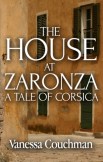
Vanessa Couchman writes for magazines and websites about French life and writing. Her short stories have been placed and shortlisted in creative writing competitions. The House at Zaronza is her debut novel set in early 20th-century Corsica and at the Western Front during World War I.

Vanessa says: “We stayed at a B&B on Corsica a few years ago. The owners had found some old love letters hidden in a blocked-up niche in the attic. They told us what they knew of the story and I was so gripped by it that I developed it into my novel, embroidering it quite a lot along the way.

I have an idea for another novel set on Corsica, inspired by a few lines in a very old chronicle of the island. I won’t give away more than that, but, as soon as I read that snippet I had that light-bulb moment.

Front cover final

Writing site: http://vanessacouchmanwriter.wordpress.com

Amazon author page: http://www.amazon.co.uk/Vanessa-Couchman/e/B00LQM4T9O/ref=ntt_athr_dp_pel_1

The House at Zaronza:  http://www.amazon.co.uk/House-at-Zaronza-Vanessa-Couchman-ebook/dp/B00M5A0U6C/ref=asap_bc?ie=UTF8 

Facebook page: https://www.facebook.com/houseatzaronza.vanessacouchman

Twitter: @Vanessainfrance

Posted in Author Countdown, Authors | Tagged , , , , , | 5 Comments

A Shrunken Head and Sexy Volcanoes

14/12/2004. Ecuador 2. After an early rise we trudge up a mountain path through the tropical forest and I stop to record my first Tanager and Toucan. There are birds everywhere and I’m so excited I don’t know where to look next. I scarcely notice the steep incline, but on the way down the other side of the mountain we pass two peasant families on small well-fed ponies, the children riding two up.

We enjoy a late breakfast and then it’s back to the bus for the tedious return journey to Quito via a stop at the equator for an experiment with water circulating in different directions in the northern and southern hemispheres. I am beckoned into the dark interior of a shop by a wizened crone with a hunch back, she glances round furtively then shows me a tiny gruesome object. It is a long moment before I realise with a shudder that it is a shrunken head.

We have a snack lunch in a tourist restaurant, excellent soup, potatoes, goats’ cheese, a piece of tomato and avocado, plus tree tomato juice for $6.70.

Clouds cling to the mountain sides. Our journey takes us up to extreme high altitude, then we dip low again until we don’t know when next we’ll be hot or cold. Lush farmlands stream past as we drive towards Otavalo. The staple crop is maize. Plastic horticultural houses dominate the land, roses of stunning quality the main export. Cultivation is mainly on the flat tops of the ridges, which fall into V-shaped canyons, but foliage is dense and there is no evidence of erosion. Even the steep road cuttings are covered with many species of plants and bushes clinging on at impossible angles.

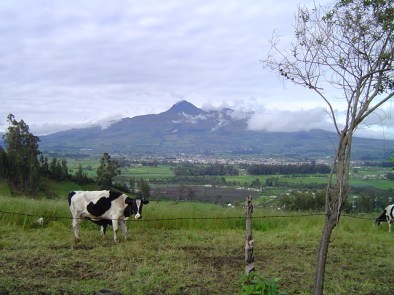
EMHolstein cow

Ecuador’s main income comes from oil in the Amazon, horticulture next, then Holstein cows and pigs. Up on the right of the road a pair of oxen plough an impossibly steep slope. There are many dogs in this country, no two alike, and all are well-loved.

Another early start as we drive to Cuicocha Lake. The road goes along the valley between two volcanoes. In Ecuador volcanoes are male or female. The one to our left has a smattering of snow, and opens in the shape of a vulva. The right hand one thrusts its single peak into the sky. Together they produce their children – the mountain range behind us.

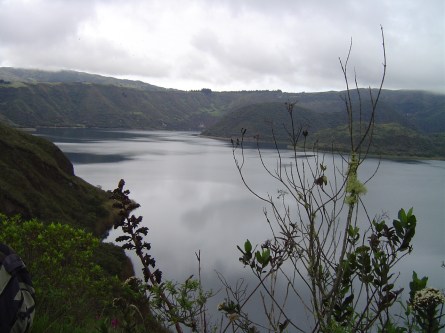
Crater lake

The snaking road takes us up the female volcano and we walk through the park gates, spotting several birds. The waters in the crater are calm with the occasional ruffle of breeze, a ruddy duck and some coots dive far below us. I spot ten more birds. The vegetation is pricked with thousands of tiny alpine flowers.

The spice lady

The clouds descend as we return to Otavalo to visit their famous market. I buy an alpaca jacket, which I still use today.

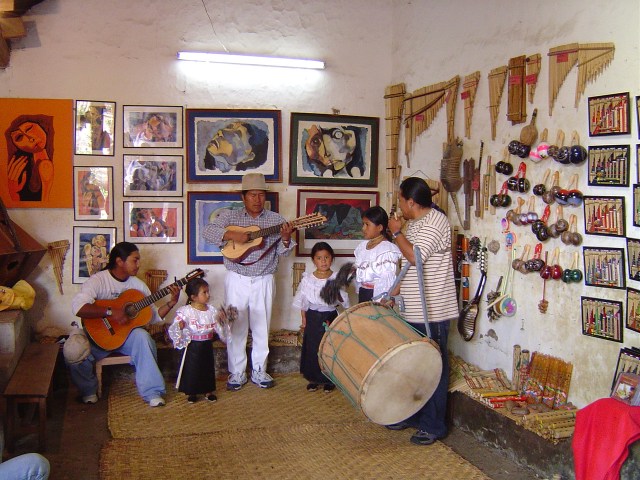
Panpipe family

In Peguche a local family serves us lunch. Corn on the cob, potatoes and goats cheese with beans. Dessert is the fruit we bought with us from Otavalo, lovingly prepared. Then the family performs. Father shows us how he makes pan pipes, demonstrating the different sounds and ending with a blow on a very long pipe used formerly for long distance messages. Two men play a duet as three children dance, dressed in Inca costume.

EMTungurahuaThe flora is similar to Kenya: wattle, lantana growing wild, gum trees. There are many plant species. The land turns even richer as we approach Machachi, and pass by wealthy homes with 2-3 acre gardens. But we’re not allowed to stay in the town as scheduled, as a volcano 50 km away has been making erupting noises.
Posted in Travels | Tagged , , , , , , , , | Comments Off on A Shrunken Head and Sexy Volcanoes

Green Jewels on a Velvet Throw

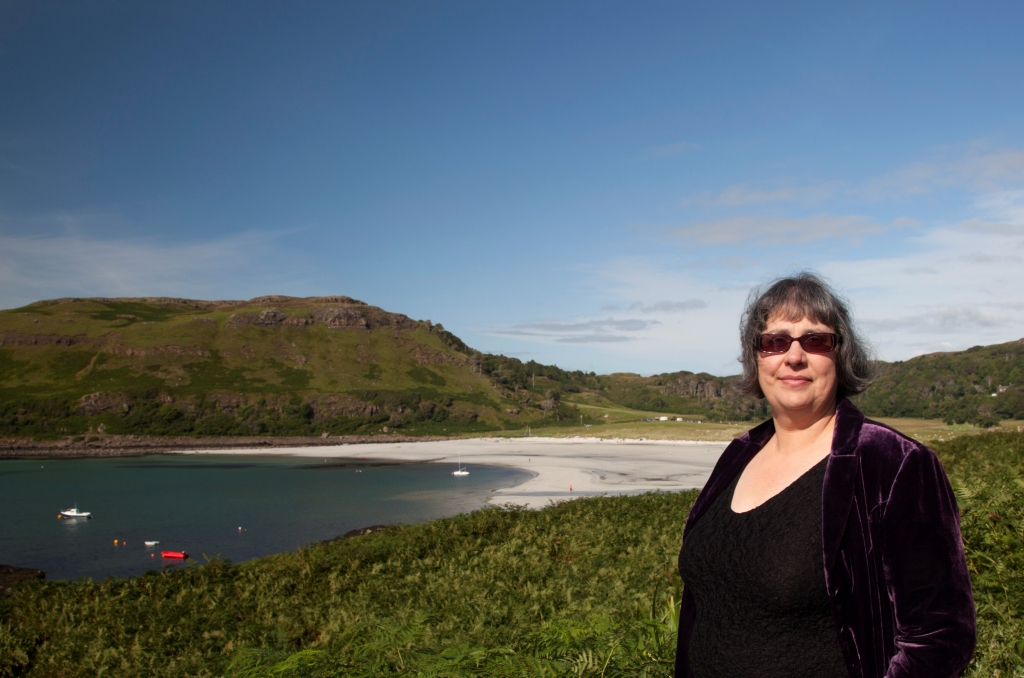
A warm welcome to another talented Crooked Cat author today.  I enjoyed Yvonne Marjot’s first novel, and look forward to another trip to the Hebridean Islands, which make me think of Mendelssohn. Over to you, Yvonne. YM author pic at Calgary

“The Isle of Mull, of isles the fairest”, goes the old song (An t’Eilean Muileach, an t’eilean àghmhor…). It certainly is, and as the setting of The Calgary Chessman it introduced readers to one of the many beautiful islands that stud Hebridean waters like green jewels on a velvet throw.

The islands of the Inner Hebrides each have their own character. There’s Skye, where in 1746 Bonnie Prince Charlie fled with Flora MacDonald on her bonnie boat ‘like a bird on the wing’. Skye has mountains fiercer than Mull, the Black Cuillins offering a more challenging climbing experience than the gentle slog up Ben More, Mull’s only Munro.

Islay is justifiably famous for its distilleries; it has more than any other island, and has produced many world-class whiskies. Every year it’s also a sanctuary for fifty thousand wild geese, which overwinter in its fields and bays.

Among the smaller islands, Rum is a sanctuary for wildlife, and its resident population of red deer has been much studied. The Cuillins of Rum are a lower but no less impressive visual accompaniment to the Black Cuillins of Skye, and on a clear day both may be viewed from the north coast of Mull, as well as the small isles of Muck, Eigg and Canna, and the lonely pairing of Coll and Tiree, sheltering Mull from the west.

Famous Staffa, celebrated in poetry and music and most of all in Mendelssohn’s composition, Fingal’s Cave, occupies a special place amongst the Hebrides, as do the Treshnish Isles where puffins abound.

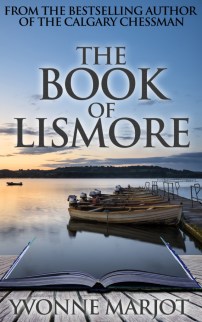
TBLismore front cover compressedOne isle is greener and fairer than all the others – the Isle of Lismore, tucked into the mouth of Loch Linnhe and only a swift trip by birlinn (medieval-era boat) from the south-east coast of Mull. It’s described in the Gaelic song Fagail Lismor (Leaving Lismore) as ‘s an t-eilean beag uain’ an caidreabh a chuain (the little green isle in the embrace of the sea).

Its name comes from the Gaelic Lios Mhor, the Great Garden, and its limestone basement rocks produced a small but fertile landscape that fed its tiny population successfully even when communities round about were being cleared in the midst of famine. There’s no doubt Lismore was affected by the clearances (the song ‘Leaving Lismore’ being one indication) but there’s something about the island that makes it feel like a sanctuary from the troubles of the world. It’s no accident the place has its own saint.

Moluag of Lismore may not be as famous as Columba, Columcille of Iona, but his presence is well attested in the literature, and the people of Lismore are proud of their ecclesiastical heritage. Moluag is traditionally held to have founded his own monastic lineage on Lismore, with monasteries in other nearby locations including the Isle of Tiree. In his book Lismore, The Great Garden (Birlinn Press), Robert Hay describes the ‘bachuil of St Moluag’, a piece of blackthorn wood studded with bronze nails (which once fastened a copper coating onto the stick); the Livingstone Barons of Bachuil have held chartered responsibility for this relic since the sixteenth century, and claim that it once belonged to Moluag himself almost a thousand years earlier.

It might seem outlandish to imagine a tiny island in the middle of nowhere having its own cathedral, but nonetheless, Lismore did, and the diocese of Lismore played an important part in the affairs of the Middle Ages. There was a Great Book of Lismore (although this may have more to do with the monastery of Lismore at Bangor in Ireland) and once there was a ‘Life’ of St Moluag of Lismore, just as we are able to read the ‘Life’ of Columba, which still survives.

On this tiny island, a monastic lineage that saw itself equal to Columba’s was founded and thrived, and it was a pleasure to me to uncover this history, learn as much as I could about it, and turn it to my own ends. Like the Calgary Chess Queen, Cas’s discovery on Lismore is fictional, but it is founded on the story of a real place, which is, if anything, even more fascinating than the story I have created. I hope you enjoy reading about it.

Now, here I have a confession to make: I have never set foot on the Isle of Lismore, despite passing in the ferry hundreds of times when travelling between Mull and the mainland. So I have no pictures of this beautiful place to share. If you are interested, you could visit the website of the Lismore community, which has many photographs of the island and its environs.

TCC cover art frontYou can buy The Book of Lismore, and its predecessor The Calgary Chessman, from any  good supplier of e-books. Here are the links for Amazon.co.uk  and Amazon.com

You can learn more about Yvonne Marjot and her books by following the Facebook page https://www.facebook.com/TheCalgaryChessman, @Alayanabeth on Twitter, or the WordPress blog The Knitted Curiosity Cabinet 

Posted in Authors | Tagged , , , , , , , , | 4 Comments

It’s Revolution Day!

Our Tim is doing the rounds this week, talking about his exciting new release, published on 30 June by Crooked Cat. I loved his first book, an excellent historical novel which uncovers the story of slavery in ancient Greece. You can find my review of it HERE. Best of luck with this one, Tim – I’m looking forward to another treat.

Hello, Jane! Thank you for inviting me onto your blog to talk about my novel,

5b Revolution Day, my second novel, follows a year in the life of Latin American dictator, Carlos Almanzor (my first, Zeus of Ithome, is set in ancient Greece and is a finalist in the Chaucer Awards for historical fiction). Now in his seventies, Carlos is feeling his age and seeing enemies around every corner. And with good reason: his Vice-President, Manuel Jimenez, though outwardly loyal, is burning with frustration at his subordinate position.

Carlos’ estranged wife Juanita is writing a memoir in which she recalls the revolution that brought him to power and how, once a liberal idealist, he changed over time into an autocrat and embraced repression as the means of sustaining his position.

When Manuel’s attempts to increase his profile are met with humiliating rejection, he resolves to take action. As he moves to undermine Carlos’s position and make his own bid for power, Juanita will find herself unwittingly drawn into his plans.

In this excerpt, Juanita, who is under long-term house arrest, looks out at the boundary that separates her from the outside world:

‘It is just a line on the ground, a slight change in colour between the asphalt on one side and the gravel on the other, a few metres away from the door of my house. The same weeds grow on both sides of the line. After rain, part of it is concealed by a puddle. When I was free, I crossed this line hundreds of times without noticing it, except when the wrought iron gate lay closed above it. But even the gate had little significance. It was never locked in those days; its opening and closing were the task of a couple of seconds. Walking over the line made no impact upon my consciousness other than a rather pleasant, fleeting sense of entering a place of peace, of refuge from the demands of public life. Or – when I was going the other way – an odd mix of apprehension and excitement as I prepared to get back to work.

“The line has not changed in any way since then. It, and the gate itself – still the same gate, after all these years – continue to be ignored by all other forms of life but me. The birds fly over it. Snails and lizards move unhindered beneath it. My cat – how I envy her this – passes between the bars as if they were not there when she begins and ends her nightly prowlings. The gate is locked now, of course, but for the various men and occasional woman who come here for one purpose or another, that fact is of no consequence. They all have keys, and the act of unlocking it hardly delays their progress at all.

But for me, the line, and the gate above it, are now an impermeable barrier. I have crossed it no more than four times in sixteen years, under armed guard. The trees on the other side of the road beyond the gate do not look any different from the ones I remember, the ones I could have walked among and touched if I had wanted to. They are no further away, in space. But I no longer see them as real trees. To me, they are like a picture of trees or, when the wind blows, a movie of trees swaying to and fro. They are beyond the line, and all that is outside it has for years been slowly fading out of reality.”

tim

If your readers are intrigued, they can find out more on my website and Facebook author page. Thanks again for hosting me, Jane!

It’s been a pleasure, Tim.

Tim’s Twitter Contact

Crooked Cat Author page:   http://crookedcatpublishing.com/item/tim-e-taylor/

Revolution Day on Amazon.co.uk  and on Amazon.com

Posted in Authors | Tagged , , , , , , | Comments Off on It’s Revolution Day!

Humming Birds, so Tiny

Oh the joys of technology! At last I have unearthed some pictures of Ecuador and the Galapagos Islands from the depths of my portable hard drive. Come back with me to 2004, and enjoy the experience!

It is Sunday 12th December, and I haven’t recovered from the journey: a headache, which isn’t bad enough for Panadol but enough to make me feel below par. The flight from Madrid was fantastic: I was upgraded to Business Class and had a glorious restful time.

EMQuito

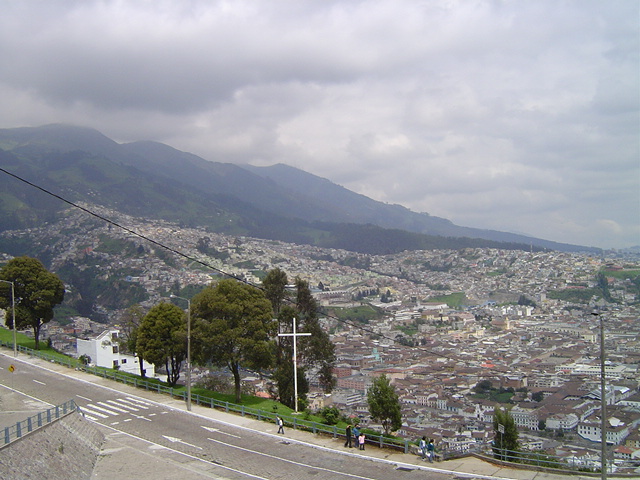
We tour Quito. Bus first, to see the Virgin of Quito with eagle’s wings atop the world, treading on a chained dragon. Quito spreads out before us, a vista of pastel-coloured buildings covering the mountain slopes. Then we trudge round the old town, entering a couple of churches while mass is in progress. I want to buy a book on birds, so Diego our guide takes me to the rich part of town, just like any ordinary shopping mall. The only bird book available is a scientific double volume costing $128, so I buy one on Galapagos birds instead.

We drive through endless Quito the following morning, until at last we reach the countryside. Very steep mountains and valleys on all sides. We descend through the cloud forest –  thick tropical undergrowth. The vegetation is familiar, and I realise with a deep sense of joy that we are at the same latitude as tropical Africa. We pause to walk in a place abounding with exotic orchids, winding round steep muddy paths, and enjoy our first dose of hummingbirds hovering round coloured sugar-water plastic containers. Such delightful birds, so tiny, their wings going literally in circles while they hover.

Back to the bus – double seats on the left, single on the right. Down, down and down. Thick dense forest rising in cones around us. Down to Mindo where our altitude headaches disappear and we feel normal again. We’re the only guests in a lodge beside a river, and we have to take our shoes off before entering, to enjoy six more varieties of hummingbirds while we lunch on rainbow trout, beautifully served. We’re not allowed to linger for long, though.

owl butterfly

Owl butterfly

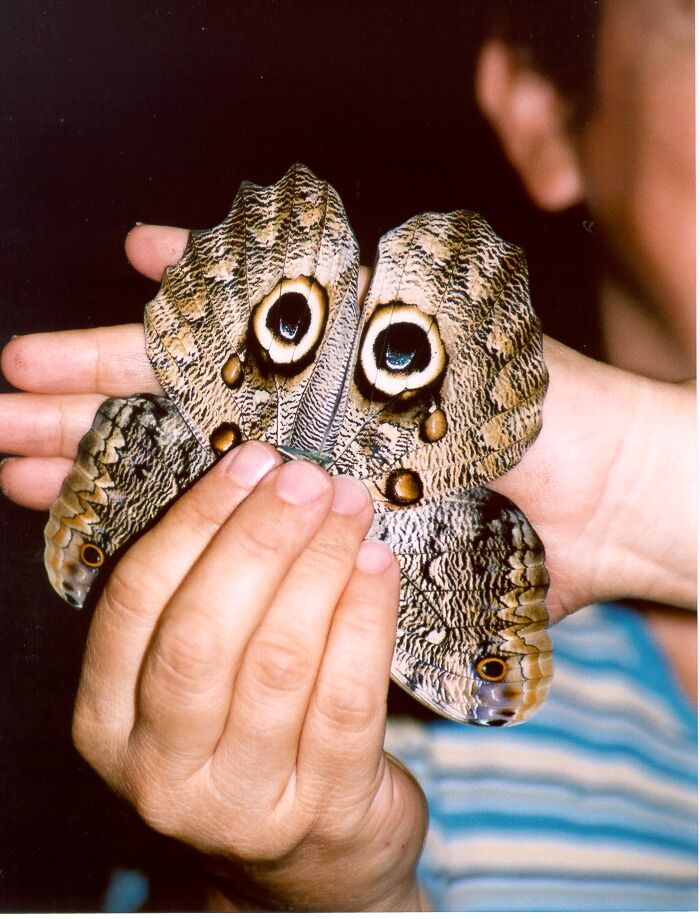
A butterfly centre is next, where we witness their cycle of life, before going on to a place where even more humming birds delight our eyes, and going wild with excitement, we grab our cameras. Mine, sadly, is not up to the task. We have tea, and are preoccupied with the birds until nightfall. A mot mot flies in – an exotic bird with trailers in its tail.

On the way back to the lodge, half of us elect to walk the final two kilometres. I almost regret it, but feel better when I remove my tight water-proof trousers as the rain stops. At least I have earned my supper.

Posted in Travels | Tagged , , , , , , | 5 Comments

Everything Is a Bit of a Blur

I am  taking you back for one moment to October 2010.  Everything is a bit of a blur after we experience the wonders of Petra, and I am very tired. The old body is not keeping up with the mind, but it is all so interesting and I don’t want to miss a thing.

167 Amman city (1024x575) 172 Houses of Amman (1024x575)

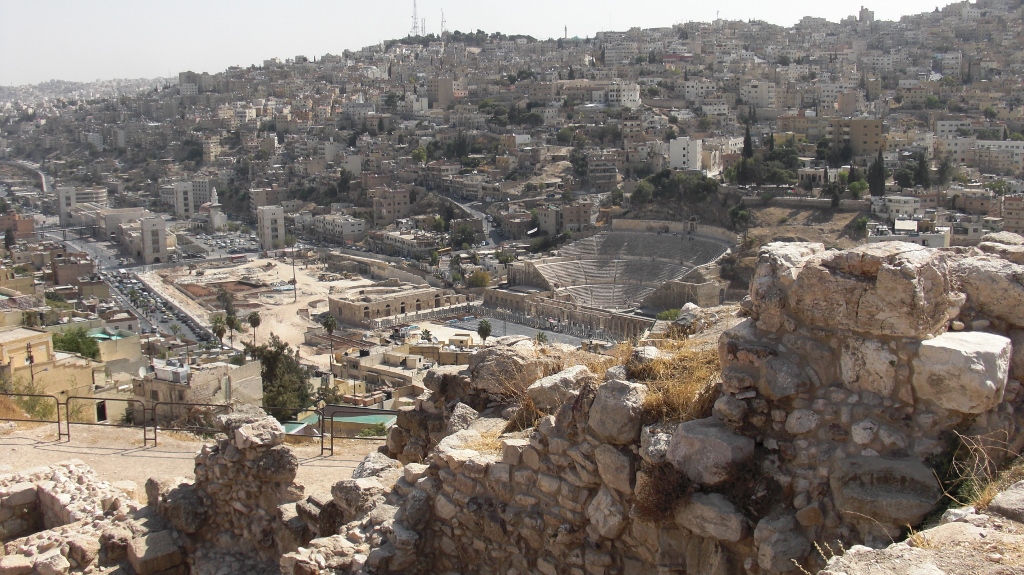
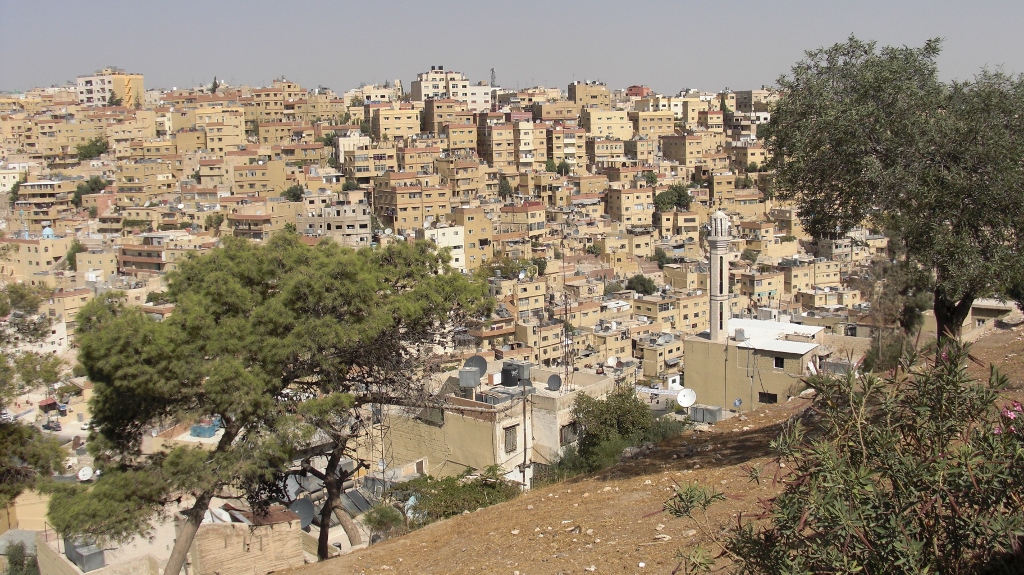
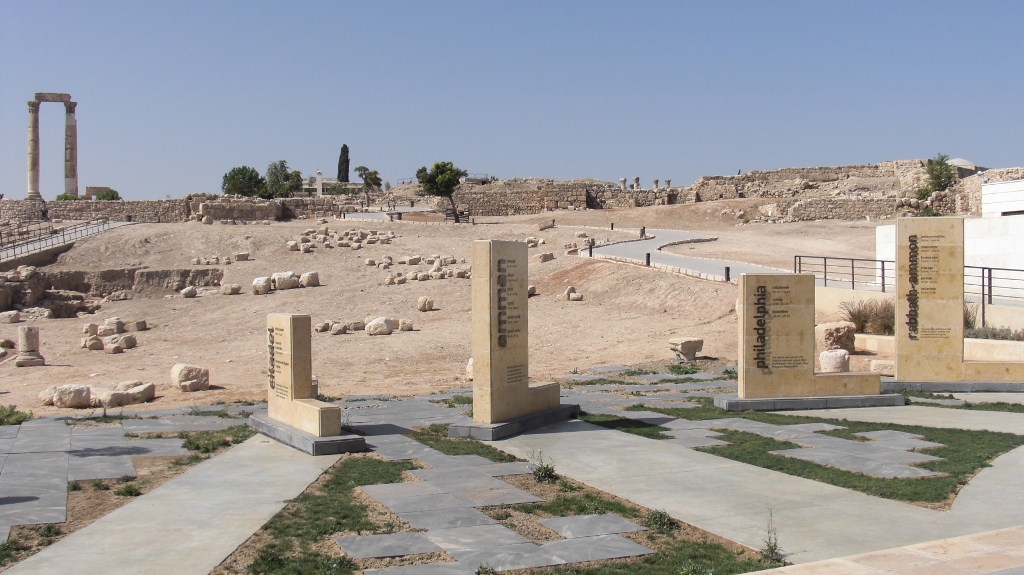
We are off at 7.30am for the long drive to Amman, and are taken on a whistle stop tour of the citadel and museum in the centre of Amman, in sweltering midday heat. I’m blowed if I can remember any of it, even after looking at my photos. Amman is a sprawling city of flat topped sandstone houses as far as the eye can see. The countryside has abundant trees, and there are oleanders, roses and ornamental bushes in the gardens. We pass by the heavily guarded US Embassy.

166 Citadel tour (1024x575)

The Citadel

Then a 45 minute drive through fertile valleys and hills to Jerash for a two hour exploration of the Roman city, starting at 3pm. By four, the sun has lost its edge and a breeze is blowing.

We are led in easy stretches from shady patch to shady patch, our guide ensuring we don’t have to climb too many steps.

173 Hadrians arch Jerash (1024x575)We walk through Hadrian’s Arch,

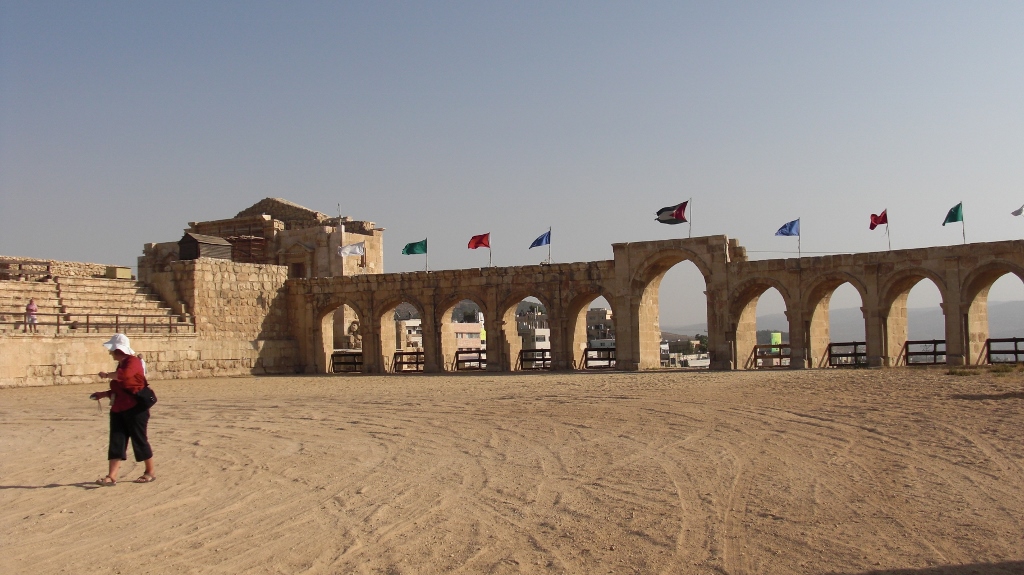
174 Hippodrome (1024x575)and enter the Hippodrome, where they hold chariot races twice a week surrounded by the imposing architecture.

176 South Theatre (1024x575)

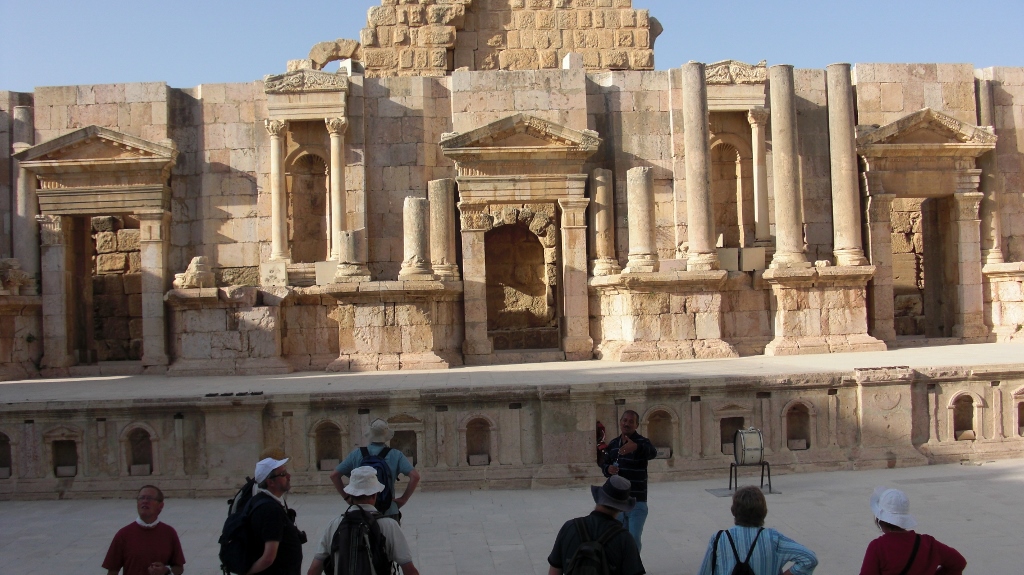
The South Theatre

We pass through the impressive oval plaza and the Temple of Zeus into the South Theatre where the excellent acoustics are demonstrated by two men with bagpipes.

Then up to three churches, destroyed in an earthquake, but one with a lovely mosaic floor, which I can’t help feeling will not last much longer if they don’t protect it from the sun.

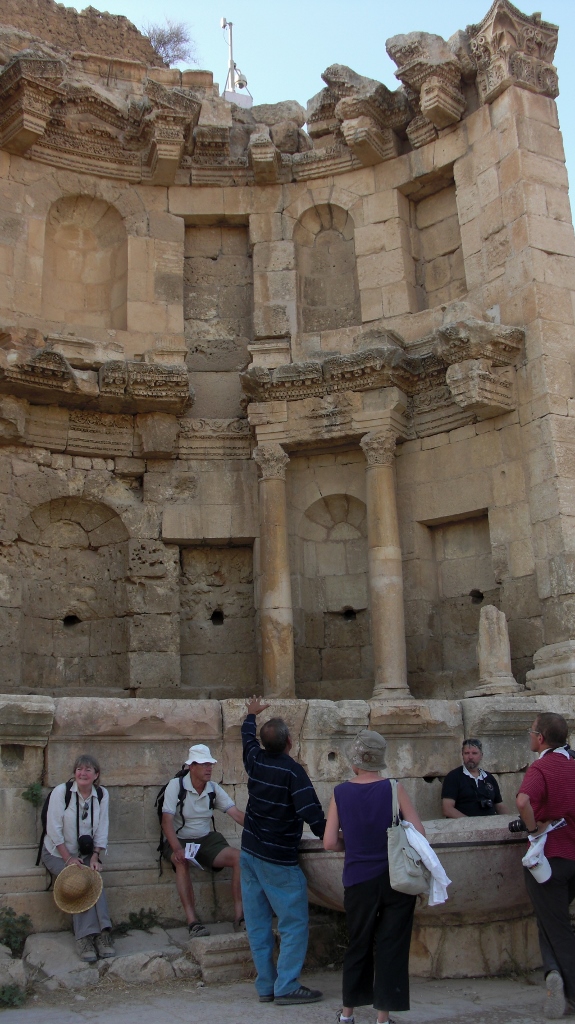
177 Temple of Artemis (575x1024)We visit the Temple of Artemis. Its columns are sectioned and joined on rods through the centre, so when an earthquake strikes, they sway instead of toppling. We descend to the Colonnaded Street, then back to Hadrian’s Arch via the Nymphaeum fountain.

Our plush Toledo Hotel in Amman is a pleasant touch of luxury. All you can eat buffet supper is excellent value at 8 dinars.

After a 6.30am start the following morning, we travel down winding roads, through fertile valleys, passing children on their way to school. To our dismay the old cramped bus waits for us on the Israel side of the Bet She’an border!

Garry comes to the rescue; he is an expert and packs the bags tightly in order to free up that vital extra seat for our new guide. Betty tries to marshal us dictatorially, but at the Basilica of the Annunciation in Nazareth, some rebels go looking for refreshment. The church isn’t as crowded as those in Jerusalem. A solemn priestly service is in progress in the centre of the main hall as we wander round examining the mural. St.Joseph’s church nearby is a prayerful place, where I rest for several minutes.

We all look forward to the Sea of Galilee… which I tell you about HERE in a previous blog.

Let’s go somewhere completely different next week. Has anybody been to Ecuador and the Galapagos Islands?

Posted in Travels | Tagged , , , , , , , , , , | Comments Off on Everything Is a Bit of a Blur

EIGHT WAYS TO ENERGISE YOUR MARKET – LOUD AND PROUD

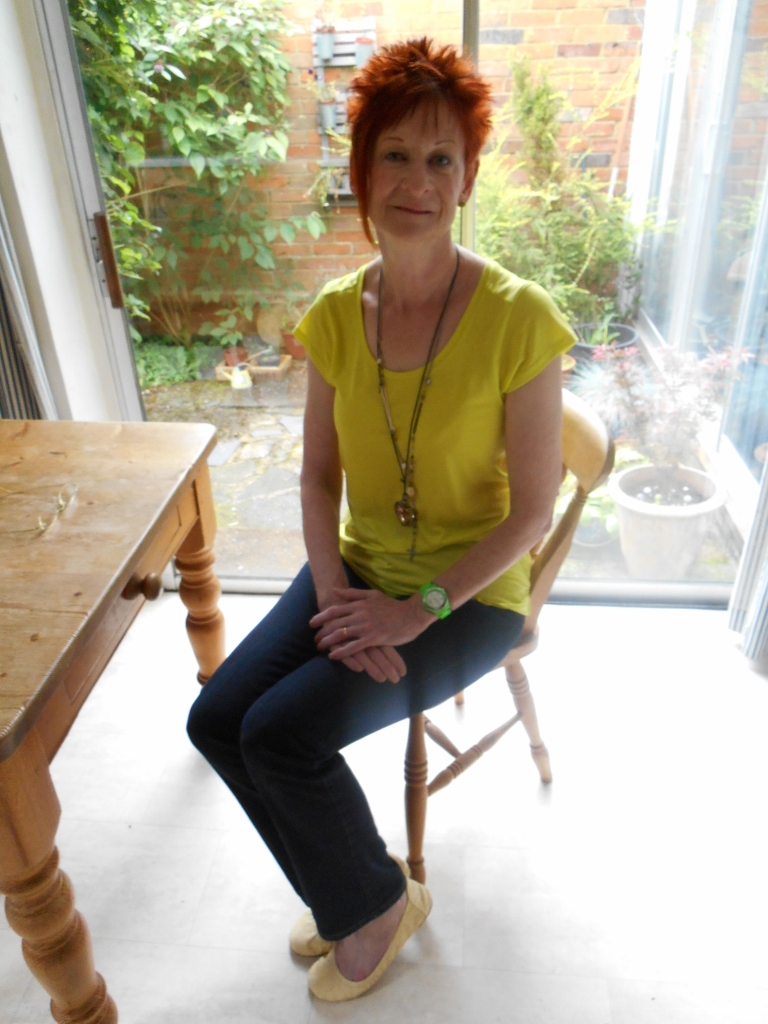
Sound advice indeed, Carol Hedges, especially #1!
 Carol's Birthday 2014 003 (768x1024)
So you’ve published a book – congratulations! And now you’re sitting back and waiting for the money to roll in. Sorry – that’s not how it works! Writing a book and getting it published, by whatever conduit you use, is only the start. To get any sales, you have to make people aware of your masterpiece. In this guest post (thank you Jane B.), I’m exploring some of the ways I use to promote my work, because unless you are out there, loud and proud, nobody will notice you.
1. Social Media: Most of my sales come from Twitter. And practically all come from people recommending the books to other readers, and that comes from me chatting, interacting and posting funny stuff. In other words, I’m a friend first, an online character second, and a writer selling books third.
2. Press Releases: The local press are (usually) delighted to receive a press release, a publicity pic and a free copy to review.
3. Press Releases: Anywhere your book is set will be delighted also.
4. Local Radio: Contact them via Twitter, phone them up, arrange to do a studio interview. Listen, I sound like a 15 year old mainlining helium, but I still do it.
5.National Press: Will be interested if you have a brilliant backstory, particularly if it involves abuse, or hardship. Also if you earned shedloads of advance shekels or you are very very photogenic. I haven’t cracked this one yet. Maybe you will.
6. Literary Festivals: Everybody’s doing it. Local library will have contacts of yours. Get in touch. I did the first St Albans Literary Festival last November. I ran a workshop on how to get published … ooh, and I had some books on a side-table.
7. Signings: Local bookshop is worth approaching. If it’s Waterstones, good luck.
8.Talks: Women’s Institute – you have to audition and be approved, but it’s worth it. Local book clubs/writers’ groups are also worth contacting. If you write YA or childrens’ fiction, schools are always keen to have a visiting writer. Make sure you get paid – the Society of Authors has recommended fees.
As you now see, there is a lot more to being a writer than merely writing. Writing is the ”easy” bit! And lest you should eye your mainstream published brethren and mutter ‘bet they don’t have to do all this‘ – YES THEY DO! Big publishers are very selective about who they spend their publicity budgets promoting. If it ain’t you, you will still have to do the legwork. I’ve spoken to some ”famous” names, and it is so.
Finally – make sure you are registered for PLR – Public Lending Rights: that’s the money paid by libraries every time your book is borrowed. You can register at www.plr.uk.com. Every little helps.
Stuff:
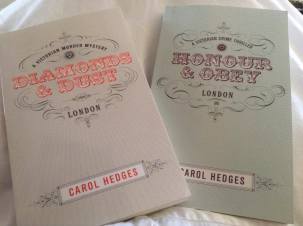
D&DH&Ocovers11014276_10153316388497578_954064357765800138_o
 
twitter: @carolJhedges
Amazon author page: http://amzn.to/1N1P3DF 
Posted in Author Countdown, Authors | Tagged , , , , | 14 Comments