ANCESTRY RESEARCH – And the Plot Trigger was Pulled.

Isn’t it strange how things work out sometimes? Last Tuesday I hosted a blog by an author with a name for digging around her family tree. And now I welcome prolific writer Nancy Jardine to my place once again; she has “discovered” ancestry in her most recent book, Monogamy Twist. It is top of my to-read list, Nancy, I just can’t wait!
For CC (420x627)Hello Jane! It’s lovely to come back and give you an update on my writing, though I’m going to dip first into the recent past… to autumn 2010.

Plot ideas can come from strange prompts!

I wasn’t really thinking beyond my historical writing. I was redrafting what became The Beltane Choice, Book 1 of my Celtic Fervour Series but things happen in curious ways. I’d started to research my own family tree and found ancestry research a fascinating time-consuming habit. My family files were stacking up and in addition to on-line storage of details, I was making print copies. During one episode of the current BBC dramatisation of a Charles Dickens book, I was organising my ancestry research binder. That series wasn’t about Great Expectations but the plot trigger was pulled.

Maybe I should try a contemporary novel instead of a historical? Some ideas burbled around. How about a contemporary English setting and a humorous version of a Dickensian bequest plot? Someone inherits a house but doesn’t know why it’s them? Excitement grabbed me. I’d be able to tie in ancestry somewhere in the plot if the contemporary characters had to do some family tree research to find out why the bequest had been made in such odd circumstances. Not just a contemporary story but a mystery!
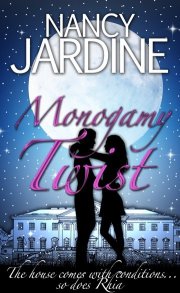

MonogamyTwistNancyJardine x360

When Luke Salieri inherits a dilapidated English estate from a woman he’s never heard of— with quirky conditions attached—it’s a mystery he wants to see resolved immediately. But there’s a catch: he needs a woman to meet his needs, though just how far will he have to go to persuade her?

The job of researching Greywood Hall and its fantastic contents is enticing, but can Rhia Ashton see herself living with gorgeous Luke Salieri for a whole year and then walk away? Rhia has her own ideas about what will make it worth her while. But neither expect love to enter the game.


Monogamy Twist was conceived that night. I decided that the inheritor was going to be the male main character (Luke Salieri) and he’d be aided by a very convenient female main character (Rhia Ashton) and they’d solve the mystery together. I thought of making it an inherited Scottish castle but that didn’t ring sufficient parallels with my image of a Dickensian plot. A castle would maybe work for a version of a Sir Walter Scott novel, but I was on a Dickens bandwagon! I pulled out a map of England. The Yorkshire Dales grabbed my attention—sufficiently bleak in places and a fabulous choice for my Greywood Hall.

I wrote the story of Monogamy Twist in a mere few months, during the two-days-a-week when I wasn’t teaching. In March 2011, I sent the manuscript to a US eBook publisher who immediately declared that they’d publish the novel and gave me a two-year contract on it. However, as a ‘Romance-Only’ Press they insisted I add a lot more steamy romantic scenes to my original manuscript.

Crooked Cat has recently re-launched a brand new version of Monogamy Twist which is back to being much more like the original manuscript of my humorous, ancestral based mystery. It’s still a romantic story but the mystery drives the action more than the development of the relationships between the main characters!

I like to think that Charles Dickens was an author who was fairly flexible in his writing and hope he’d approve of my ‘borrowing’ his bequest concept to make my fun inheritance mystery in Monogamy Twist.

This April of 2015, I’m also about to publish my first time travel historical for a Middle Grade/ YA and older readership. The Taexali Game  is set in Aberdeenshire, Scotland, but my intrepid trio of time travellers are whisked back to AD 210 when the Ancient Roman Emperor—Septimius Severus—floods the area with legions of troops.

Perhaps I could return in a while, Jane? To tell you more about The Taexali Game and how it came to be written because that’s also a nice long story…

You are welcome any time, Nancy – I look forward to seeing you again.

****

Nancy Jardine lives in Aberdeenshire, Scotland. She currently shares a home with her husband, daughter, son-in-law, 3 year old granddaughter and 1 year old grandson. It’ll continue to be a busy household till late summer of 2015 when the new build home will be completed for the young ‘uns on what was Nancy’s former back garden. The loss of that part of the garden won’t be missed since there should now be more writing time available this spring and summer! Childminding is intermittent over the day and any writing time is precious. (If interested in how a new house is built these days, follow my blog posts named ‘Gonna build a house’ )

All matters historical are a passion for Nancy; Ancestry research a lovely time-suck. Nancy regularly blogs and loves to have guests visit her blog. Facebooking is a habit she’s trying to keep within reasonable bounds! Any time left in a day is for leisure reading and the occasional historical series on TV.

*************

Author links:

http://nancyjardine.blogspot.co.uk   http://nancyjardineauthor.com/    Twitter @nansjar  Facebook: http://on.fb.me/XeQdkG


Amazon Author page for books and to view book trailer videos:

US http://amzn.to/RJZzZz   UK  http://www.amazon.co.uk/Nancy-Jardine/e/B005IDBIYG/ref=ntt_dp_epwbk_0

Novels also available from Barnes and Noble; W.H. Smith; Waterstones.com; Smashwords; TESCO Blinkboxbooks; and various other places.

Blurb March 2015

Buy from:

UK http://amzn.to/18YfHQM

US http://amzn.to/1Nhfq8V

Posted in Authors | Tagged , , , , , , | 1 Comment

Deb Doesn’t Like Buffalo Any More

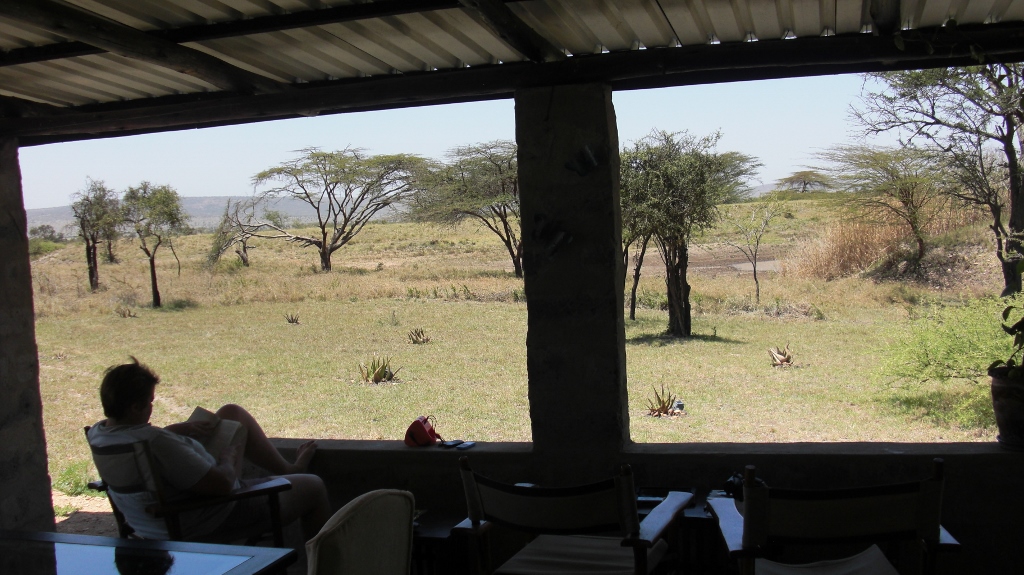
What a wonderful morning! Up at 6.30am in my faded purple robe, waited upon by Deb, my hostess. A blanket is wrapped round my legs, her jacket lies across my shoulders, as I sit on the open patio watching the rising rays of the sun reveal the plains below.

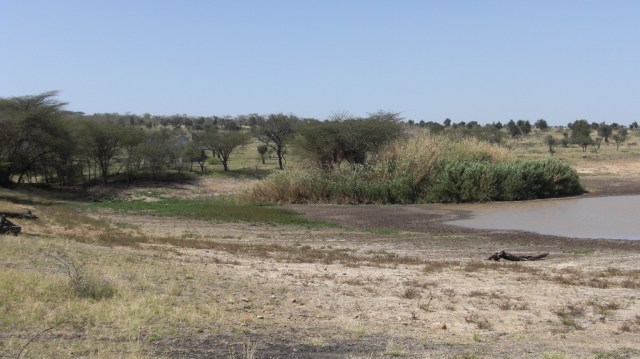
Looking towards the Eburu Hills

Looking towards the Eburu Hills

A family of impala skitter across the parched plains. Some Grants gazelle shoo away a lost impala youth. Zebra clip-clop below me from right to left, a group of warthog wallow in a mud patch near a fringe of forest. Then five buffalo appear out of nowhere to water at the trough set there precisely for the animals. There’s a rock of natural salt beside it, which lasts a week. One lasted only a day, Deb told me, and she suspects the nearby encampment with their fenced boma for goats and cattle.

“They would have sold it to a duka in Naivasha,” she said. “It’s very expensive: Shs.1,400/-. They don’t look after their cattle properly, so the salt couldn’t have been used for their stock.”

If you look in the centre foreground, you may just glimpse some buffalo.

If you look in the centre foreground, you may just glimpse some buffalo.

Deb doesn’t like buffalo any more.

Six weeks ago she was mauled, when walking her three Alsation dogs in the bush. It suddenly charged at her out of the bush. She thinks perhaps the dogs had annoyed it.

She yelled and screamed and ran behind a thorn tree, but the buff got her, breaking a rib. She kicked and yelled, and then it backed off for the final charge.

She thought in that brief moment it was the end.

The dogs came to her rescue, hassling and distracting the animal until it ran away. Some watu came to help; but she wouldn’t let them lift her – she was hurting too much.

Then a Green Park vehicle arrived and took her to the doctor. They found her shoes hung up on the branches of the thorn tree, she had been kicking out so wildly.

Many thorns were embedded in her leg and the scratches were still visible. The thorns are not all out yet.

Lucky Deb.

CIMG1954 (1024x575)

Water hyacinth has drifted in to the northern side of Lake Naivasha. Steam jets from Hell’s Gate spume in white clouds from behind the opposite hills. Eburu hilltops rise behind me. My hearing aids allow me to hear the soft trickle of water from the fish pond beside the patio. And the birds come out. I astonish myself: I can remember their names, but have to resort to Deb’s bird book to positively ID the yellow bishop. Bulbuls, sunbirds, weavers, cordon bleus, red winged starlings; a black headed oriole. Then out come the swallows as the sun rises higher.

A cooling breeze makes the chime over the front door tinkle (I could do without that).

CIMG1950 (1024x575)

Below me a ranger vehicle has arrived. Three men stand by while one does something on the ground in the fenced compound where the cattle had been. They swat at the occasional fly and change position from time to time; three supervisors, one worker. I can hear the faint sound of a hammer as the breeze veers my way.

Behind me, Deb’s workers chat as they labour on a new ground level water tank, and move furniture and beds around as she’s expecting a large party of guests later in the week…

But I must prepare myself for that dusty road once more.

Website: http://janebwye.com/

Posted in Kenya, Travels | Tagged , , , , , , | Comments Off on Deb Doesn’t Like Buffalo Any More

TEN THINGS NO ONE TELLS YOU ABOUT BOOK PUBLISHING

I am delighted to welcome back a valued friend, Karen Charlton, from my Authonomy days. Her  little piece is so, so true. And the strange thing is, we all have to learn every one of these lessons by personal experience; sometimes more than once.

karen author photo cream (3) (528x640)In a recent survey carried out by YouGov and published in The Independent newspaper, 60% of UK adults declared that being a writer is their ‘dream job.’  14,294 adults were interviewed for this survey. I can only assume – that they all assume – that being an author is both stress-free and lucrative.
In response to this article about the YouGov survey I stuck my tongue in my cheek and jotted down a few observations about the truth behind a publishing contract – especially with a small publishing house. This list of observations is gathered from my own experience and that of fellow authors. I have decided to share it with you below.

If you are ‘lucky’ enough to acquire a publishing deal with a small traditional publisher the following may happen…

Ten things 2

  1. You probably won’t be paid an advance and won’t see a penny in royalties until six months after the book is published.
  2. In the meantime, you will be expected to do an awful lot of marketing to promote the book and this will cost money. A surprising amount of money. You will buy in lots of stock, organise expensive book launches which no one attends and travel up and down the country to poorly attended events where no-one buys your book.
  3. You will annoy and pester your teenage children into designing webpages for you. And beg them to teach you about Facebook and Twitter.
  4. You will rapidly lose friends – especially on Facebook and Twitter – as you harass everyone you know into buying your book.
  5. Those family and friends who do read your book will make the most bizarre assumptions about upon whom the characters are based.
  6. You will soon realise you are spending more time marketing your first novel, than you are writing the second one.
  7. You will harbor a secret hope that despite having no publicist or marketing budget that somehow your novel will make it onto the best-seller list and be signed up for a film deal. You will dream of retiring from the day job, moving to the Mediterranean and spending the rest of your life sipping cocktails beside the pool, while tapping out another best-seller on the laptop.
  8. Everyone else in the world will assume that you are coining in the cash, while you may have an uneasy suspicion that this is just turning out to be a VERY expensive hobby.
  9. When your first royalty cheque arrives, you will be devastated and convinced that there should be another zero at the end of that figure. At this point, your long-suffering partner will lose all patience with you and refuse to support you or your writing anymore. If you are really unlucky, your publisher will fold and disappear off into the ether still owing you money.
  10. Despite the fact that your spouse has filed for divorce and the bailiffs are on the doorstep, no-one will ever have any sympathy for you…because you are a writer ‘living the dream.’

Of course, this is the worst case scenario but even authors with the bigger publishing houses have problems. They write to strict deadlines which are often inflexible and can be exhausting. Midlist authors with the Big Five live in constant fear of being dropped by their publisher because of poor sales and as we all know, we are all only as good as our last novel.

Self-publishing authors work to their own timetable but have a massive learning curve to undergo in order to be successful. They need to source decent book cover designers, editors and proofreaders and have to learn how to format.  They are entirely responsible for their own administration, marketing and success and it is not easy to get your novels noticed on Amazon when yours is just one novel among so many millions.

Having said all that – if it works out—being an author IS the best job in the world. Like many novelists, my experience of the publishing industry has thrown up some horrible lows as well as highs.  There is hard work, heartache and disappointment behind every one of my books. But each morning as I climb out of bed with a spring in my step and a smile on my face, I remember the words of Édith Piaf: “Non, je ne regrette rien.”

Karen Charlton writes historical mystery and is also the author of a nonfiction genealogy book, ‘Seeking Our Eagle.’ She has published short stories and numerous articles and reviews in newspapers and magazines. An English graduate and ex-teacher, Karen has led writing workshops and has spoken at a series of literary events across the North of England, where she lives. Karen now writes full-time and is currently working on the third Detective Lavender Mystery for Thomas & Mercer.

Charlton-The Heiress of Linn Hagh-CV-FTLayout 1

A stalwart of the village pub quiz and a member of a winning team on the BBC quiz show ‘Eggheads’, Karen also enjoys the theatre, and she won a Yorkshire Tourist Board award for her Murder Mystery Weekends.

You can find out more about Karen’s work at http://www.karencharlton.com, and her portfolio of publications can be found on amazon.co.uk and on amazon.com

Posted in Author Countdown, Authors | Tagged , , , , , , , | 44 Comments

Pandemonium and Dust.

You don’t have to try and imagine what would result if four roads meet and cross and there are no rules. It happens throughout the day outside the YaYa Centre Shopping Mall in the city of Nairobi.

CIMG1944 (1024x575)

A traffic policeman hovers on the brink, and steps in when the tangle of vehicles comes to a complete standstill. It is a miracle that more accidents don’t happen. I suspect that many minor brushes of paint and fender occur without due record. But as my holiday progresses, do I discern a distinct wariness growing among the drivers? Less of a rude push-in and impetuous grab of a few feet of empty road – unless it is a matatuof course; or if the policeman is out of site.

The President has recently directed that traffic lights are to be installed at all roundabouts. I hear the sceptics ask what difference will that make, as drivers already ignore lights with impunity.

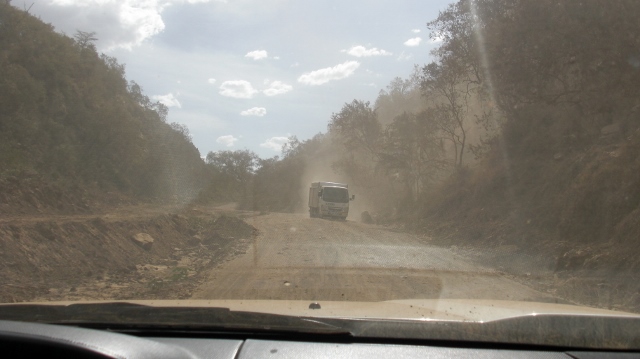
Dust(640x359)

Dust is another hazard. This is the “road” under construction from the main Nairobi/Nakuru highway to Green Park on the north side of Lake Naivasha in the Great Rift Valley. I have been warned. If I go too slowly, my dust catches up with me. When a vehicle passes from the opposite direction, I have to stop because I can’t see beyond the bonnet of my car. But the road gradually improves as I progress round the top end of the Lake,  and ends in gleaming new tarmac as it meets the old escarpment road back to Nairobi.

By the way, a talented Kenyan writer, Yvonne Adhiambo Owuor, has written an award-winning book entitled “Dust”. It is an excellent read. You can read my review of it HERE on my website page.

Product Details

On another day, while on my way to lunch with a friend, I have time to spare, so I pop up to Karen dukas to post cards to the grandchildren. I pass the free car park before I realise it, so I turn into the old road to the main stores and am confronted by a No Entry sign. To my right are several empty parking slots outside the Co-op Bank, so I swing in there.

A quick glance round. No notices to say I have to pay. I lock the car and try to remember where the post office is. I hear a shout, and a couple of men call out as I wander towards the provision stores. Studiously ignoring the commotion, and convinced it is some sort of deliberate distraction, I clutch my bag tighter to my side, and catch sight of the post office. Ten minutes later I return to the car and notice a bright yellow clamp on the front wheel.

“Whaaat?”

I look round. Nob0dy is taking any notice. A man loiters on the steps above me.

“Where do I go for this?” I ask, pointing at the wheel of my car. I look at my watch. In the dim and distant past on the one and only other occasion I’d been clamped, I remember wasting hours with Council officials before my car was released.

He gestures casually towards an elderly woman in a bright yellow jacket sitting under an umbrella. She studiously ignores me as she fingers through some papers.

I approach her, but she forestalls me. “You ignored me – didn’t you see me standing right by you?”

The angry tirade makes me step back.

“No –”

“I called out to you when you got out of the car, then told those people to stop you!”

“But –”

“You have to pay me Shs. 2,000/-!”

“ – I thought those men were trying to harrass me…”

“What is your phone number? You must pay me.”

“I am a wageni here; a visitor. I did not know I had to pay – there are no notices!”

She repeats herself, shouting me down. “You’re no wageni. Your Swahili is too good.”

“I am a visitor. I left Kenya more than ten years ago.”

She does not look me in the eye.

In exasperation I fumble in my purse for two 1,000/- notes.

“I want your phone number,” she says, bringing out her mobile.

Then I realise…

“I know nothing about paying by phone,” I retort; “I don’t use Mpesa.”

I put 2,000/- on her table.

“It’s 2,300/-“ she says. “You have to pay the parking fee. What is your phone number?”

I only have a 500/- note.

“I need the change.”

The man standing by steps up to my elbow.

“She needs your phone number to send you the receipt,” he explains.

I have a hopeless memory for numbers, and can never find my own number from my mobile. I fish out my diary and show her my new sim card number, which I have written on the front page.

She copies it onto her phone and walks away, turning back to shout at me. “I’m going to get your change!”

I lean over the railings, watching her cross the road towards another yellow-coated woman.

“She’s kali sana,” I say to the man at my side. He nods, agreeing that the old mama is indeed very fierce.

I look at my watch. “Now, I’m going to be late.”

“Make sure you ask to see the receipt on her phone,” he says, as she comes back.

I do not bother to be polite any more.

“Let me see your receipt,” I demand as she hands me the 200/- change. I make a show of looking at the phone, which I cannot read in the bright sun.

“I’ll text you the receipt,” she explains over her shoulder as she goes to unlock the clamp. “We do not use paper anymore.”

I do not deign to look at the woman as I enter my car and reverse out. But later on, I do receive a receipt on my phone.

There’s plenty to moan about in Kenya: corruption, the drought, the traffic, and now the dreadful Al Shabaab have reared their ugly head yet again, this time in Garissa; a town consisting mainly of Somali people; a speck in the desert on the long eastern border with Somalia – which has always been a thorn in the side.

Kenya – my heart bleeds for you. It is a fine line you have to tread on this new frontier in the global war against terrorism. You cannot stand alone, and yet the majority of your well-wishers have no true idea of the vastness of your country and the immensity of its problems. As you have done in the past, you will pull together.

To my family and friends, and friends of friends – to all the people in Kenya – my thoughts and prayers are with you.

It is so easy to maintain a dismal outlook – but it is Good Friday after all, and things can only get better …

… See you again next week – and have a peaceful Easter weekend.

Posted in Kenya | Tagged , , , , , , , , , | 2 Comments

Fiction as Made-up Truth

A very warm welcome to Jane Davis today – an author who has used both the traditional and the self-publishing routes for her novels. (Do sign up to her Newsletter, she asks; I have!). I asked her a few searching questions and received some thought-provoking answers.

JD Bench 034

Your favourite description of fiction is that it is “made-up truth”. How right you are! What would be your answer to the inevitable question: “How much of your writing is autobiographical?”

Although it may only be an emotion, it’s inevitable that something of me ends up in each of my books. If I need to write a tired and emotional scene, I might set the alarm for the middle of the night.

While I was writing “Half-truths and White Lies”, my middle school was pulled down to make way for a housing estate. Since it was within walking distance of my job, I made a pilgrimage every lunchtime to see the wrecking balls do their work, documenting the progress with photographs. In the evenings, writing as Peter Church, I described the dismay he felt at discovering that a block of flats had been built on the place where he used to play marbles and that more blocks had been built on pitch where he played football. He asks himself the question, is it possible to mourn the loss of a building as you would a person? “Or is it simply that St Winifred’s was the shell that I stored so many of my memories in? How is it that my old school was torn apart and I didn’t feel a physical wrench?”

In “A Funeral for an Owl”, Jim discovers that his pupil Shamayal is living in the council flat that he had lived in as a boy. I knew that flat because I lived there too and so some of the small anecdotes are things that happened to me.

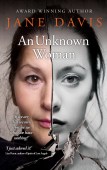
I wrote my latest release, “An Unknown Woman” in a year when my income had dropped An Unknown Woman finalto a level that I hadn’t earned since the late eighties, and so I chose to explore our relationship with material possessions. I also wanted to write about a character who is like me, but is not me. A woman in her late forties who has chosen not to have children and is living with a long-term partner, but is unmarried. Although she’s happy in her relationship, there is a nagging sense of alienation that she doesn’t like to acknowledge, sometimes from her friends whose time and energy is taken up with young children, sometimes from the life she imagined for herself when she played Mummies and Daddies, and was bridesmaid at an aunt’s wedding. In many ways, her life lacks milestones. Measures of success and achievements. And so she has ploughed everything into her relationship, her work – which she loves – and her home. And then her home and everything in it are taken away from her. In the first scene, Anita is standing outside her home watching as it burns to the ground. The house is recognisably mine. If you set out to write something that is authentic and true, you have to make it personal.
Your first book, “Half Truths and White Lies” Winner of Transworld/Daily Mail First Novel Award, was traditionally published – and yet you have self-published ever since. Has this been a successful move on your part?

Your question credits me with slightly more planning than was involved! I would be lying if I said that self-publishing was my first choice, but it certainly hasn’t turned out to be a consolation prize.

My writing career has been a roller-coaster ride. My first unpublished novel earned me the services of an agent, and she was the first person who told me, “Jane, you are a writer.” She was also the person who suggested that I attended the Winchester Writers’ Conference, where I learned about the Daily Mail competition – just two days before it closed for entries.

Told I was going to be the Next Big Thing, my reality check came with the rejection of my second novel. Transworld published me under their women’s fiction imprint and my next book was not women’s fiction. In 2009, the advice – advice I paid for time and time again – was that any self-respecting writer should hold out for a publishing contract. Of course, in this rapidly moving industry, what was true even two years ago is no longer true. Last year, The Society of Authors Chief Executive, Nicola Solomon, gave self-publishing the stamp of respectability when she said that that traditional publisher’s terms are no longer fair or sustainable. Her advice to members was that they should consider each project and decide whether they would be better off doing it themselves.

And so I held out – for three years. Retreating with my tail between my legs gave me the luxury of time. If I’d been under contract, I would have had to produce a book a year. As it was, I had time to let my novels rest, going back and adding layers and depth, finding new angles, different emphasis; identifying that one sentence on which the entire story pivots. When other authors say to me that they do three edits, my reaction is three? The eureka! moment might not come until the fiftieth edit.

It wasn’t until November 2012 that I decided I owed it to myself to investigate self-publishing. I attended the Writers’ & Artists’ conference and it was a revelation! There, established authors who had been dropped by their publishers were rubbing shoulders with first-time writers who had released their e-book priced at 99p and had sold 100,000 copies within a year. It was a publishing revolution. So was I in or was I out?

It’s important to point out that being under contract doesn’t guarantee sales. In fact, book sales are far lower than most people imagine. Readers tend to only hear about bestsellers, which distort the figures. A couple of weeks ago, The Telegraph published an article exploring ‘Why Great Novels Don’t Get Noticed.’ In this case, the novel had been written by Samantha Harvey, whose debut had been longlisted for the Man Booker, shortlisted for both the Orange Prize for Fiction and the Guardian First Book Award, and had won the Betty Trask Award. Her third novel, ‘Dear Thief’ had scores of glowing reviews following its September release, yet, it had only sold 1,000 copies. I also write in a difficult-to-sell genre and so could never expect a high volume of sales. In fact, regardless of genre, only 5% of novels sell over 1000 copies.

As I have no intention of planning for failure, that’s the model I work to and, with the services I need to buy, it only allows for break even. If you look at volume of sales as the only measure of success, there’s always going to be disappointment. Very few writers are lucky enough to earn a living from their craft. I measure success by reader reviews. When readers discover me, they enjoy what I write. I’m very happy with my 5-star average.

 Now that you have experienced both worlds, what are the drawbacks of self-publishing, and how have you overcome them?

Provided that you are realistic about your budget, there are very few drawbacks to self-publishing. I am able to write the books I want to write without fear of censorship. My work isn’t pigeon-holed into the category of “women’s fiction” as I was for “Half-truths and White Lies”. In fact, I can choose to market myself as a brand if I wish. I can present my novels in the way I want to present them, without having a title change imposed on me, or what I consider to be a misleading, salacious or otherwise inappropriate cover design forced on me. The main drawback is that bookshops, who work on very narrow profit margins, are unable to offer terms that make it practical for me to push to get my books stocked more widely. But as 95% of my sales are of e-books, that isn’t a priority at the moment.

 How much more do you market your books now? And how much has being an award-winning author helped you?

After my competition win, I was told by my publisher that they would do all of the marketing. I took that advice at face-value and so, save for maintaining a website, I did very little. However, this is another area where the gap between traditional and self-publishing has narrowed. Last summer I gave a talk with a traditionally published author, debating the benefits of traditional v self-publishing. I had expected her to come down very strongly on the side of self-publishing, but she advised that she had received no marketing support on the release of her tenth novel. So, not only was her advance very much less than she received five years ago, but she had invested all of it in marketing. As far as I could see, the main difference between us was that I have no marketing budget to speak of, and so my main thrust takes the form of direct contact with readers via my website and social media. She was using traditional PR and advertising.

I love your website – very professional and lively. Up to date, too. How much time per week do you spend on promoting yourself and your books, and what do you leave over for writing?

Thank you for your comment about my new website. I invested last year because my old site wasn’t optimised for hand-held devices. I worked with The Curved House and I’m very happy with what they’ve done for me. It’s a clean design and it’s very easy for me to update.

The split between promotion and writing isn’t as clear as it might seem because I also receive 350 emails a day and try to reply to them all. I also work one to two days a week to pay the bills. But of the time I have available for writing activities, I would say that it’s an 80/20 split. And the 80% is promotion, although it’s not all self-promotion. I am a firm believer that part of my job is to read extensively and to review other writers’ work. Like you, I interview other authors. But if I’m not active on social media on any given day, I don’t sell any books. It really is as simple as that.

What would be your ideal environment and time schedule for writing your next book?

I have only ever written at my dining room table, which is definitely not an ideal environment – I don’t live alone and it is the highway to the kitchen and the bathroom! However, Stephen King describes in his book “On Writing” about how he used to write at a small desk under the eaves, and it wasn’t until he had his first office that he first suffered from writers’ block. So if it ain’t broke, don’t fix it. In terms of schedule, I aim to produce a book a year every year, but my current project is very research-heavy. My main character is an Edith Sitwell/Vivienne Westwood hybrid who, having been anti-establishment all of her life is horrified to find that she is on the New Year’s Honours List. I have already read five biographies, and am still going. It would be nice to give myself the luxury of two years.

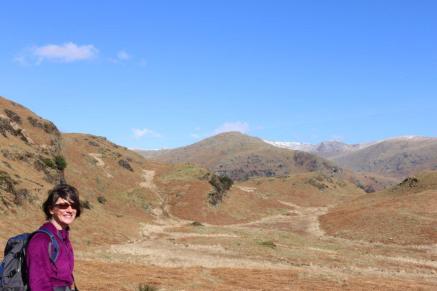
You say that you can often be found halfway up a mountain – have you reached the top of any? We’d love to see a picture or two!

IMG_0326

I have just returned from a week’s walking in the Lake District and, yes, I’m pleased to say that we reached the top of several. We experienced all four seasons in one week – sun, rain, hail and snow – so it was a mixed bag, but that’s only to be expected for March.

Thank you so much for your time, Jane. It is a privilege hosting you.

Jane’s website: www.jane-davis.co.uk

Facebook: https://www.facebook.com/jane.davis.54966

Twitter: @janedavisauthor

Posted in Authors | Tagged , , , , , , , , , , , , | Comments Off on Fiction as Made-up Truth

Not Quite Paradise

… But near enough.

Maanzoni – twenty odd miles south of Nairobi – is a true haven. We sat on the verandah of Anthea’s weekend hideaway, enjoying the cool breeze.

CIMG2003 (1024x575)

It is warm inside, where we went in the late evenings to sit beside a roaring fire which heats the water for our morning showers.

Intriguing solar devices are scattered around. You press down on them to produce light. Others, battery-operated, include candle imitators which flicker like real flames. But Anthea prefers using the warm glow of hurricane lamps.

CIMG1999 (1024x575)

I had an excellent night’s sleep on the very high bed reaching to the window-sill so I can lie there and look out onto Africa. Later, I asked Anthea if I couldn’t just have a little step, to help me onto the bed, as I’m rather short. She snorted her displeasure.

“No Mum. Steps are not allowed. How do you get onto the bed? Show me.”

I showed her, clambering awkwardly onto my stomach and almost wrenching my back in the process of turning over.

“Not like that, Mum. Look – this is how you do it…”

She posed with her back to the bed, then flung her legs up over her head and roly-polyed onto the mattress.

“You try it.”

Casting dignity to the winds, I tried it. And it worked a charm.

CIMG1998 (1024x575)

She cooked delicious meals for me, then left me for a week. Communing with nature. Soaking up the atmosphere. Every morning the animals passed through the not-quite-dried-up dam. A herd of fifty impala, zebra, giraffe, gazelles. The island is no longer an island because of the severe drought, but a family of hyaenas still live there, and if I’m quick at dusk and dawn, I catch a glimpse of them sneaking in and out.

CIMG2011 (1024x575)

The birds occupied most of my time, distracting me from writing my new novel and causing me to make daily forays into the bush by car and on foot, armed with binoculars. It is decades since I’ve seen the majestic kori bustard, or a secretary bird, that eater of snakes. I watched a goshawk make many fruitless tries to catch a partridge, then a rabbit. The silly bird fell at least three feet short at every dive.

CIMG2024 (1024x575)

But all is not completely well in Africa – we are in the real world, after all. Poachers snared an eland and got away with the meat. A hyaena ran amok and bit a night guard. And opportunist contractors anxious to make as much money as possible out of the booming Nairobi construction industry, send in lorries to devastate the private land and steal away the sand. Great gashes have been made in an area of pristine thorn bush. Tunnels undermine the roots. Heavy lorry tracks criss-cross the area.

But Nairobi – glittering, buoyant, chaotic and full of character has bounced back from catastrophe in true African fashion. It is amazing how, after the most serious of droughts, little grass shoots of green thrust upwards within hours. Kenya’s economy is set to boom in 2015 and you get the feeling it could be on the verge of something special. There is an air of expectation among the burgeoning middle class which is exploding in the ever expanding city.

How is it that the rest of the world doesn’t realise what is happening here?

Posted in Kenya, Travels | Tagged , , , , | 8 Comments

A 12th Century American City and A Novel’s Inspiration

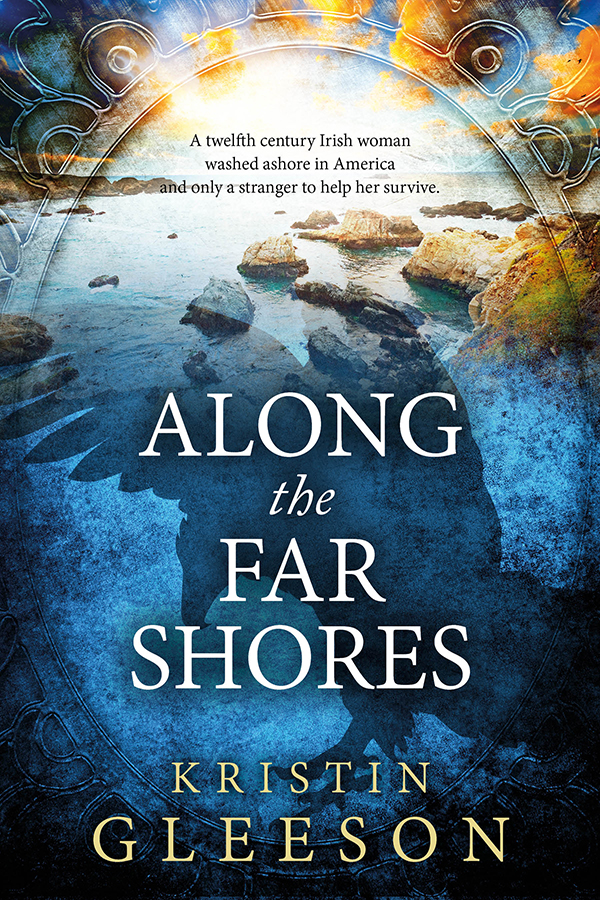
After a lengthy absence from the Internet, I am delighted to break the ice on my blog today, and welcome back a treasured friend, Kristin Gleeson, who introduces her latest novel, Along the Far Shores.

Along the Far Shores Cover MEDIUM WEB

Inspiration for novels can come from almost anywhere, and for Along the Far Shores the inspiration came from an unexpected place. When I was a children’s librarian outside of Philadelphia, years ago, I was doing some much needed weeding and I came across a book that told about the legend of Prince Madog of Wales’ voyage to America in 1170. It wasn’t a picture book, laid out in a beautifully illustrated manner; it was a nonfiction text that investigated the legend in order to substantiate its truth.

I was so intrigued I took it home and read it in a night.  I have to confess I’d never heard of the legend before this.  I’d read about Leif Ericson’s 11th century voyage along Labrador and that area, and of course I’d heard of the 6th century voyage of St. Brendan in the same general region. Madog’s voyage apparently ended up in Mobile Bay, in present day Alabama and he sailed up what is now called the Mad Dog River.  All very intriguing.

According to the legend, Prince Madog’s father, Owain ap Gruffydd ap Cynan, King of Gwynedd, died leaving ten sons from several different marriages.  In Welsh tradition the eldest wasn’t automatically the heir, so the throne was up for grabs.  Against this backdrop Prince Madog, a much younger son, decided to take to the seas.  Previously, he’d spent years sailing around France, Spain and into the Mediterranean, trading in various ports.  Navigation was still primitive in the 12th century, but his voyage west most likely began in Wales and across to France, down along the French coast and then westwards.  Eventually the strong ocean currents caught him up and it is speculated that they took him into the Canaries and then to what is now the Alabama and Florida coast. There he sailed along the coast and ended up in what we now call Mobile Bay, Alabama.  He landed, left a few men there, and returned to Wales to bring more colonists. Those left behind travelled upriver encountered friendly and unfriendly natives and built stone structures along the way, until they eventually settled in the Great Plains of the Midwest.

Few people, however, would know about the Mississippian culture that flourished there at this time and lasted for almost 900 years, c. 600-1500 A.D., and, like the more well-known Central and South American counterparts had great urban centres, some of them more populous than any city of Europe at the time.

It was along the fertile valleys of the Mississippi and its tributaries that these cities arose. Ocmulgee, Etowah, Cahokia, Moundville and Spiro were some of the biggest cities. Etowah and other cities traded many items and raw commodities like obsidian, gold, silver and conch shells.  Trade grew into important networks that linked much of the Midwest and East.  Such links offered many chances for sharing and improving skills, acquiring or modifying languages, religious and cultural practices.

Etowah

Etowah, which features in the novel, was located in north central Georgia, and was one of the largest cities of the Mississippian culture. Its remains are still evident, today. Surrounded by a moat and a bastioned wooden palisade it had six earthen mounds that loomed over the city. The three largest mounds were grouped around a large plaza, the most central one rising 61 feet with a base that covered about 3 acres.  Its flattened top extended to about ¾ size of a football field and commanded an impressive view of the surrounding plain.   A second plaza, paved with clay was to the east and had a ramp that extended from the plaza to the summit of the first mound.

In later centuries a small elite, The Nobles/Honoured Men, lived on top of the mounds near to the all-important temple.  Their houses were colourfully painted and decorated with elaborate designs and housed richly carved items.  The commoners living in the plains below the nobles dubbed “the Stinkards.”  The Great Sun was the leader and his relatives, known as Suns, held the city’s administrative positions.  The political dominance of this elite group usually extended beyond the city to the surrounding areas, where lesser chiefs ruled small towns.  All members of the region and the city were obligated to send tribute to the Great Sun periodically.  Once the Great Sun died, this strong regional network often fragmented if there wasn’t a strong person to replace him.

The novel seemed a wonderful opportunity to bring out this relatively unknown period and culture and one of Madog’s passengers, an Irish woman and a Native American man as perfect vehicles to explore the interaction of two widely differing cultures.

Links: www.kristingleeson.com

http://www.amazon.com/Along-Far-Shores-Kristin-Gleeson/dp/B00PSOVZU2/ref=sr_1_1_twi_2?ie=UTF8&qid=1426241771&sr=8-1&keywords=Along+the+Far+Shores

http://www.amazon.co.uk/Along-Far-Shores-Kristin-Gleeson-ebook/dp/B00PSOVZU2/ref=sr_1_1?ie=UTF8&qid=1426242671&sr=8-1&keywords=Along+the+Far+Shores

Posted in Authors | Tagged , , , | Comments Off on A 12th Century American City and A Novel’s Inspiration

Life Ain’t No Bed of Roses

John Holt’s meanderings – they make me want to laugh and cry at the same time. Welcome again, John, for my final author spot before I hike off to sunny Africa until the spring!

john holt books

Once again my great friend Jane has done me the great honour of featuring me on her web page. The last time she actually gave me a topic to write about, “Challenges”. That made things a little easier. This time, however, she just took me to the deep end and threw me in. No life jacket, no life belt, and me a non-swimmer. “Write what you like,” she says. “Just get on with it.”

So what to write about? My views on world affairs perhaps, that should be good for seventeen words or thereabouts. “Looking at what is happening in the world I would say that we are in big trouble.”

So much for world affairs, so what’s next on the agenda, global warming maybe? No, it’s already been done. Okay, what about life itself? Now there’s a topic and a half. Surely I can manage 1000 words on such a vast subject, shouldn’t be too difficult.

Well firstly let me say that certainly life ain’t no bed of roses, that’s for sure. It’s no fairy tale is it? You know the kind of thing I mean. Once upon a time there was a beautiful princess. One day she met a frog. She picked it up and kissed it. It suddenly became a handsome prince. They were married and lived happily ever after. Or what about the story of Cinders, who does go to the ball wearing glass slippers. Incidentally have you ever tried dancing wearing a pair of glass slippers? I haven’t, but I can imagine it would be quite uncomfortable. A decent pair of trainers might have been more suitable. They might not have gone with the silver sequined ball gown I know, but they would have been much easier on her feet. But I digress. Let’s get back to Cinders at the ball. She’s having a great time, boogying on down, when the clock strikes twelve. All hell lets loose, pandemonium. In her panic to get out of the palace she carelessly loses a shoe, or perhaps because of the discomfort, it was deliberate, who knows. Whatever, she eventually ends up with a prince. Once again they get married and live happily ever after. Nice work if you can get it, I say, but just as well because the Department of Works and Pensions was just about to stop her benefit payments.

So much for fairy tales, but life isn’t like that is it?  No, I’m not just talking about the frog turning into a prince either. We don’t all have a fairy godmother watching over us. And there aren’t that many princes hanging around, looking for glass slippers. No, what I mean is that life isn’t just a straight line linking someone’s birth and their death. It’s not that simple. Along the way there are many twists and turns that may (okay, substitute will) cause complications. Our road through life won’t be a nice smooth path. More like the M25 I would say, or Interstate 5 in California (I know, I’ve driven on both of them). Full of twists and turns, pot holes here and there, road works, detours, and obstructions. There will be many problems to face. Money worries, health problems, family troubles – you name it, you’ll get it in spades.

There will be decisions to make, no end of decisions. Is this the right thing to do? What will happen if I do this rather than that? Will my decision affect others? Bound to I would say. No man (or woman) is an island. We all have a direct, or indirect, effect on everyone else.

There will be many crossroads along the way. Do I turn left, or right, or should I go straight on. Then, of course, there are all of those side routes that beckon us only for us to end up in a dead end. A road going nowhere and just a side track from where you wanted to be. The problem then, of course, is can you get back to where you were before you arrived at where you are, so that you can carry on to where you want to be. Sounds complicated I know – well it is. No one said that it would be easy. There’s never a Fairy Godmother around when you need one is there.

Of course that’s another interesting aspect to consider. Where are you going? I mean do you know for certain where you want to be, who you want to be, what you want to be? When I was eleven and just starting grammar school I wanted to be a doctor. A noble profession you might say, a worthy ambition, possibly. The only thing is I can’t stand the sight of blood, (especially mine), and I faint easily. Just right for a doctor, I don’t think. Needless to say, I changed my mind and eventually when I left school aged eighteen I became a Surveyor, thereby saving many a patient from additional suffering, and a fate worse than death.

We all make decisions which we later regret, or at least wish we had taken another route. How many times have you changed direction, changed your job, or moved house only to find that the grass wasn’t greener on the other side, and the lawn had as many bumps in it as before. Or perhaps we do in fact eventually take the right route but only after many false starts. Maybe the error was of our own making, or maybe we were influenced, for good or bad, by someone else. Maybe it wasn’t a person that was the influence. Perhaps it was a place, or an event, or a circumstance.

Of course life isn’t just about one thing anyway. Life is made up of numerous strands, events, people, places, and experiences, all playing a part. Maybe some of those places, people, events, were shown not to be that important in the grand scheme of things, but they happened anyway, and you can’t change that. Maybe you learned something from it, so maybe it wasn’t entirely wasted.

We don’t know what life has in store for us, what cards we will be dealt. What life is going to throw at us.  None of us are immune, and we will all have different ways in which to deal with things.

I guess all that I’m saying is that life isn’t like a fairy tale, although I hope all of you princesses out there eventually meet the prince of your dreams. And that all of you frogs turn into princes. And Cinders I hope you get to the ball and meet your prince. Oh, and don’t forget to invite me to the wedding.

Okay so that’s that done and dusted. It wasn’t so bad I guess. Just hope that you enjoyed it.  And how about taking a look at his books as well:

http://www.amazon.com/John-Holt/e/B003ERI7SI/ref=ntt_athr_dp_pel_pop_1

Posted in Authors | Tagged , , , , , , | 11 Comments

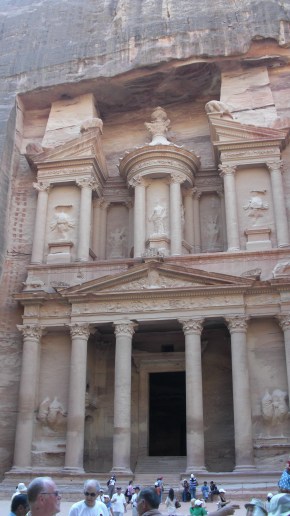
The Jewel of Jordan

We trudge for two and a half miles through the dramatic Siq, leading to the ancient Nabataean town of Petra. A narrow passage through the rock.

119 Horse and trap

Mohamed urges us from one talking point to another, barely waiting for stragglers before starting his spiel.

124 First sight of the Treasury

125 Pinker


The Treasury appears, rose-red between the rocks. Awesome. Photographs cannot do it justice… nor words describe.

The locals ply a great trade with horses, carriages, donkeys, mules and camels up and down the pathway, kicking up red dust, and creating a bustle with their bargaining.

128 Beyond the Treasury133 A veritable treasure

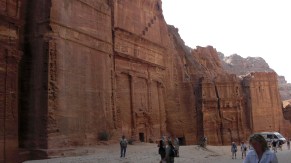
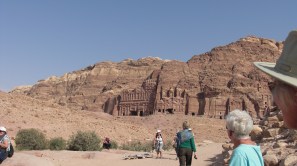
We come to the Theatre, and the Colonnaded Street. Intriguing caves, and rock tombs look down on us. I don’t have the energy to explore up there; I know I won’t be able to face the laborious uphill slope back to the entrance. Towards the end, a young lad latches onto me, offering his grey donkey for the return journey.

“Shouldn’t you be at school?” I ask.

No, school closed at 3 o’clock, he says, avoiding my eyes.

I negotiate 5 dinars for the ride back to the Treasury, but I need to rest, and he isn’t to harass me further.

He is true to his word, and waiting while I sip a cold drink.

130 Tombs and caves

“Would you like to ride up to the tombs?” he asks.

But my mind is set on reaching the end, and I do not have the energy for more bargaining.

He stops before we come to the Treasury. I have a feeling he needs to avoid the officials. I wander back up the Siq.

At last, the starting point for the horses. They come with the price of our entrance ticket, but our guide said they would expect a tip of 2 dinar, and he does not recommend them, as no hard hats are provided. I decide to take the risk, and succumb to the first approach. My grey animal has seen better days. A man leading a striking well-fed mule comes up and I am sorely tempted, but am not allowed to change my mind. We walk sedately up the loose rubble while others gallop past in clouds of dust.

Although I’d dearly love to climb to the Monastery tomorrow, I know I cannot.

Day off!

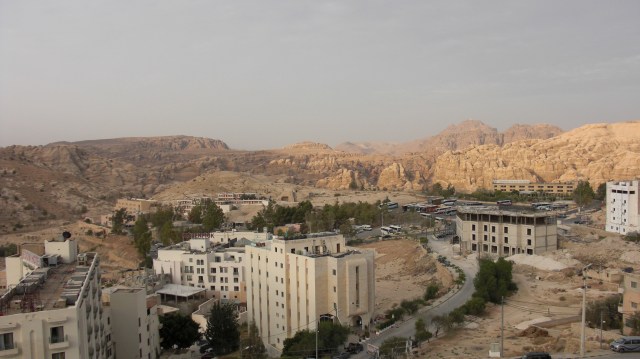
138 Sunrise over Petra

I go to the roof to watch the sun rise over the hills of Petra, and sit in the restaurant all morning, writing post cards. I saunter down to the Post Office. A couple of taxi drivers sit on plastic chairs overlooking the entrance to Petra, and offer me one.

118 Horses

I eat my lunch, and watch through binoculars as the horses are made to strut their stuff before the tourists.

148 In the cave 153 Immense Little Petra


We go on a special tour of Little Petra that afternoon. This Siq is only 300 metres long. We learn how the ancient aqueducts worked, and peer into an enormous cistern deep in the rock. We pause inside an important family chamber, with adjacent kitchens, which doubled as a tomb when the time came. Centered in the main room is a circle for a fire, there are ledges for sitting on, and stone hooks in the walls for hanging candles.

154 Descending

We climb precarious steps to marvel at a unique ceiling painting beautifully detailed, in soft colours. The rockscape is formed of weird rounded knobbles, the product of wind, sand and rain storms.

159 Looking over the field

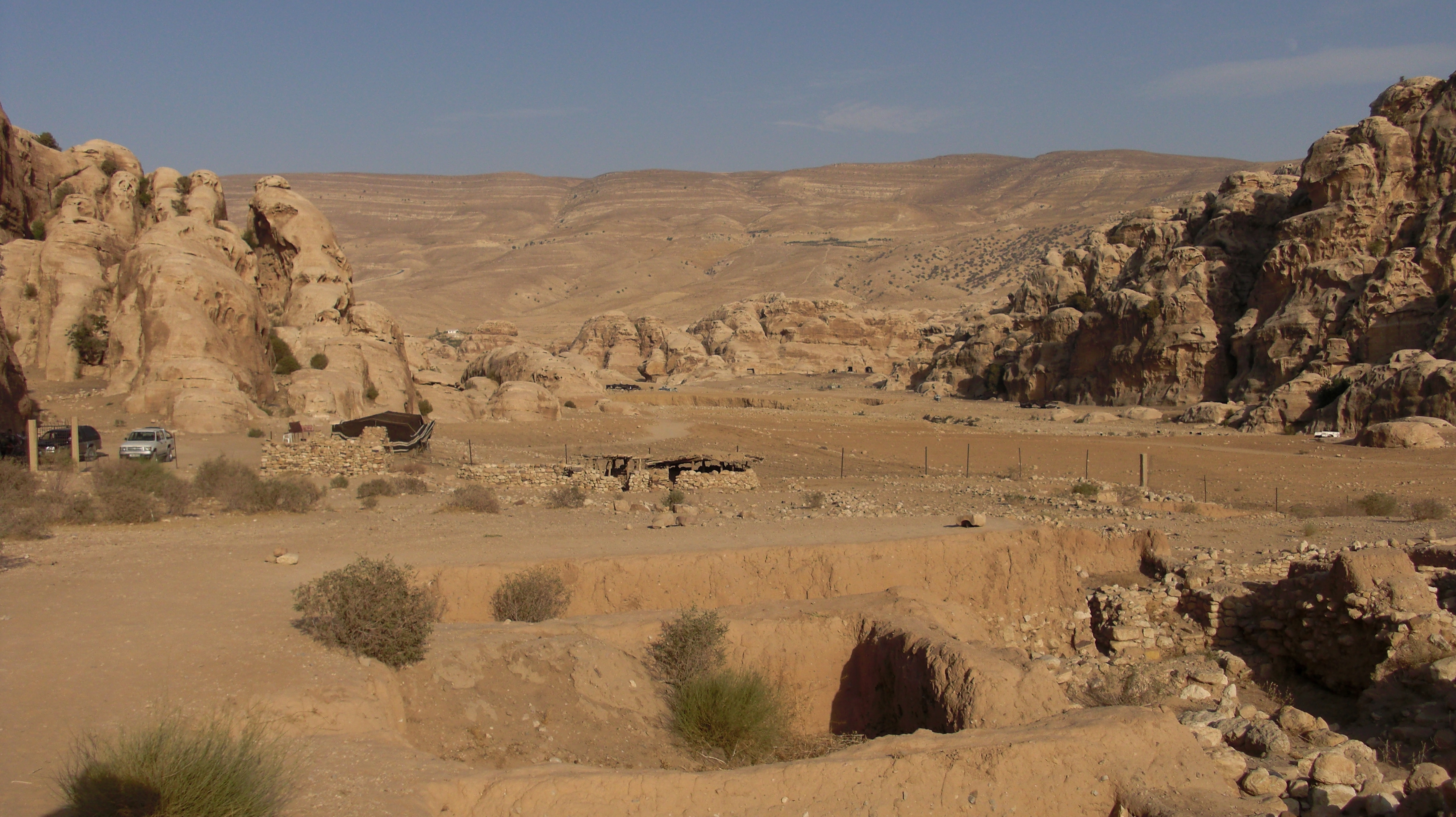
Old Petra, the Bayda Neolithic Village flourished around 7000 – 6500 BC, with some archaeological finds dating to the 10th millennia BC. It was a town of little people, for its stone rooms (in the foreground) are tiny. Beyond is a harrowed field, ready for planting barley when the winter rains come.

163 Having tea

161 Bedouin goats


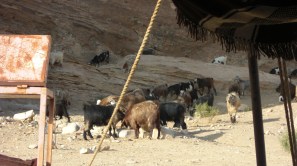
We enjoy sweet sage tea (the perfect rejuvenating refreshment) in a Bedouin tent with a shy elderly lady who, we are told, has countless children to care for. And I manage to catch a photo of some goats before she shushes them away.

155 Modern Moslim misses

I’ll leave you now – for I am off to hibernate in the sunny warmth of Kenya once again.

See you in the Spring!


Posted in Travels | Tagged , , , , , , , | 1 Comment

Writing for the Movies?

I am delighted to welcome seasoned author J.S. Watts, who shares something we’ve all been wondering about.

J.S.Watts website

You don’t have to be a scriptwriter to dream of writing for the cinema. Let me explain.

As a writer of both poetry and fiction I am frequently asked which I prefer writing: poetry or prose? (The answer, should you be interested, is both, equally). The follow up question is, almost inevitably, what is the difference between writing poetry and fiction? At which point I rattle on about stylistic and tonal differences, differing writing processes and the fact that, ultimately, the similarities outweigh the differences. I never mention the movies and I should, because, for me, that’s where the biggest difference is between poetry and prose.

When I write poetry I don’t spend my time daydreaming how it might get turned into a film – let’s face it, it ain’t never going to happen. Also, for me, a poem is a self-contained thing. When I write a poem I immerse myself within it: its words, its rhythms, images and narrative – all exist within and for the poem. The external sources and experiences I draw on serve to feed the poem. Basically, the poem is where it’s at.

Writing stories, whether shorts or novels, is different. It’s a more outwardly focused process with characters and story line at the centre of things. I become a teller of tales, conscious of my audience and conscious of other story-telling media – the cinema, for example.

Okay, let’s be honest, I would love to have a film made of one of my novels and there are precedents. Writers have become famous (and wealthy) by having their stories and books turned into a film. Who doesn’t want to see their story up there on the big screen? I know I fantasise about it. Indeed, during the process of writing I often see my story playing out for my inner eye as if it were already a film. I also find myself wondering who might play one or many of my characters if the film got made for real. And I don’t think I’m alone in this.

In my defence, visualising the story cinematically is a valid writing tool. I have to know and visualise my characters in order to describe them convincingly to my readers. If I can hang their physical image on a ready-made, off the peg actor, it fixes their image clearly in my head and makes the early stages of story writing that much easier.

Confession time: for my first novel, a dark fiction tale of myth and psychological shadows entitled “A Darker Moon”, I cast (only in my head, of course) my anti-hero, Abel, as the rather wonderful British actor Clive Owen. Yes, he would have had to wear brown contact lenses to get truly in to character, but otherwise, whenever I thought of Abel I saw Clive Owen. Then my delusions got the better of me and I dreamt of a big budget American blockbuster version. This involved transferring the story from England to the US (a small loss) and replacing Clive (as amazing as he would have been) with the tabula rasa non-pareil, Keanu Reeves. Moreover Keanu would not have had to wear contacts – his eyes are naturally the right colour for Abel.

Interestingly enough, I never mentally cast any of the other characters in the novel, but then Abel is the lynch pin of the book, so I guess I thought job done.

When it came to writing my second novel, “Witchlight”, a story of modern day witchcraft and magic, I went a step further and mentally cast at least four of my characters with major league British and American actors.

My main character, Holly, a diminutive but forceful woman, was played by either Holly Hunter (right name, right looks, right personality) or Anna Belnap (CSI New York – in case you were wondering). Clive Owen (I do like Clive Owen, you may have noticed) was recast as her love interest, Jake Wortham and Ninanna, a close relative of Holly’s, was played by a youthful Tippi Hedren or Nicole Kidman. For a long while I was uncertain whom the significant character Partridge Mayflower would be played by and realised, only after he had sadly left us, that he was really an early mid-life Robin Williams.

Fortunately, the benefit of casting your novels in your head, rather than for real, means that you can call on any actor, whether living or dead, at any stage of their career. It’s all pure fantasy after all. Except, well, if either Keanu or Clive was available and looking for a project to both fund and star in, I’d love to see “A Darker Moon” up there on the big screen. What do you say, guys?

J.S.Watts is a British writer who lives and writes in the flatlands of East Anglia. Her poetry, short stories and reviews appear in a diversity of publications in Britain, Canada, Australia and the States. Her debut poetry collection, “Cats and Other Myths” and subsequent multi-award nominated poetry pamphlet, “Songs of Steelyard Sue” are published by Lapwing Publications. Her dark fiction novel, “A Darker Moon” is published in the UK and the US by Vagabondage Press. Her second novel, “Witchlight” is due out from Vagabondage in Spring 2015. You can find her on Facebook at http://www.facebook.com/J.S.Watts.page or on her website http://www.jswatts.co.uk

Posted in Authors | Tagged , , , , , , , | 3 Comments