The Scarlet Thread

It’s my turn, today, to join my fellow Crooked Cat authors in providing an item for our more-than-a-month-long extravaganza of FREE short stories, non- fiction articles and poems.

This “Christmas with Crooked Cat” contribution contains experiences in the Holy Land which left me with mixed feelings. Not wanting to be overwhelmed by religion, I went with a secular group.
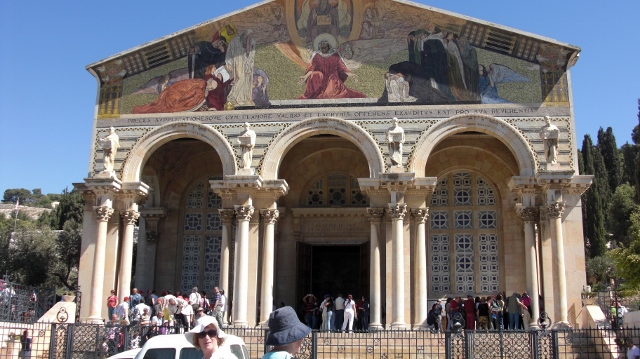
15 Church of Gethsemane (640x359)

We emerge from our hotel on the far side of the Kidron Valley; our first stop is the Garden of Gethsemane, and I detach myself from the group to sit in the Church, listening to familiar hymns while English pilgrims hold a service. I join in, but am called by the others before the service ends.

We walk across the valley and up towards St. Stephen’s Gate (The Lion Gate), which leads to the Muslim quarter. There is a pile of stones on the right. I think of Paul, guarding the clothes of those who had stoned Stephen, the first Christian martyr. The road to Damascus, where Paul was converted, isn’t on our itinerary.

The following day we go to Bethlehem on the West Bank, passing smoothly through the checkpoints and the wall, with its graffiti. It is much quieter than the Israeli side; shops are boarded up and the streets are deserted. We pass some grand houses and many tourist buses, for the Israelis and the Palestinians are at “peace” now. Our guide jokes that in peace time, life is hectic and tense because of all the tourists; when they are at war, the people live a quieter life.
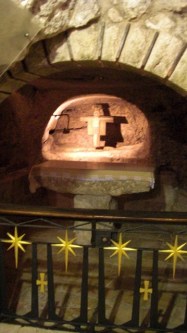
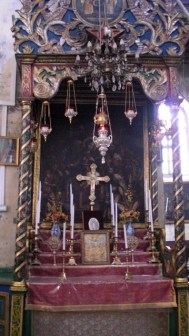
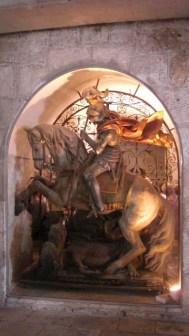
41 Shrine (359x640)43 Another altar (359x640)44 Beautiful statue (359x640)

The Church of the Nativity is full of scaffolding. There are areas for the different religious sects, each with their own style of chapel. People quietly go about their private prayers, walking round, or just sitting and looking. We cannot get near the alleged spot where Christ was born, nor do I glimpse it through the “keyhole” in a wooden door from the other side (somebody is blocking my view). But away from this main attraction, it is a restful, holy place.

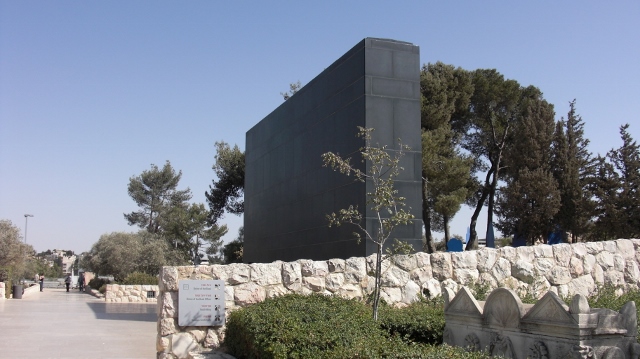
49 White dome (640x359)50 At the Museum (640x359)

Back in Jerusalem, the Museum displays a model of the ancient city in the blazing sun near the entrance. I spend an hour under the white (good) “Shrine of the Book” dome learning about the Qumran Scrolls, and on a lower level, the Dead Sea Scrolls. Time whizzes by. A black (evil) wall stands in stark opposition to the dome.

My novella I Lift Up My Eyes is written round a visit to the Holy Land; here is an extract:

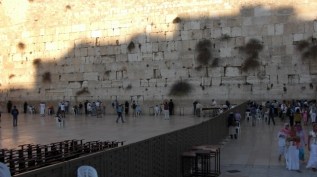
“In the Jewish quarter, away from the madding crowd, austere black-clad figures, their tight curls showing below top hats, glided down the stone pathway. A graphic mural depicted Jerusalem past and present, the atmosphere was hushed and reverent. (Ann) stepped into the sunshine and descended towards the western wall. A sabra in dull green and brown camouflage lounged against the wall, self-contained and aloof. Their eyes met and Ann recoiled at the animosity of the gaze. The face was young and fresh, how could it harbour such hatred?

Ann tweaked at the flowing veil draped over her head and shoulders against the sun. Her blouse had long sleeves, she wasn’t indecent, surely? Other ladies in her group were showing more flesh.

A mass of black figures in top hats converged on the Wailing Wall far below. Some earnest young Jews accosted her and she responded, politely accepting their blessing in the form of muttered prayers. She glanced at their faces. They must still be teenagers. Their voices were friendly, almost pleading. She didn’t understand what they were saying.

One of them gently took her hand and produced a thin scarlet thread. With polite enquiry he mimed tying it round her wrist. Was this some sort of ritual? Ann shrugged. They seemed friendly enough, so she offered her wrist. Two more came close. Did they want money? She had to catch up with her group. Ann fumbled at her bum bag, and they crowded round her like greedy ravens, chattering urgently in their strange language. She only had a few coins left, and didn’t feel like giving them a note. Her steps quickened. They trotted after her, raising their voices. What was this ritual? Did they think because she had the thread round her wrist, she owed them something?

An elderly woman squatted above the pathway surrounded by baskets. She called out at the three youths, castigating them roundly, and they fell back. Sighing with relief, Ann paused in gratitude; the woman waited expectantly. Ann had no desire to go near those youths again. She fumbled in her purse and drew out a handful of coins, placing them in the woman’s palm. There was a gasp of disappointment. Ann sensed the youths starting back towards her. She fled down the hill. The scarlet thread was still fastened round her wrist. She tore at it as she ran, trying to get it off. It was strong and wouldn’t break. She couldn’t get it over her hand.

“I can’t take this wretched thing off!” she said as she caught up with her guide. “He put it round my wrist – what does it signify?”

She wrenched again at the thread, trying to force it over her hand, which was going red with the pressure. She had to get rid of it…

“Here, I’ve got a pair of scissors.”

What a relief to be free of this symbol of she knew not what. She threw it into the dust.”
34 western wall (640x359)


Posted in I Lift Up My Eyes, Travels | Tagged , , , , , , , , , , , , , | 3 Comments

O Israel!

Let’s change track now, to a topical venue. With the coming of Christmas, this little part of the world is the focus of millions of people around our shrinking globe.

9 Dome of the Rock from Mt. of Olives

I went there in 2010, a place I’d always wanted to visit. And when I finally came to Jerusalem I was astounded, shocked, bewildered.

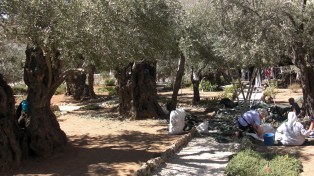
13 Garden of Gethsemane

The Garden of Gethsemane is tiny. Inside, a group of people pick and grade the olives. I wander beside the Garden, marvelling at the ancient twisted olive trees, wondering at the smallness of it, picturing Jesus in his agony. Where was it that he left his disciples to “watch and pray”? Where did he ask for the cup to be taken from him?

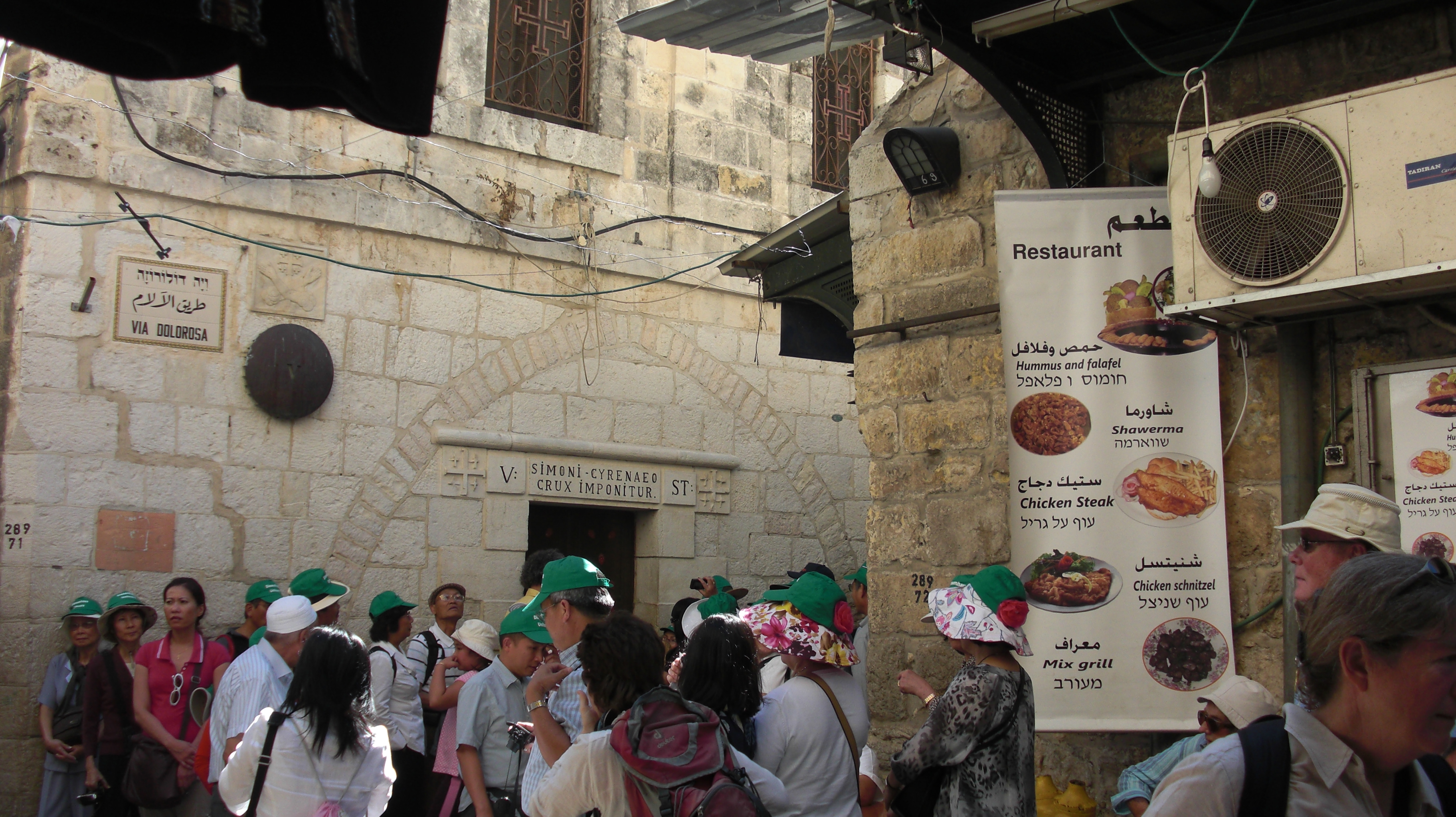
26 Simon of Cyrene

Chapels of many differing denominations line the Via Dolorosa; the devout try to pray in the melee; some groups wearing green caps stand out.

27 Becoming crowded

It becomes more and more crowded, diverse and commercial as we progress, probably, rather like it was in Jesus’ time; a medley of nations and faiths. Vibrant traders are at every turn, selling imaginative trinkets. Prices are exorbitant.

No wonder Jesus wept…

28 Coptic Monastery


Then we arrive in the Christian quarter. Blessed peace and quiet. An Ethiopian monk emerges from a rounded clay dwelling and pads by. We pause to savour the intricate decorations in a tiny Coptic church, passing a mute invitation for offerings, before descending some steps, which bring us back into the cacophony of commercial Christianity. The square of the Church of the Holy Sepulchre.


I’ve written a little novella round my visit, it is called “I Lift Up My Eyes”. Here is an extract:

Jerusalem. Ann walked up the Via Dolorosa, among a medley of nations and faiths going about their spiritual business. With deadpan faces, vendors shamelessly extorted every penny from their customers as they offered holy relics and exotic goods.

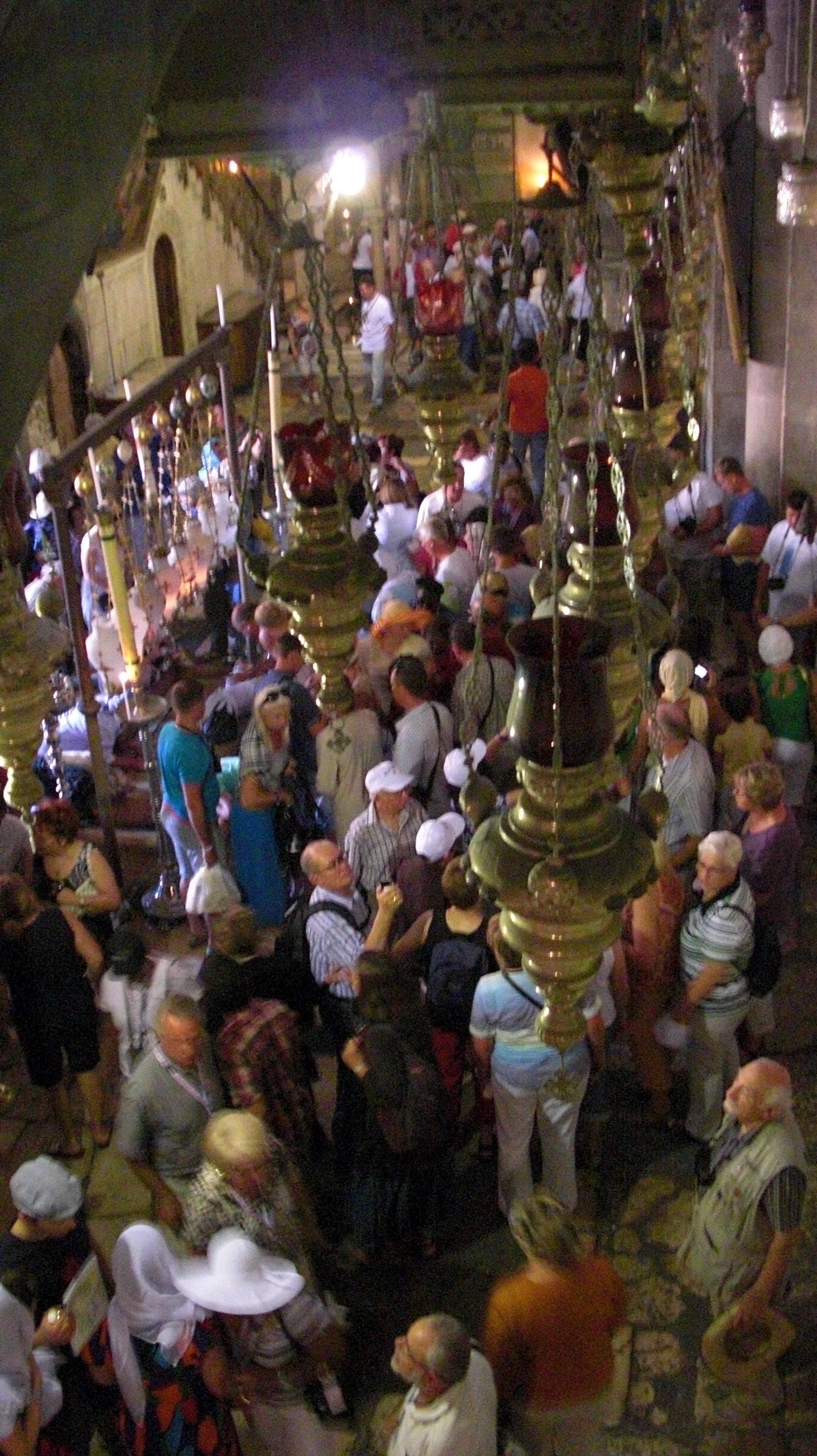
The Church of the Holy Sepulchre was a vibrant mass of people clothed in the colours of all nations. Several clergy led their groups in prayer, others watched from the side. Tour guides waving banners pushed through the throng to make way for their followers, calling in many languages over the clamour as they shouted their spiel. Winding queues of humanity waited to perform obeisance, obliterating the holiness of the surroundings through sheer force of numbers.

31 Crowded pilgrims

Ann climbed to a higher level, her heart a stone as her detached gaze took in the scene, from the golden glory of the high dome to the cacophony below. What was she – a watcher? She certainly felt no desire to join the endless queues to kiss the embalming stone, or pay homage at the traditional site of the crucifixion. Or even to see Jesus’s traditional burial place. Her legs were aching, and there was no place to sit.

Was it like this in Jesus’s day? It must have been. No wonder he wept.

29 The Holy Sepulchre

She turned away with a final look at the dome, and walked to a corner of the outside courtyard. She climbed up worn stone steps and emerged into a different world.

A musty Coptic Church held jaded relics of grandeur, yet there was calmness, dignity and quiet reverence here. She savoured the blessed peace and dropped a coin among the meagre offerings. A woman carrying a jar of water on her head regarded her with polite curiosity.

“Not many visitors come this way,” said an Ethiopian monk, who emerged from a round clay dwelling and padded up to her. He guided her through the small courtyard and Ann nodded in appreciation before allowing herself to be led through a stone passageway and back to the melee below.

More next time…

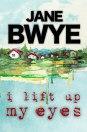
cover1 (419x640)


You can read about I Lift Up My Eyes HERE and buy it on Amazon. In fact, both of my books are on bargain sale if you BUY NOW!


Posted in I Lift Up My Eyes, Travels | Tagged , , , , , , , | Comments Off on O Israel!

Like Literary Russian Dolls

It gives me great pleasure to welcome fellow Crooked Cat author Mark Patton once again to my place.  This is such an interesting piece which describes Christmas through the Ages covered by his latest book, Omphalos.  I enjoyed it greatly, and you can find my review of it HERE.

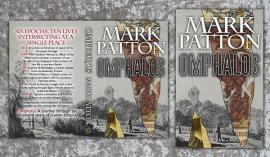
Omphalos Cover 2

Around the time of a book launch, an author inevitably does a great many guest-posts, and I was wondering what to write about here, so I was glad when Jane suggested that I say something about how the characters in my novel might have celebrated Christmas. Omphalos is made up of six stories, each set in a different time period, nested one inside the other like literary Russian dolls.

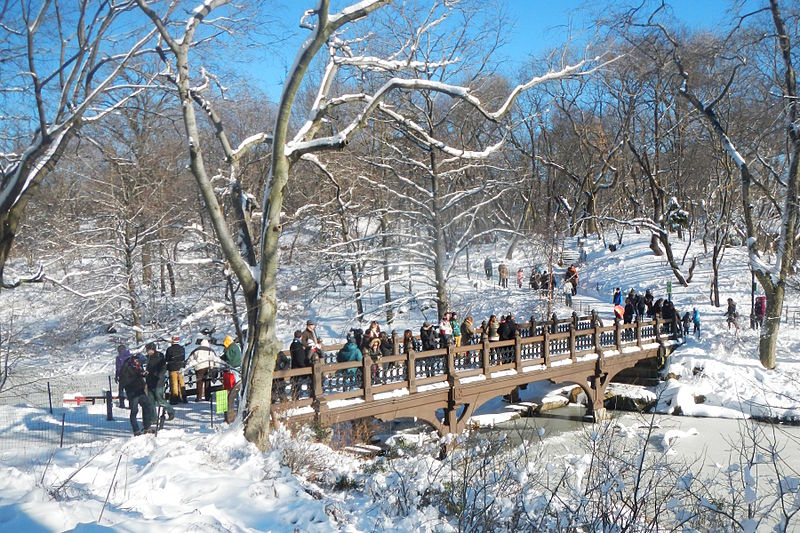
Central Park snow

“Central Park Snow” – Central Park in the snow. Photo: Jim.henderson (image is in the Public Domain).

The first story, “Touching Souls,” is set in 2013, and the central characters, Al and Naomi, would not celebrate Christmas as such, since they are Jewish. They would have celebrated Rosh Hashanah in the autumn, marking both the creation of the world and the beginning of the new year. They are also Americans, however, living in New York, a city in which most people cheerfully join in one another’s festivals, and Christmas is hard to ignore.

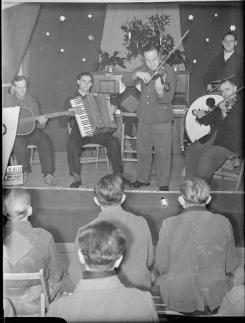
German prisoners in Britain 2

“German prisoners in Britain 2” – German prisoners-of-war performing in a concert. Photo: Imperial War Museum, non-commercial license, D26720.


The second story, “The Spirit of the Times,” is set during and immediately after the Second World War. There would have been precious little Christmas cheer going around anywhere in Europe in 1945, and certainly not in Jersey, where my central character, Friedrich Werner, is serving with the German army. The island had been cut off from the outside world for six months, pushing both the islanders and their German occupiers to the point of near-starvation. His wife and children, meanwhile, are spending much of their Christmas in air-raid shelters, as the bombs rain down on Berlin. The Christmas of 1946 was very different. Frierdrich, now a prisoner-of-war in Wales, writes to his wife: “My Christmas was good. Those of us who wished were allowed to attend a candle-lit service at the local church. I led a small choir singing Stille Nacht. The local congregation seemed to appreciate it …” (we know that this did, in fact, happen).

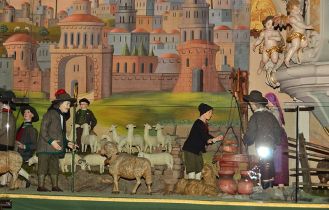
Nativity Scene Ried in Zimmertal

“Nativity Scene Ried in Zimmertal” – 18th Century nativity scene (these figures are from the Tyrol, but similar figures could be found in France). Photo: Herzi Pinki (licensed under CCA).


The third story, “The Infinite Labyrinth,” is set at the end of the 18th Century. Suzanne de Beaubigny, a Catholic refugee in a Protestant community, is initially shocked to receive an invitation to a ball during Advent. She had grown up thinking of Lent as a time for fasting and penitence in advance of the Christmas celebrations, although she does not allow this to interfere with her enjoyment of the ball when it happens. There would have been no Christmas trees, but she might have heard “The Holly and the Ivy” being sung (it dates to 1710), and homes would have been decked out with boughs. One thing that she would have been familiar with is the Christmas crib, by this time fairly common across Europe.

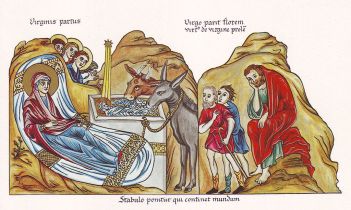
Nativity Hortus Deliciarum

“Nativity Hortus Deliciarum” – 12th Century Nativity scene, from the Hortus Deliciarum of Herrard of Landsberg (Image is in the Public Domain).


The fourth story, “Jerusalem,” is set in the 16th Century, and the fifth, “The Path of Stars,” is set in the Twelfth Century. Perhaps surprisingly, the characters in these two stories would have celebrated Christmas (the word itself goes back to the 11th Century) in very much the same way. In both cases, their experience would have been dominated by religious observance, attending mass on Christmas Day itself, but also on 26th December (St Stephen’s Day), 27th December (Day of St John the Baptist), 28th December (Day of the Holy Innocents) and 1st January (Solemnity of Mary, Mother of God). Only after all of these solemnities could the feasting begin, on Twelfth Night. One of my 12th Century characters, Guillaume Bisson (a knight’s steward), recalls one of these evenings: “More distant memories flood back to him. A winter’s night in the great hall at Rozel, Jéhan the dwarf telling ghost stories. He had spoken of an apparition, a hanged woman who spoke, but whose words were difficult to make out …” Gifts were more likely to be exchanged at the Feast of the Epiphany (19th January, since they would be using the Julian, not our Gregorian calendar), recalling those brought by the Magi.

The sixth story, “The Song of Strangers,” is set in 4000 BC, so clearly there could be no Christmas. Instead, the Winter Solstice (21st/22nd December) was the focus of ritual activity, marking both the shortest day of the year, and the point at which the movement of the sun along the horizon changes direction. Many ceremonial sites of the Neolithic period are aligned towards either the rising or the setting point of the sun at the solstices. Some years ago I visited Maes Howe in Orkney for the Winter Solstice sunset, but saw nothing, because the sky was cloudy. A few years later, however, I was privileged to witness the Winter Solstice sunrise at Newgrange in Ireland, the first rays of sunlight shining directly into the passage of the 5000 year-old tomb, and lighting up the carvings on the wall.

Merry Christmas, Frohe Weihnacten, Joyeux Noel and Feliz Gabonetako to one and all!

MarkPatton


Mark Patton’s novels, Undreamed Shores, An Accidental King and Omphalos, are published by Crooked Cat Publications, and can be purchased from www.amazon.co.uk or www.amazon.com. He blogs regularly on aspects of history and historical fiction at http://mark-patton.blogspot.co.uk.

Posted in Authors | Tagged , , , , , , , , , | Comments Off on Like Literary Russian Dolls

One Lovely Blog Award!

I am honoured to be nominated by the distinguished Nancy Jardine for the ‘One Lovely Blog Award’.

The award recognizes bloggers who share their story or thoughts in a “lovely” manner, giving them recognition and helping them reach more viewers.

So, first, thank you Nancy Jardine for this lovely compliment and opportunity, which I am delighted to accept. Here’s her lovely BLOG  which I’m sure you’ll enjoy.

In order to “accept” the award the nominated blogger must follow several guidelines.

SEVEN THINGS ABOUT ME

1. First and foremost, I am a mother, a grandmother – and oh when am I going to become a great-grandmother? My six children are scattered around Australia, Africa and the UK. Now that the seven grandkids are growing up and beginning to travel, I see more of them, and look forward to family reunions – which are never 100% complete. But then ecstasy when twinged with sadness is part of living, I suppose.

2. Travelling is my second love. Financial constraints caused a long delay before I discovered the delights of visiting new places. But I completed a 10 month Round-The-World walkabout when I was over 60. Come with me on my adventures by following the action! https://jbwye.com/category/travels/

img118

3. More things about me? I am a loner – I love wandering in wide open spaces all by myself, savouring the freedom of the wind and drinking in the beauty of nature. I come from Africa, after all! (And click on my book this week to get it at a throwaway price)

Breath of Africa cover pic

4. Reading is my favourite pastime. During the long months of my several pregnancies, I discovered I could knit baby woollies AND read at the same time. No matter that sometimes sleeves would end up of different lengths, because I’ve been too absorbed in a book to pay attention to my knitting. I had at last found a way NOT to feel guilty about indulging my passion for other people’s stories; and my children were never short of sweaters.

5. But I am also an industrious person, I suppose. I always want to be doing something – even if it’s only dreaming, if that makes sense. I live life to the full. I limit myself to serving on two Committees at a time. I still play tennis, twice a week and avidly follow Andy Murray and Roger Federer – I’ve seen them in the flesh, too.

6. The arts have always interested me; I wanted to be a ballet dancer before my thighs grew too big. Since coming to live in the UK I have gone to countless concerts, operas and plays. I sing in a choir (earlier, I belonged to three different choirs, but I’ve become more sensible now). I don’t know where this fits in, but I also play duplicate bridge: it keeps my brain working, and the people I play with are delightful.

7. But over and beyond and through all this, I am blessed and blessed again. My God is my supporter and my friend; my rock and my guide. I live at the foot of the South Downs, and every day, I Lift Up My Eyes!!

cover1 (419x640)

This little novella also has much of me in it … it will only take you a couple of hours to read, and there’s a special offer on it : you can buy it HERE:

And now, in no particular order, I NOMINATE two people for THE LOVELY BLOG AWARD!

AJ Vosse (I call him AJ)  is a good virtual friend of mine from Authonomy days, who has reached an extraordinary milestone in his blogging career. As “Ouchmybackhurts” he has blogged every single day for over three years, and I’ve followed him most of the way. His style is so natural and his photographs are amazing. Take a look for yourselves:  HERE.

Ailsa Abraham. Magical Ailsa, has been my guest here many times, and her blog never fails to delight me, whichever personality she cares to express. Meet her HERE at “The Bingergread Cottage” and join in the fun: you never know what’s coming next, and she can say the most outrageous things in the most amusing ways.

The Rules for accepting the Award(s):

  1. Thank and link back to the awesome person who nominated you.
  2. Add the One Lovely Blog Award logo to your post and/or blog.
  3. Share 7 things about yourself.
  4. Nominate up to 15 other bloggers and comment on their blogs to let them know.


Posted in Authors, Breath of Africa, I Lift Up My Eyes | Tagged , , , , , , | 2 Comments

Faction or Fiction

What an interesting piece this is, by an author I have admired since meeting her on Authonomy several years ago! Please meet Margaret Callow, who has recently signed a multi-book deal for her historical novels with publisher Holland House Books.

My Photo

There have been debates before and doubtless more to come about faction and its place in literature. It is clear there are two camps divided on this subject and as someone who writes historical fiction, I should like to venture a few thoughts.

The blend of fact and fiction has been used many times since the beginning of creative writing and the word faction leaves no doubt as to what it alludes to. I like to describe it as a skeleton of fact with fiction providing flesh on the bones. However you describe it, it seems faction has grown in popularity.

Some have argued that historical fiction “contaminates historical understanding,” others put forward the notion that faction is the result of a poor imagination on the part of the novelist. Naturally these claims are vigorously refuted by those who think otherwise.

My interest in social history was fired even more by the discovery that my great, great grandmother was a pauper inmate in an Union workhouse in 1900. It was when I was reading the names on the Register for that time that I thought how many stories were waiting to be told. It was then, I decided it was important to me to give people who had gone before a voice so that maybe they would finally be acknowledged.

Whilst the likes of Wat Tyler, George Loveless and Robert Kett are remembered in history as men who led risings in England which gave us some of the freedoms which we enjoy today, it was surely the support and sacrifice of ordinary folk who walked with them and fought with them which made victory possible.

However some point out there are pitfalls in writing historical fiction particularly if the novelist is presenting a major historical character for the reader has no idea what is known fact and what is the product of the writer’s imagination. Some have observed that a novelist strays into “dangerous territory” when they fictionalize real people however imaginative their creation might be.

None of this was in my mind when I wrote the first of my trilogy. What has occurred to me since is that historical fiction set further back in our past makes the issue less pressing if only because of the lack of accurate material. Here diligent research is key, but finding relevant accounts of the period is still not without problems as I found with two of my books set in 1381 and 1450 where facts were few and filling in the blanks relied on considerable amounts of imagination.

Perhaps it is important to change the names of the real historical characters so that the reader is left in no doubt that the version they are reading is simply not reality. Would this not also give the writer the freedom to take the reader on a bolder journey without any fear? Certainly one could go places out of bounds for historians.

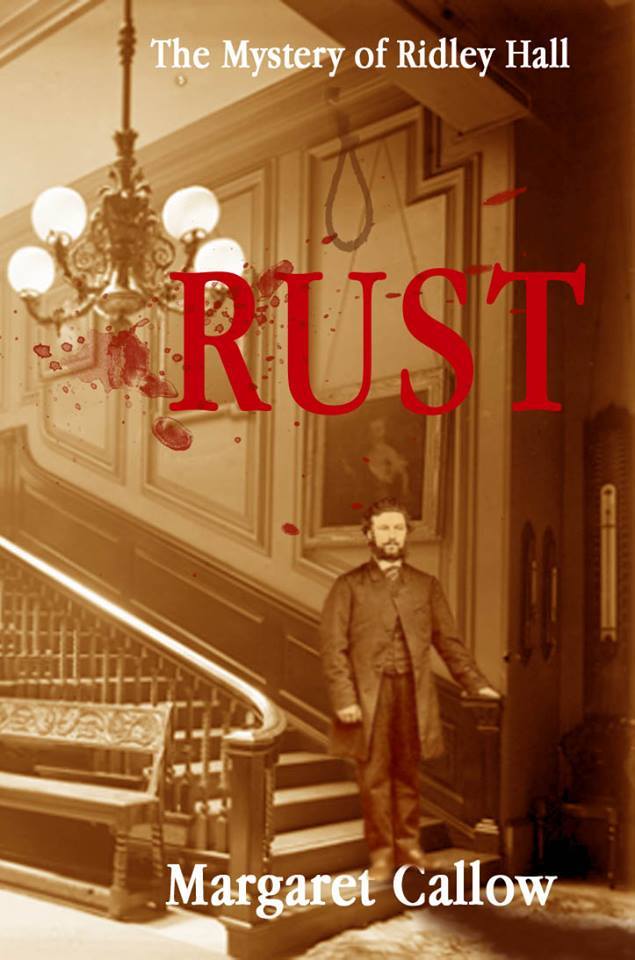
Margaret Callow book

So that brings me to my historical crime novel ‘Rust’ which is due for release on March 19th by Holland House Books. Although it is based on a true story, I have made a point of using fictitious names. Whilst the dreadful murders appalled people far away from Norfolk, it is essentially a crime of the county and especially in and around the city of Norwich in 1848.   This means there are likely to be descendants of the families involved still living in the area. I was anxious not to cause any concern or offence particularly since in places the narrative is much imagined! However it can work both ways and as if to underline my decision, I did in fact receive a letter whilst I was writing the book. A local lady wrote to tell me her family was once in possession of a certain mask attributed to the murderer and this had led them to believe he was a highwayman. She had heard I was writing the story and was much amused when I told her the man in question was not quite who they thought he was. The mask had been presented to Norwich Castle museum some years ago.

Yes, all historical facts must be meticulously researched, but if both the writing and narrative are good and you can offer your reader the very best of an historical adventure which is fast paced and vivid, what more could anyone want? After all, Hilary Mantel, CC Humphreys and Phillipa Gregory have all done a great job with historical fact which is generously laced with fiction. So it is here that I leave you to ponder. . .

You can find Margaret’s blog here: http://margaretcallow.wix.com/mmc-author

Posted in Authors | Tagged , , , , , , , , , , | 10 Comments

The Only Tourist

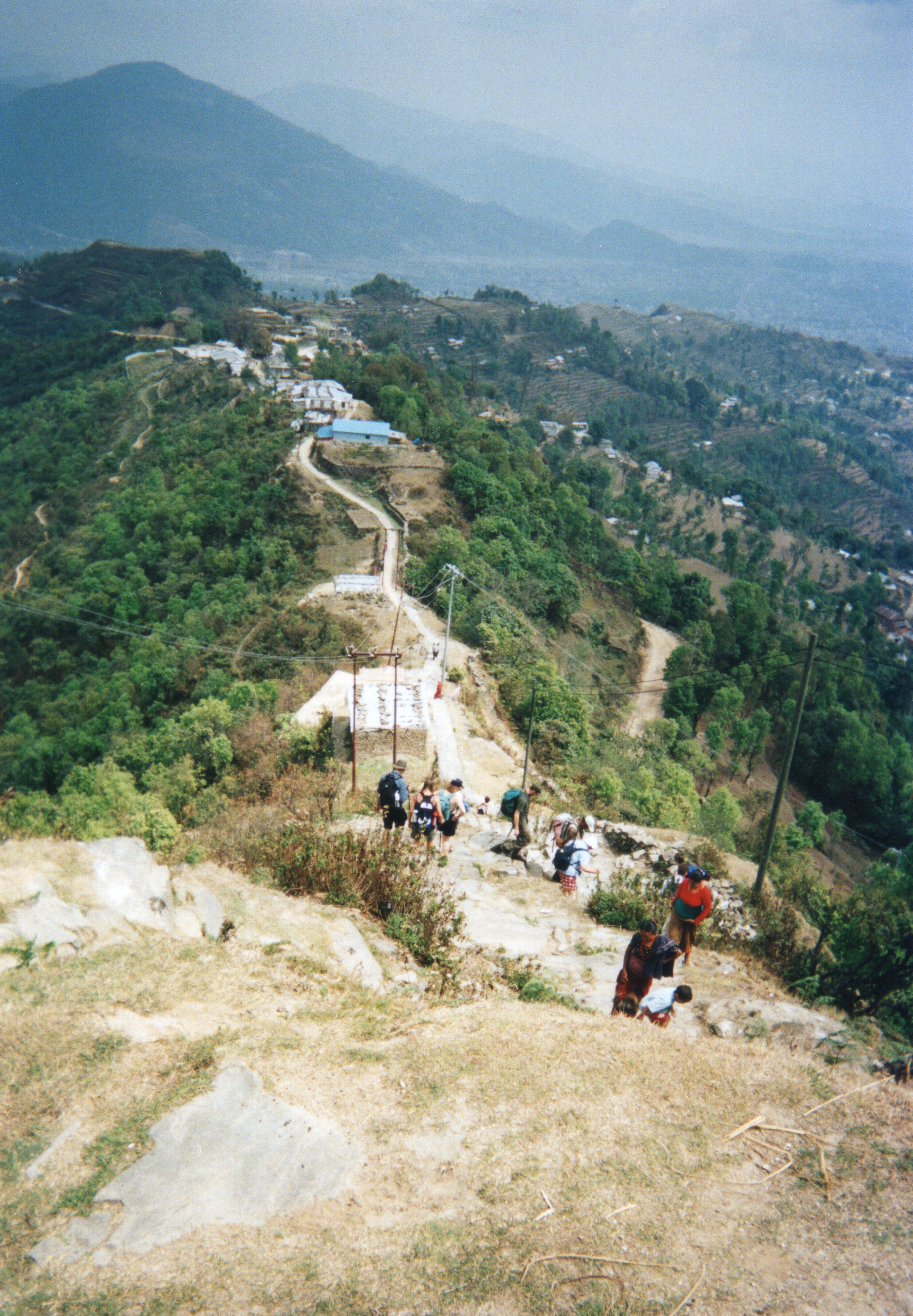
Morning, and still no mountains. Despite the cool weather, I perspire profusely during the day and change my shirt every lunch time. My solar hat, while causing the usual curiosity especially from the children, keeps my brow dry. When I remove it, sweat drips continuously down my face.

We walk down more steep steps, along more dusty winding paths, avoiding some slightly aggressive buffalo.  Friendly people everywhere.  An English teacher stops us to ask for donations towards a school toilet. I suspect they’ve been doing this for years; I remember a friend from Kenya telling me about donating towards a school toilet four years ago. Trinket stalls are at almost every corner, and we are subject to some very aggressive selling. I buy a colourful cotton tablecloth, only to discover it is made in India.  (However the following day I treat myself to a genuine 200 knot Tibetan carpet made in Pokhara Tibetan village).

After four hours we pause at a roadside dive and are entertained by two gentlemen high on drugs while we eat our lunch. The trek food, Tibetan in style, is excellent.  They pile our plates with deliciously spiced vegetables, sauces, dahl, rice, local breads, salads, meat;  breakfasts are oat or rice porridge, muesli, egg, toast, honey, marmalade, tea, coffee, chocolate and fruit.  They boil all drinking water and I have no stomach problems at all, although some of the others suffer, especially in the latter days of the tour.

img116

Another 45 minutes’ walk to meet our bus and wind back down to Pokhara. We gather in the garden of the Tibet Resort for a traditional trek conclusion.  Our camp helpers and Sherpas – 35 people in all – sit in rows on the grass facing the 16 of us while Marion gives a little speech of thanks. In turn, we each call out an individual’s  name, thank him (there are two women porters) and hand over an envelope of money.  There is much clapping, mutual appreciation and sentiment.  We are then each presented with a white silk scarf; a moving ceremony. I take no photographs because I left my camera upstairs, and my legs are so stiff they just refuse to make the effort.

img117

A gentle day follows. Friday and Saturday are the Nepali weekend days, and we are taken to Lake Phewa Tal to fend for oursleves.  I leave the others to their shopping and wander down to the lake.  I take a paddle boat to the Varahi Temple, a local worship place on a nearby island. The paddlers ply a busy trade to this bustling little place. Pigeons coo and a fresh breeze blows up the lake. I sit on a stone and doze a bit, watching people enjoy the sunshine along the lake shore, then I turn back to witness freshly-daubed families having their photos taken outside the temple. Here, I am the only tourist.

I catch a boat back with two local families, friendly and chattering and laughing non-stop. Then I wander slowly back to the hotel on foot, taking an hour, stopping to buy fruit to nibble. The people are desperate for trade, and tourists are few because of the political problems. Today’s paper tells of several teachers being killed and others victimised by the Maoists. I hope our itinerary is not further disrupted.


Posted in Travels | Tagged , , , , , , , | 1 Comment

Being Grateful, Being Thankful

There’s no need for me to say anything – Sarah Butland has said it all. May everybody enjoy a peaceful Christmas-tide.

Being Grateful Being Thankful 5X7One Month ‘Til Christmas

Stores are stocked with decorations and chocolates in the shape of reindeer and Santa heads, depending where you are the ground may be covered in that white stuff and holiday music is filling our ears. It’s, some say, the most wonderful time of the year.

And it is, a very good time indeed for most. Christmas brings family, friends and a general feeling of goodness into our soul so why not have this tingling feeling most every day?

New mothers can REJOICE in their child’s need for comfort as through all the crying and waking during the night, to feel needed is something we can all CHERISH. Hark the ANGELS who have left your world physically but look down upon you to keep you safe, not just at Christmastime when their setting at the table is filled by someone else but every day.

Everything frustrating and annoying just needs a shift in perspective to bring love and happiness into your life. With each day we count down till that special day, deck your halls with pictures of happy times and look at them, remember and talk about it. Celebrate the silent nights and the sleigh rides all year ‘round and know that family is whoever you feel comfortable inviting into your home when it’s a mess.

With the launch of Being Grateful, Being Thankful, each reader takes away a completely different focus within the book but all come out feeling warm and fuzzy. The mosquito that used to bother you, the dandelions you just can’t get rid of and yes, even the snow, all have a purpose and a certain beauty about them we can all say thank you for.

So in one months time… actually, right now, say thank you to all that your life has brought you and appreciate who has been with you through all the frustrations and soul searching you’ve been experiencing.

Celebrate the now!

Thanks for reading,

297_65529990244_7462_n

Sarah Butland

Author of Being Grateful, Being Thankful: For Even The Rain Brings Rainbows

Posted in Authors | Tagged , | Comments Off on Being Grateful, Being Thankful

This Time I am Not a Tourist 

I say goodbye to my fellow travellers of the past three weeks, and the hotel calls a taxi for me which takes me to Patan Hospital for R300. Patan city does not have the character of Kathmandu or the serenity of Bakhtapur. It is just Nepal at its most ordinary, with open drains, rubbish and plastic bags drifting around. Ordinary shops, ordinary bakeries and restaurants, bicycle rickshaws, potholes and plenty of ramshackle taxis.

img125 Jeanette, who was born and raised in Bakhtapur, meets me in a rickshaw, and then directs a taxi along narrow streets to a house with a small green patch of lawn and flower beds. Their flat consists of the storey above their landlord.
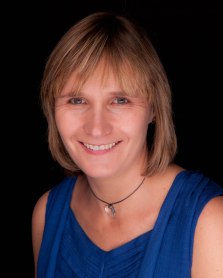
I dump my luggage in the spare room, and we walk the dusty winding streets for twenty minutes to a non-denominational church service. I don’t need to ask why they don’t drive their car anywhere; it takes less time to walk. Ron goes to work in the NGO bus every morning. He teaches adult English literacy classes and does a fair amount of editing too. I am in an expatriate NGO community, reminiscent of my days working for the European Economic Community in Nairobi.

On Monday I go with Jeanette to distribute toys in the children’s ward of the Patan Mission Hospital, and magazines in the orthopaedic ward. It is very clean and spacious. Such pleased faces, bright eyes and gratitude. Family members stay with the patients, bringing food and keeping company, just as eager to enjoy the hand-outs as the patients. A sixteen- year-old mother, with a malnourished gnome-like two year-old, tells us she has another child, aged three  at home. She smiles, saying how lucky she is to have a husband, and to work in a carpet factory.

Only one or two people speak English so I feel a bit frustrated. They have the same problems as hospitals in Kenya; patients are not allowed to leave until they can find the money to pay for their treatment. Some disappear, or leave too early for the same reason. I wonder why first-world hospitals don’t also allow patients to eat, or even buy, their own food. Think how much cheaper it would be! After doing our rounds we disinfect the remaining toys ready for the next day, when they will be swapped again. Small press-and-squeak toys are at a premium; invariably they “disappear”, as even the older children just love them and it is a joy to see their eyes light up.

We visit a Tibetan village carpet factory where the women sit chatting cheerfully, their fingers rapidly manipulating the wool on the looms, following intricate patterns with ease. They are paid piece-meal so can work in their own time. The finished products are more varied in design than in Pokhara, but the number of knots per square inch is limited to 100 here.

I take Ron and Jeanette out to supper at a local restaurant, which serves me my final delicious dal bhat. The price for three dinners is comparable to what I had paid for only one course for myself as a tourist – and there is no tax added here either.

My taxi to the airport to catch the plane to Vienna also costs one third of the price I paid as a tourist.

img136

A temple in Bahktapur

Posted in Travels | Tagged , , , , , | Comments Off on This Time I am Not a Tourist 

I Get Grumpy at the End of a Day…

It’s always a pleasure to meet new authors, and I am specially proud to to entertain Emma Mooney today. She has recently had her first book published by Crooked Cat, and the quality of her work is therefore absolutely guaranteed.

E Mooney

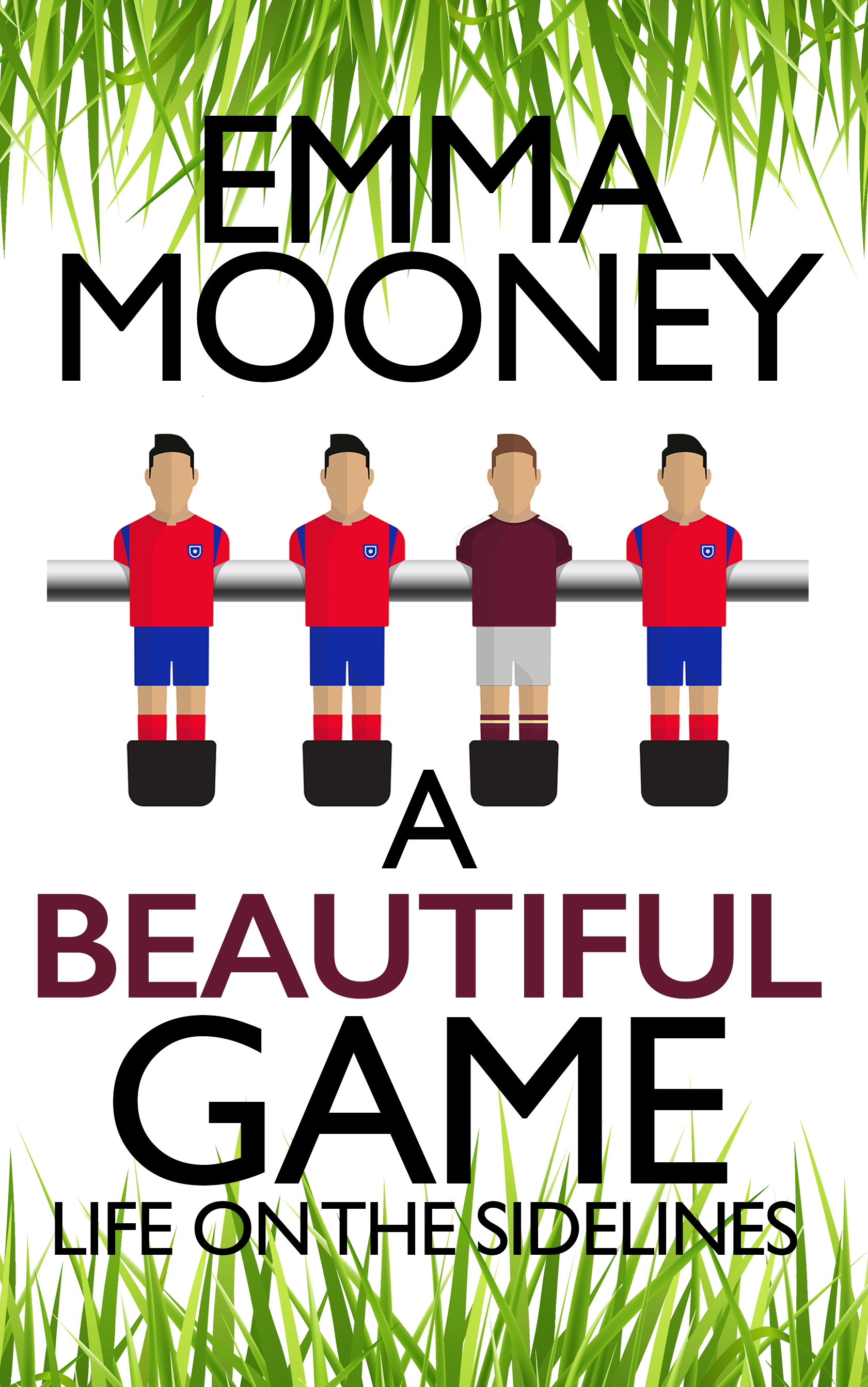
Emma – I have read your astonishing interview with the Daily Record about what made you write “A Beautiful Game”. Do you plan to write more books relating to the experiences of children?

The book I’m currently working on is called ‘Beat The Drum’ and it explores sectarianism through the eyes of Lizzie, a young girl growing up in Central Scotland in the 80s.  She’s a strong, sparky character and I’m really enjoying getting to know her.

I think young people often have a clearer and less complicated view on issues than many adults have, and yet they are rarely asked their opinion or given the opportunity to voice their concerns.  There’s a lot we can learn from them.

emma book cover

I see that “A Beautiful Game” started life as a short story.  What other stories have you written / published?

When my children were very young I struggled to find the time to write lengthy pieces and so I tried to refine my craft through writing poetry and short stories.  I was determined to write a novel but knew that I’d have to wait until all three of my children were at school.  So when Laura, my youngest, started school six years ago I began writing my first novel.  A Beautiful Game is the third novel I’ve written in that time but I’m happy to put the first two down as learning experiences.  They now live in the cupboard under the stairs.

Would you like to expound on the benefits and caveats of belonging to a writers’ group?

Writing can often be a solitary and lonely undertaking and so it’s great if you can find a group of fellow writers to bounce ideas around with.  I really enjoy discussing other people’s work and I find their commitment and hard work very inspiring, which in turn motivates me to get on with any projects that I’m working on.  I’m always happy to accept any comments or criticisms on my work in progress and I believe being open to suggestions can be a very positive experience.

How did you find Crooked Cat?

I was in the very early stages of preparing to send A Beautiful Game out to agents and publishers when I saw a post on social media which said Crooked Cat was open to submissions for three days only.  I looked them up and immediately knew that I wanted to send my novel to them.  I loved their energy, enthusiasm and their attitude towards publishing.  I spent the full three days polishing my submission before pressing the send button.

I agree with you that Crooked Cat and their family of authors are very special. What are your plans for the future of your literary career?

I get grumpy at the end of a day if I haven’t found time to write, even if it’s only five minutes grabbed whilst waiting in the car, and so I can’t imagine a time when I won’t be writing.  I often think of writing as my therapy.

I love trying out new ideas and I hope that I continue to experiment and try out different voices.  My plan at the moment is to continue writing about subjects that are important to me and I guess I’ll just have to see where that road ends up.

What books have most influenced your life, or your writing?

My favourite books are the ones that stay with you long after you’ve finished them.  These tend to be books which successfully draw you into the world of the character and include ‘The Curious Incident of the Dog in the Night-Time’, ‘The Book Thief’ and ‘The Universe Versus Alex Woods’, but there are so many more – too many to mention!

I love reading books that experiment creatively with voice and structure and I recently enjoyed ‘The Shock of the Fall’ by Nathan Filer.  I’m currently reading ‘The Girl with All the Gifts’ by M. R. Carey which is turning out to be a very gripping and surprising read.

Apart from having your family, what is the proudest moment of your life so far?

My three children make me proud every day and of course I was extremely proud when I received a copy of A Beautiful Game through the post but there is another incident which stands out.  I have been a primary teacher for the past twenty years and earlier this year I was badly hurt in an accident in my classroom when I intervened and prevented a young boy from being killed.  My recovery has been long and difficult but I’m quietly proud to know that there’s a family out there who still have their child because of my actions.  Nothing is more important than the people around us.

Oh my … I am full of questions, but perhaps now is not the time. Maybe herein lies the beginnings of yet another book – but, to change the subject: I see you’re something of a traveller. Care to describe a place you’ve visited, and what it meant to you?

IMG_7958

I visited Rome with my family last year and fell I love with the city.  We rented an apartment close to the Vatican and so we walked through St Peter’s Square at all different times of the day.  I’m not a religious person but it was a very special place and it was fascinating to watch people’s reactions when they arrived.

The extremes between the vast wealth of the church and the poverty of the people begging in the street is something I’ve tried to write about since returning home and I’m sure it’ll appear in a novel at some point.  Before we came home I threw a coin in the Trevi Fountain and I definitely hope to return one day.

IMG_8413

The Trevi Fountain, Rome

If there were no barriers, what would you like to do / be / have?

What a great question!

IMG_1868

We have a memory jar in our house that we fill with little notes scribbled on squares of coloured paper which try to capture the little moments in our day that make us happy – things like seeing a rainbow or catching up with a friend.  I suppose I’m trying to teach my children that life is about today, and that we’re lucky to have the things we have.

The only request I’d have is for life to slow down because my children seem to be growing up in the blink of an eye!

Thank you for your company today, Emma. It’s been great getting to know a little about you.

You can find out more about Emma by following these links:

www.emmamooney.co.uk

https://twitter.com/EmmaMooney21

http://www.amazon.co.uk/A-Beautiful-Game-Emma-Mooney/dp/1909841927

Posted in Authors | Tagged , , , , | Comments Off on I Get Grumpy at the End of a Day…

Big Ideas From Small Boats

Kathy Sharp’s Isle of Larus is one of my favourite books – brimming with atmosphere and charm – and now she’s produced another one! I am delighted to host her on a very special day.

KathySharp

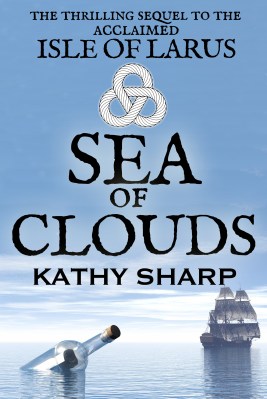
A big thank you to Jane Bwye for giving me this blogging opportunity on the launch day of my new novel, Sea of Clouds.

A question I am frequently asked, especially by other writers, is, “Where do you get your ideas?”

I’d like to give one of the answers to that question by telling you a story. Once upon a time in the very long ago (Oh, all right, it was in the sixties), I went with my family one day to look at a boat. We owned the smallest cabin cruiser you ever saw, and we were looking for something a little more spacious. But not expensive. You get the idea. And that was how we came to be inspecting the Imp with a view to possible purchase. She was a big, old converted lifeboat – roomy, broad-beamed, clumsy and heavy. She also had an unfortunate tendency to sink. Indeed, she had sunk the previous week and been laboriously pumped dry.

We climbed aboard and opened the cabin door. After a day or two underwater in the soupy river, and another day or two on the surface in sticky July warmth, the smell wafting out was so strong that we slammed the door and never ventured into the cabin at all. Needless to say, we quickly decided she was not the boat for us. Within days she had sunk again, was dried out again, and soon vanished from the moorings.

I have no idea what happened to the poor old Imp after that. But I never forgot her. Boats feature quite heavily in my Isle of Larus stories, and when I needed a new one, one with distinct character, for Sea of Clouds, I thought of the Imp. And so there she is, having undergone a few changes in my imagination, but essentially the same, in all her chaotic glory; still bearing her original name, still heavy and clumsy, still smelly, and still inclined to sink without warning.

I shall never know what adventures the real Imp had, but her fictional counterpart is renamed and lives through some exciting times in my story. She has a glorious future ahead of her in my next book, too. I’d quite like to be immortalised like that myself!

So the answer to the question, “Where do you get your ideas?” in this instance is “from an odd memory of looking at a battered old boat one summer’s day in Kent.”


Sea of Clouds is published by Crooked Cat on 11 November http://amzn.to/1wYCPH0
front

Isle of Larus http://amzn.to/1ys4i76

Flash fiction with Kathy, my Monday blog http://bit.ly/XWTsVL

Twitter: @KathySharp19


Posted in Authors | Tagged , , , | Comments Off on Big Ideas From Small Boats