Marj’s Meanderings

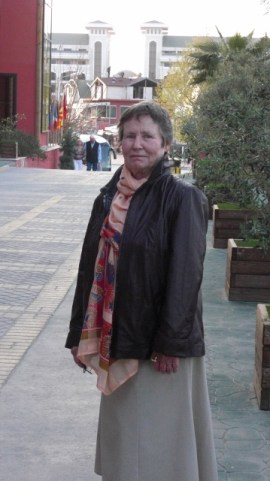
I love Marj’s meanderings, which help us to get to know her a little more… since she is shy, you might notice that it’s not precisely a clear close-up. You can find Marj’s blog HERE.

Image

Jane has asked for a piece about my journey as an author. So here I go.

I’ve always been a reader, from the time I was in Primary school and discovered – the library!  I read everything and anything. I remember my mother once saying about a book I was reading – doubtfully, “There’s a lot about sex…”  I would have been about twelve, and since there never was ‘the talk,’ I wasn’t quite sure of the mechanics of that particular exercise. (I worked it out with the help of James Bond books and a dictionary)

In my early twenties, I decided to write a book of my own. It didn’t work very well. I wrote a couple of thousand words – and then the ending came to me – such a delicious irony and I couldn’t resist. It was a very short book.

I didn’t try again for many years, and then I wrote a dozen or so full size books before the first that I published – ‘Not a Man.’ Not a Man: The Story of Shuki Bolkiah

I made some mistakes when I first started writing – like totally forgetting that a man grows whiskers. He could not be held as an unconscious prisoner for three weeks without ending up unpleasantly bearded.

And if I bestowed a pet on a character that was ‘always with’ that character, then I really should not forget its existence.

It was a series, and twenty (fictional) years had passed before I quite suddenly remembered that a man of sixty in the first book is going to be eighty after twenty years had passed. And that was sad – how could my main character stay young and sexy as more and more years pass. Well, those books had magic, so it was easy. I decided that certain powerful wizards had always lived longer than normal. My man was a very powerful wizard, and was the only wizard who just didn’t appear to age at all.  So even after a century, he still looked twenty-four (and a very nice twenty-four besides.)

Continuity. Chapter 23, one of the minor characters died. But oops!  In Chapter 25, he was merely retired.

But now:

Now I know that men shave, I know that people get older as the years pass, I usually remember the pet, and I don’t bring people back to life.

So I guess that now I can call myself – an author.

Image

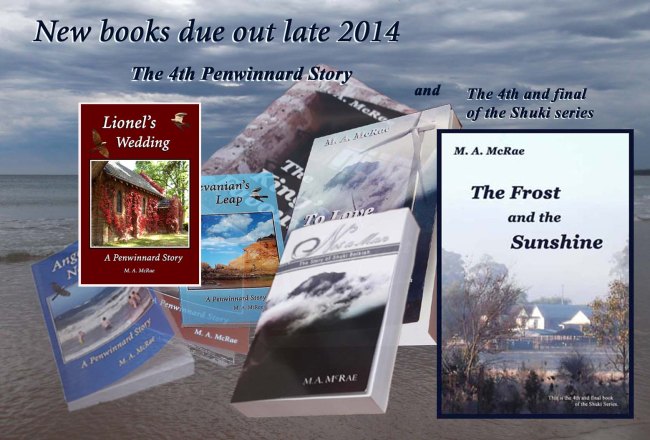
My books: Two separate series – the Shuki series, starting with ‘Not a Man,’ and ending with the book I completed this morning, to be called ‘The Frost and the Sunshine.’  It will be published late this year.  Each of them has a decent conclusion – no cliff-hangers.  I hate that in a book, series or not.

And then there are the books I call ‘The Penwinnard Stories,’  not a series in the true sense of the world – all individual stories, but featuring the same setting and some of the same characters. I will be working on the completion of the fourth story quite soon, working title, ‘Lionel’s Wedding,’ and it, too, will probably be published late this year.


Posted in Authors | Tagged , , | 3 Comments

An Island of Contrasts

I rub my eyes after a four o’clock wake-up call in Honolulu for a 5.15 a.m. pick-up… but I don’t arrive on the island of Maui until three hours later, thanks to security requirements. Six of us rattle around in a large bus for the tour, plus our guide Peter who talks non-stop. He is one of thirteen children, and has four of his own. A true Hawaiian, he was born in Maui, he tells us, and has a Masters in Business.

We drive along a flat valley floor through sugar cane and pineapple plantations, then wind up a tortuous ten thousand feet to the summit of the bleak and dormant volcano Haleakala. At one stage on the ascent we pass a field of bumpy spiny grass; I remember seeing similar large tufts on the moorlands of Mt. Kenya and Peter explains it was indeed brought from Kenya in the mistaken belief that it was good for cattle. They also imported mongooses to control their rodent population before they realised they should have chosen snakes instead.

We come across several cyclists grouping on bends in the road, before releasing their brakes and riding helter-skelter down the steep gradient in a thrilling race with the clouds to the bottom. We learn that the only time the volcano top is clear, is in the early mornings, and often not even then.  So we are lucky.

Image

The changes in vegetation as we climb higher are clear, and at seven thousand feet we see unique silverswords: flowers not unlike sunflowers arranged as for groundsel; the spiky silvery base is quite lovely. The barren “crater” is a misnomer, as it is really two valleys fused together over time, but it contains a series of little cones.

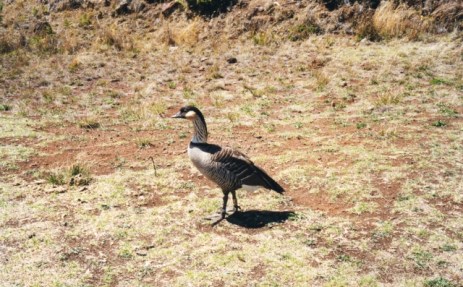
Image The Park Officer at the summit tells me of a pair of Hawaiian geese or nene, which are only to be found on this island, so on the way down our driver makes a detour into an isolated trailhead.  My Bird book of North America does not include Hawaii, so I take a photograph of this miniature version of the Canada goose, parading with peaceful lack of concern on the car park.

Image After a fresh fish sandwich at a local restaurant, we are transported to the west wing of the island, and look upwards at the Iao needle from a rain-forest within an overgrown crater. It presents a huge contrast to our morning experience – rivers, a verdant, humid valley, the green covered pinnacle and a mass of cloud with the sun occasionally peeping through.  We look over towards Haleakala, seemingly only a stone’s throw away, but it is  also covered with cloud.

We drive along the seafront to old town Lahaina (Peter tells us that you must pronounce every vowel in Hawaian words. They only have seven consonants). There is still a feeling of shock, and planes and buses are very empty; however, a few campers, sun-worshippers and surfers line the seafront. An arts bazaar is in progress under an enormous Banyan tree in old Lahaina, but the few customers are crowding round a group of energetic young drummers. I wander through a couple of art galleries. Local hero Christian Lassen, acclaimed surfer and environmentalist, produces striking oils. I see zebra, cheetah and lion, the work of a South African artist. Then I track down some juicy slices of pineapple, which are pleasantly acid-free. But prices here are utterly outrageous.

I’m glad I read James Mitchener’s Hawaii in preparation for my visit, as it gave me some excellent background history of the islands, and I’m looking forward to experiencing Pearl Harbour tomorrow.


Posted in Travels | Tagged , , , , | Comments Off on An Island of Contrasts

A Man with REAL Dreams

Larger than life, and a computer geek to boot – but I’ve always believed that if you scratch the surface of one, you will find a delightful, fascinating character, and Thom Stark hasn’t disappointed. Click on the pic below and you’ll see what I mean…

Thom Stark

Thom – care to tell us a bit about yourself – what you do/did for a living before you became a writer in 1995?

At one time or another I’ve worked as everything from typesetter for a suburban newspaper to carnival roustabout to air switcher for a San Francisco independent TV station. Beginning in 1986, I became interested in computers, and worked my way up from computer tech for an A/V rental firm to Senior Research Analyst for Wells Fargo Bank. Eventually I became an independent consultant specializing in computer networking. Then I accidentally became a professional (i.e. – “one who gets paid for it”) writer. I’ve been doing that ever since. (I’d love to hear about your “accident” – but perhaps we’ll leave that to another day…)

Wally&Watson

You are a versatile writer, who likes alliteration (your “loveable mutts” are named Watson and Wally – the pup on the left); tell us about the Boardwatch Magazine and the other very diverse publications you write for.

Well, my writing career started in the pages of LAN Times magazine. When new management replaced Susan Breidenbach, the editor who hired me, I wound up getting the boot, too.

Boardwatch was a very highly-regarded publication aimed at Internet Service Providers. Jack Rickard, who founded the mag, recruited me to write for it, after reading a feature article I did for Internetworks magazine on the IAHC’s attempt to expand the top-level domain structure of the Internet. It was pretty heady company in which to find myself, because some of the top scientists and programmers in the geek universe wrote for Boardwatch. While on the Boardwatch masthead, I wrote a monthly column called @internet, as well as occasional feature articles – most of which, I’m proud to say, were the featured cover story for the month they were published.

I’ve also written for various other computer magazines, including Byte and Cnet, as well as for local newspapers and Las Vegas Citylife magazine. I’m a member of ASCAP, as well, and I hold or co-hold copyrights on four dozen or so songs.

Prompted by the interesting gestation of your book May Day I have down-loaded your free 38,000 words. Reading the first few pages puts me in mind of Nine-eleven (referred to in a recent travel blog of mine!) How close does your book come to that event, and what was your reason for writing it?

May DayIn fact, what happened to America following the 9/11 directly inspired American Sulla, the novel of which May Day is the first volume. So many times in the years since those attacks, I’ve heard people say how differently things would have turned out if Al Gore had become president, instead of George Bush, so I decided that having a liberal Democrat as president when Lower Manhattan is destroyed by a nuclear weapon was the right point of departure for the story of what might happen to this country and the world following an attack far more destructive than 9/11.

May Day is the first of your American Sulla trilogy. I had to google the name! Fascinating. Please tell us how you came to use this Roman political and military leader as your model.

Well, as you now know, Lucius Cornelius Sulla was a Roman general who was elected Dictator of Rome at a time when civil war and chaos swept the Republic. Sulla – who was the only Dictator ever to be appointed for a five-year term – put down the rebellion, then used his power to reform what he regarded as a badly-broken political system (as well as to settle personal and political scores). Before his term expired, he felt he had accomplished everything he had set out to do, so he stepped down as Dictator, handed power back to the Senate, and retired from politics.

I thought the notion of a President becoming a military dictator in the aftermath of a nuclear terrorist attack was actually a quite believable turn of events – and the temptation to use that power to try to fix our badly-broken political system would be an increasingly-irresistable temptation. The question of how that might play out – of whether a President could wield such power without becoming hopelessly corrupted by it – is the central conflict with which American Sulla wrestles.

What has been the most difficult aspect of writing and selling your book, and how did you address the problem?

 The hardest challenge is the one all first novelists face: attracting an audience. How to make your voice heard above the clamoring multitudes is the principal difficulty all artists face, regardless of the medium in which we work. For me, one of the bigger obstacles to that effort has been the fact that my wife’s cancer treatment cost us our entire life savings, so the financial resources available to me for advertising have been essentially non-existent.

(Let me say that my beloved Judy – to whom I dedicated May Day – has been cancer-free for the past five years, and that makes the cost of her treatment completely worthwhile for me, despite the inconvenience it presents to my marketing effort.)

I am so sorry to hear about your wife’s cancer, Thom – and delighted she is now cancer-free. Our lives are somewhat parallel: my husband has been cancer-free for over twenty years, now; but he’s living with the consequences, and the change in our lives led to me completing Breath of Africa. If it’s any consolation, advertising my book was costly, and produced little in the way of returns!

What marketing methods have you used?

I’ve devoted a lot of time and effort to interviews such as this one, as my primary promotional strategy.  They do seem to help. I’ve also tried to leverage social media to help market May Day, and I think that’s also helped. And, too, I’ve sent out copies of the book to influential people, in hopes that one or another of them will decide to read, and then champion it. So far, that hasn’t been as successful as I’d hoped it would be … to put it mildly.

I recently joined an author’s collective called The Booktrap. The notion is that we cross-promote the group and each other’s books. Each member contributes his or her special expertise – I narrate audiobook excerpts of our members’ work, for instance. It’s still too early to tell whether our execution will be as good as the idea, but there are certain individuals who are putting tremendous amounts of energy and effort into it, so I’m hopeful that it will pay off for everyone.

 Has it been worth your while publishing it in paperback format?

 I think so. A number of my friends and family members have ordered copies of the paperback edition, despite its cost. I’ve also mailed proof copies to people who could be powerful allies, should any one of them actually decide to read the book – including President Obama (who you will recall remarked to the press that the possibility of a nuclear explosion in New York City was a bigger worry for him than Russia’s annexation of Crimea).

Do you have a wish list – what would you love to do / be / have if there were no barriers?

 Well, I’ve wanted to be a spaceman since I was a child of six – since before the words “astronaut” and “cosmonaut” were invented, in fact. Given my increasing age and deteriorating health, that’s unlikely to ever happen, but it’s still my most cherished ambition.

I’d also very much like to follow on horseback the path of Alexander the Great’s military campaigns, but, given that his trail leads through some of the most dangerous territories on Earth (Iraq, Iran, Afghanistan, and the tribal areas of Pakistan among them), that, too, is probably out of the question. I’d still love to do it, though. Oh, me too! I went riding for a couple of hours in Cappadocia a couple of months back, and I’m afraid my old body kicked back at me. But there’s no harm in fantasizing.

And, of course, I’d jump at the opportunity to become immortal, invulnerable, and wealthy beyond the dreams of avarice – but, more realistically, I’d be happy to settle for merely becoming an author who’s successful enough at writing to make a living at it!

A man with REAL dreams – I love it! And now, Thom, I am becoming hooked on your book… you can read my review HERE

May Day – Book One of American Sulla   http://www.amazon.com/dp/B00FT8U6IOp:

The American Sulla home page (download the 38,000-word sample here):http://www.starkrealities.com/Sulla.html
 

Posted in Authors | Tagged , , , , , | 1 Comment

Oregon – and a Dip into Kenya’s Distant Past

The journey to Medford is weird. I am warned to report at the airport three hours early because of heightened security at LAX, and I’ve already spent a very relaxed day at the hotel after the group left.  Fortunately I decide to buy Tom Clancy‘s latest tome to while away the hours, and spend a few dollars on the Internet, learning that Ansett has gone bust, so occupy my time on the telephone changing the Australian leg of my journey to Quantas. I must say, it is quickly and pleasantly achieved.

The hotel shuttle transports me to the nearby airport. The vast check-in hall is virtually empty of passengers. Gun-toting security personnel are obvious everywhere.

I make sure my little bag containing nail scissors and needle and cotton are safely stowed away in my main luggage. I even include my bee-allergy epipen to be on the safe side, as yesterday the papers were full of pictures and descriptions of potential hi-jacker items, which had been confiscated. Sadly, I decide to leave my Zion walking stick at the hotel – but am assured that I will get a cheap hiking pole in Nepal.

It takes me two minutes to check in. Only a handful of passengers gather at Gate 86, and we each have three seats to ourselves.

In Medford, Sally wants to stay at home instead of going on our planned trip to Mt. St. Helens. I am not surprised, and am quite ready for a true break and rest.

11 Medford 11 Oregon

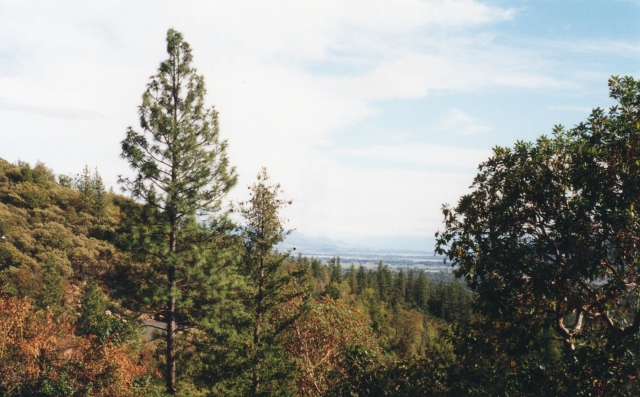
This week, perched in their lovely house half-way up a pine-covered hill overlooking Sam’s Valley, it is wonderfully peaceful; but so, so dry. We anxiously watch frightening wisps of smoke on the horizon. One house just the other side of our hill goes up in flames, but is quickly controlled by fire-engines and a helicopter with swinging water bucket underneath.

After early morning communion on Sunday we join a church group for brunch in a cosy log cabin at Lake in the Woods, thirty miles away. One or two water skiers sweep by between the towering pine trees. Places are being closed up for the winter and there aren’t many postcards in the shop.

This is also the case at Crater Lake, seventy miles away. We drive there on Monday in Dennis’s Cadillac, watching the trees beginning to turn to autumn colours. As soon as there’s a chill, Sally says, the whole countryside will change overnight. I hope it will happen this week while I’m here, but I fear not.

We arrive at Crater Lake to find that the boat trip round the crater is not running and the Visitor Centre is closed. No matter.

11 crater lake

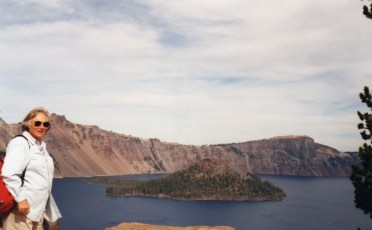
We hike a little way up the rim towering over this blue, blue lake (when the sun is out) with Wizard Island poking its secondary pine-covered cone through the still deep waters. We glimpse Phantom Ship, part of the original cone, far to the right of this 20 square mile, 2000 foot deep lake. And we spot a Clark’s nutcracker perched on a whitebark pine. On the way back we stop to wonder at a natural bridge where the Rogue River gurgles into a hollow lava tube and gushes out again in white cascades two hundred feet further downstream.

I spend an interesting morning with octogenarian Larry Tweedie, whose grandfather, Bronson visited Kenya in 1909 when Roosevelt was there.

Bronson wrote a book on his year there (now out of print), when he went hunting with George Outram, bagging many trophies, and has left an album containing several interesting (hunting and non-hunting) photographs of that time. The book and photos, together with several articles written by Bronson (who was a newspaper man), make interesting reading.

But my time is up, and Hawaii beckons. Sally sees me off at the airport.

“Be sure to visit the island of Maui,” she says. “You will love it!”


Posted in Travels | Tagged , , , , , | 2 Comments

Figuring It Out

Dee Harrison shares her thoughts and experiences as a self-published author at my place today – come and have a cup  of tea while we chat…

 Image of Dee Harrison

Dee – you are a devoted and determined self-publisher. What is the hardest part of producing your books, and have you sought any help?

Hello Jane, thank you for giving me this opportunity to talk about my books and my life as a writer. I think the hardest part of producing my books myself is that I don’t have a team of people to fall back on for help and advice but that, in the main, I have to figure out the answers to any difficulties myself. For example, ebooks usually have an interactive contents page that allows the reader to skip straight to any given chapter. It seems simple to do but actually took me a lot of sorting out. I got it in the end but it took several hours of a very busy schedule.

Another area is the cover. Although I designed the covers for my Firelord’s Legacy series myself I did need some assistance to format the cover for Createspace. Luckily I was able to call on the excellent services of fellow Authonomite Rebecca Hamilton, aka Inkmuse.  The lesson is that, if you are going to self-publish your work you have to take on board the fact that you are a publisher and not just a writer. It’s a different skill set but one I am quite proud of having achieved.

Tell us, what marketing methods did you use – and what will you use for your next book?

Marketing is a huge problem for Indie writer-publishers. I could spend all day promoting my books on the different platforms but that’s just not possible. Like many writers, I also have a full-time job so everything else – the writing, editing, marketing etc – has to fit in quite a limited time space. I have a Facebook page for my books and an author page for myself so I use the promotional sites available on Facebook to draw attention to my work. I also use Twitter and can be found on Goodreads as well as Authonomy. I have a Pinterest board, Imagination Unlimited, but I consider it more of a personal interest resource than a specifically promotional one. I have looked into using sites like Bookbub but they can be expensive and many require a minimum number of Amazon reviews of 4 and above. Getting reviews is another difficulty altogether. I also enter competitions and fun items just to get my name out there.

 Might you please explain the difference in your fantasy tales between the Firelord and your proposed Mirrorsmith series?

The Firelord’s Legacy is what you might consider a classic fantasy series. There are no Elves or Dwarves but there is magic and strange creatures and castles. I have used my study and love of history to form the background and setting. It revolves around a cast of several characters but all the action takes place on a single world, Riom.

Mirrorsmith is quite different. It is a multi-world scenario with settings ranging from almost prehistoric to High Tech, and follows a single protagonist, Junah, (and his cute sidekick Sissik).

Whilst The Firelord’s Legacy unfolds over 5 books, Mirrorsmith is, currently, a single stand-alone story – although there are short story-length tales out. For instance, in the anthology Fusion, the original Mirrorsmith story can be found.

Fusion: A collection of short stories from Breakwater Harbor Books' authors  I have already downloaded FUSION, and am enjoying reading this very well edited anthology. You describe your contribution as a “steampunk type” story. Can you please explain the term to this old-fashioned soul?

Steampunk is sub-genre of fantasy. It tends to be based in either Victorian England or the American Wild West. Technology is clockwork or steam-driven. If Jules Verne, for example, were writing today, his work would be classed as steampunk rather than mainstream sci-fi or fantasy.

Think I really am getting on – not sure I understand even after your patient explanation, but I did enjoy your Mirrorsmith story! You have published articles on Medieval History. Have you ever thought of writing historical fiction?

I have thought about it, quite seriously, and have some notes on a possible book already started. It’s still at a very early stage of development though.

What are your most / least favourite things about being an author?

I love being able to explore characters, situations and dilemmas. I like letting my imagination go and saying ‘what if..?’ My least favourite thing about being an author is, perhaps, that I know I have enough material for so many books but not enough years in a lifetime to write them so which do I choose?

I know the feeling, Dee! I also felt so exhausted after writing BREATH OF AFRICA, and again, after completing my new novel, that I just don’t want to summon up the energy to get going again. But, let’s change the subject: I see that you assess and teach people with dyslexia when you’re not writing. Which occupation gives you the most satisfaction?

I get enormous satisfaction from both, it is almost impossible to choose one above the other. However, I suppose that if today I stopped writing the effect of that would not be so great in the grand scheme of things than if I stopped assessing and teaching people with dyslexia. One I do primarily for myself, the other primarily for others.

 A brilliant answer, Dee!

You and I both are continuing members of Authonomy. Please tell us how this peer review website has helped / hindered your career as a writer.

I have found Authonomy tremendously useful as well as great fun. It provides a, generally, kind environment for a new or fledgling writer to test their wings. The reviews, especially from the genre groups, can offer so much useful advice and insight to develop your writing skills. There is a wealth of experience to call upon. Although the majority of members maybe unpublished, or ‘amateur’ writers, many are not and they are usually willing to offer the benefit of their experience to the community. There is the possibility to ask questions on all aspects of writing or the publishing process and receive useful and informed answers. It is also a good place to ‘hang out’ with like-minded people who have an interest in books and writing. There is only so much support you can get from your nearest and dearest after all!

 What has been the proudest moment of your life so far?

In terms of my writing it has to be seeing my first sale on Amazon.com. I knew it could not possibly be a friend or family member so had to be a complete stranger who had ventured their hard-earned cash on my book. It was both humbling and affirming.

 Do you have a wish list – what would you love to do / be / have if there were no barriers?

I have a kind of wish list, in that there are places in the world I would love to visit if it were ever possible eg the Taj Mahal, the pyramids etc. I would also love to be able to write full-time. However, I am a pragmatist and I will take my opportunities as life allows and enjoy what I can do rather than waste time worrying about what I can’t do.

Thank you so much again for the opportunity to talk with you today.

The Firelord's Crown (The Firelord's Legacy)       Firelord's Heir (The Firelord's Legacy)      Firelord's Curse (Firelord's Legacy)

Dee also has a Facebook Page.

And a Website 

Posted in Authors | Tagged , , , , , | 4 Comments

Nine-Eleven – The Aftermath

Round the World Walkabout, Episode 10.

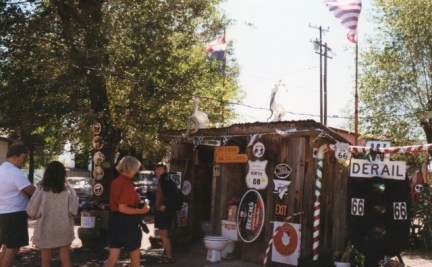
We break camp in the Grand Canyon and head south-westwards on a hot tedious drive, hitting “Route 66” where for the first and only time, Manu is allowed to turn up the car radio and broadcast canned cowboy music appropriate to the place (it is all new to my ears).

Image

We browse the shops and buy ice-creams in brash Seligman, the vendors taking the mickey out of the tourists in unashamedly slapstick American fashion. The Home in the Rock is an incredibly naïve attempt to make money out of eccentricity.

Image

Then there is Lake Havasu. Unbearably hot; and old London Bridge, spanning a neck in the lake, there in the middle of a desert. It was purchased unseen and must have cost a fortune to deliver. When the new owner finally “unpacked” it, the story goes, he couldn’t believe his eyes: he’d thought he was buying Tower Bridge. Patches of green grass surround busy sprinklers and there is an attempt at an “English” setting, complete with swans and ducks waiting to be fed (everywhere else, we are adjured NOT to feed the wildlife, for their own good).

Touristy shops line the water front, but the place is dead. Perhaps it’s the heat, or the recent nine-eleven disaster, or merely end-of-season. Hundreds of empty bungalows stand starkly on sandy slopes. Thousands of second-hand cars and boats for sale line the highway.

Image

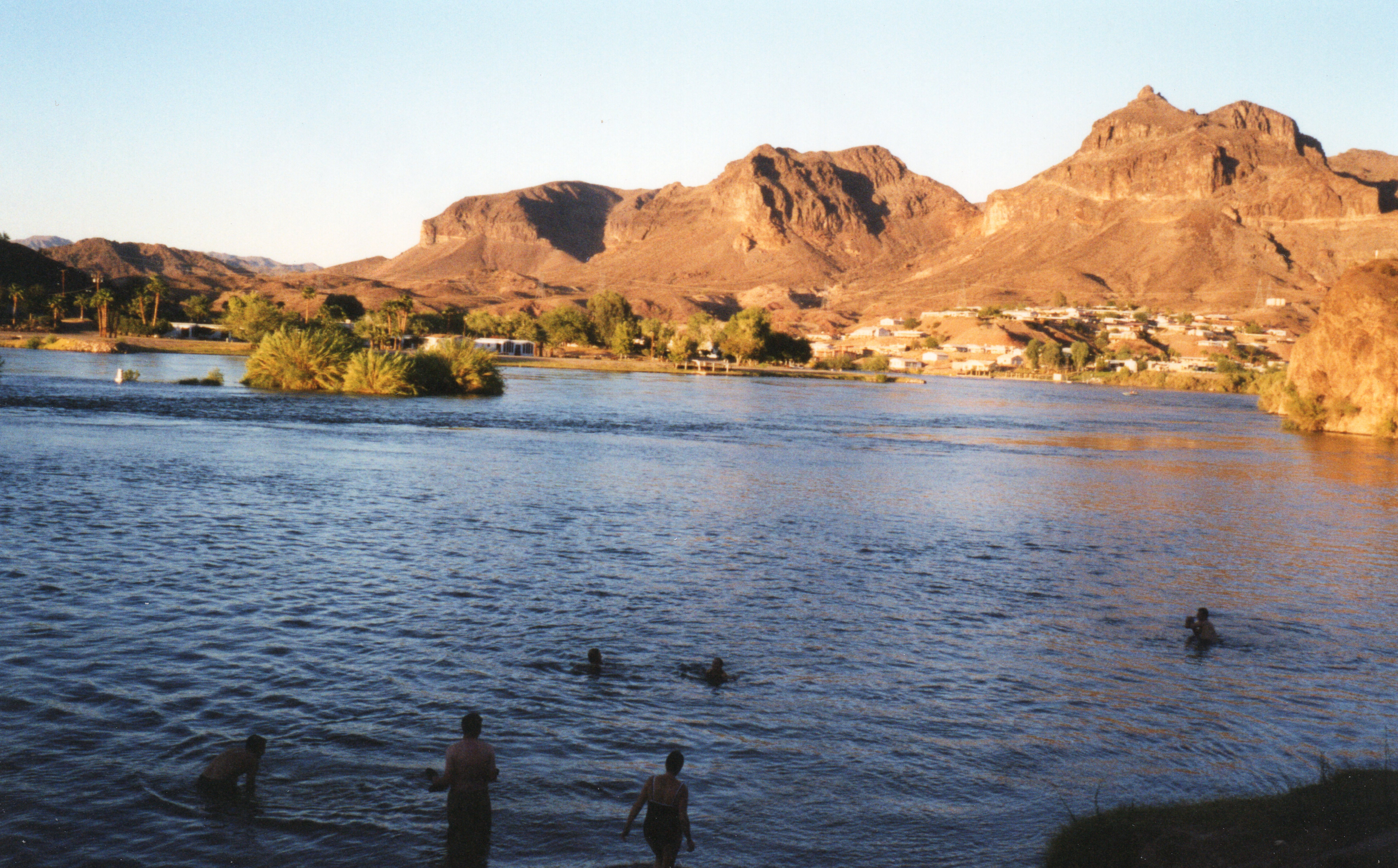
Just fifteen miles further on we turn into an idyllic campsite. Green spongy grass, a sleepy curve in the Colorado River, and only one other camper in sight. We soon disturb the peace, aided by a couple of  noisy jet-skiers.  Splashing and playing in the cool waters, we wash our fly-sheets and groundsheets and sit down to a final delicious meal cooked by Jane: risotto this time, followed by blueberry pie, fruit and cream. Let me say at this point that throughout our trip we shared camp duties, (cooking, table-setting, and washing-up), strictly organised by Jane on a “roster” none of us really tried to read or fully understand. But as no less than six people were on duty at a time, the burden was light.

Image

The next day brings an even more tedious drive to Los Angeles. I could have stayed longer in the desert at Joshua Tree National Park, where a coyote posed for us at the roadside amid the strange other-worldly trees, beckoning against the rocks. Try as I might, I cannot spot even one crazy roadrunner (a “common” type of pheasant, the blurb says).

A final stop at “The Travellers’ Tree,” a bizarre sight at the roadside, where hikers hang up their shoes to mark the end of their journey. Manu and Jane do the honours and then pose for a picture.

Image

Then an endless drag along a many-laned highway and a maze of clover-leaves along the vast length of Los Angeles valley. The people of LA, Jane tells us, get panicky when they go to the Grand Canyon because they can’t see the air they’re breathing.  Well, we certainly can’t see the hills which she assures us are there to the north. Thick pollution. A city without character. But according to Jane it grows on you more every time you go there.

We dutifully do the city tour of Hollywood, walking the star-studded pavement with cries of recognition as we come across the names of favourite film stars; we gaze at the foot- and hand-prints of the stars of bygone days, captured for ever in the cement; and we drive as slowly as we dare through Beverley Hills, gaping at the residences of the stars. Loitering there is an offence.

Left to our own devices, we wander round the almost empty pavements of Santa Monica before ambling some way along the wide sandy beach and catching the bus back to our hotel.

But America is going to war against terrorists, airlines are cutting back, hotels suffering cancellations, and nobody is feeling at all happy.


Posted in Travels | Tagged , , , , , , , , , | 5 Comments

Turkey – Final Episode

After three days in the hotel doing nothing but play bridge and read (thank heaven for my kindle), it was time for a trip to Perge; twenty euros each for 5 of us. Then it turned out the driver expected us to pay the TL15 each for tickets on top…

CIMG1763 (640x359)

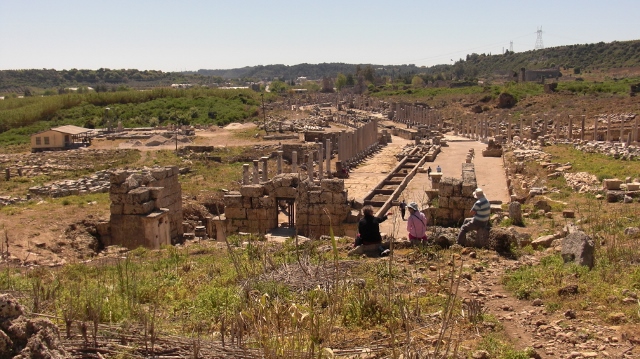
Ahmed left us to guide ourselves. I opened my Rough Guide and we picked up a leaflet map of the ruins. It was like a treasure hunt and jigsaw puzzle rolled into one. There were very few tourists in this fascinating place. Image We spied two tiny tortoises as we roamed through the bath complexes, where a portion of marble tiled floor was exposed.

CIMG1770 (359x640)


We strolled through the Gates and the two Nymphaeums –

CIMG1771 (640x359)

CIMG1777 (640x359) – and walked up the Colonnaded Street with its central waterway between lines of shops.

It was a fascinating blend of Greek, Roman and Ottoman dynasties. CIMG1767 (640x359)

Marble carved pieces lay haphazardly around.

We wandered back through the ticket gates and into a ruined stadium with tiered stone seats and a partial view of the nearby theatre, cordoned off for ‘restoration’ at least nine years ago. I bought a turquoise necklace at a stall for TL20. It was a wonderful, stress-free three hours, exploring and wandering at leisure.

We were late for lunch, and Ahmed dashed us to a roadside café in Aspendos, where our hosts had prepared a Turkish-style lounging corner for us, draped in carpets … but the others made a bee-line for a conventional table in the far corner. CIMG1782 (640x359)Glancing longingly at the carpeted corner, I lingered to watch  the mama preparing our stuffed pancakes (cheese and spinach) using a thin stick with great skill and baking them over a domed hot plate, frequently turning them with wooden paddles. The daughter dripped them with fat, folded and cut them into segments, before plating and serving with olives, cucumber and tomatoes. Absolutely delicious. We looked over groves of oranges, and Ahmed plucked one each for us to take “home.” Mine was juicy and tasted refreshingly sharp.
Our long and devious journey back to the hotel took us via a mosque, then off to wave at Ahmed’s relatives on the balcony of his house. He took us through windy byways. I wondered if this was his first group of tourists, he was young enough and he peeped the horn frequently, laughing as he saluted acquaintances along the way. A sly suggestion to Jim that he might want a girl? That was too much – we were looking for the post office to despatch our postcards, and he finally obliged. Ahmed had done very well by us; but we did have a most interesting and enjoyable time, getting back to the hotel well after 4.30pm.

***

The biggest surprise on a free day in Antalya was a compulsory visit to the D’Enver leather factory. We were herded into an auditorium; the curtains closed, lights dimmed, and into the spotlight walked Diana, clad in a sumptuous leather calf-length jacket with leopard and fur motif. She made a sophisticated model, rising beautifully to the occasion. The lights dimmed once again and we witnessed a professional catwalk show, featuring leather garments of mouth-watering richness. They trim the lambskin of  its outer membranes, leaving the soft fatty inner part to make the garments. Colouring is of natural ingredients.

CIMG1700 (359x640)

We were let loose in their shop for half an hour. I did not mean to buy, but found myself coming away with a magenta jacket – at one third of the asking price – to replace the rather frayed hand-me-down from daughter Heather ten years ago.

The elongated journey home to the UK was the usual travelling nightmare, and the taxi ride from Gatwick Airport to Polegate at 2.30am seemed as if it would never end. Most of us nursed sore throats and coughs in varying stages of development, and although it was not all bad, I resolved never again to be a package tourist.

Posted on by jbwye | 5 Comments

LIFE AND CULTURE IN KENYA by Jane Bwye: Guest Blog

A true feeling of life and culture in Kenya –
Please head over to Jeff Gardiner’s blog today, where I am holding forth on a subject I just love!

Posted in Kenya | Comments Off on LIFE AND CULTURE IN KENYA by Jane Bwye: Guest Blog

Babies Really Can Fly

I will always have a special feeling for authonomy authors, who helped my book, Breath of Africa on its bumpy way to publication over a year ago. An especially warm welcome to Tracey Scott-Townsend one of my generous ‘virtual’ friends, and author of The Last Time We Saw Marion, which was launched on amazon earlier this month.

Product Details

Tracey describes her flight path to the birth of her novel in a candid, entertaining and unusual manner:

I remember my mother reading ‘Peter Pan in Kensington Gardens’ to us as children. All babies had the ability to fly for a short time after birth, and some would deliberately fall out of their prams so they could make use of this gift. Of course, the sensible ones got back in their prams in time to become normal babies and grow up into adults. Peter didn’t. I was sad that he could not have both his freedom (as a baby who could fly) and at the same time return to the safety of his mother’s arms. He had to choose one or the other. And in the end he left his choice too late, by the time he decided to go back to his mother, her window had bars on it. He cried and pounded on the glass but she did not hear him. She already had another baby by then. Peter was destined to be a free spirit forever, but he never stopped regretting the loss of the nurture that a mother represented.

In my novel The Last Time We Saw Marion (now out with Inspired Quill Publishing), Marion longs for freedom from the restrictions of body. When she finally achieves her freedom she enjoys it so much that, like Peter Pan, she leaves it too late to go ‘back’. Marion is forced into the prison of another body and destined to repeat the same physical experience that she found so dis-satisfactory the first time around.

Both Marion and Marianne choose Anorexia as a means of identifying the essence of their true selves. In my late teens I became fascinated with this condition. I read many books about girls who suffered from it. I understood completely the craving at the root of what soon becomes a dangerous illness: to strip away the layers of physicality and get to the core of being human. Of being a ‘Being’, in fact.

I didn’t know what I was or how I fitted into the world. As a child I wondered constantly where I had been ‘before’ I became the baby that had turned into me. So from a very young age I had a strong sense of mortality. I knew that I had been somewhere (or nowhere) before I was born and that I one day would be in some kind of unfathomable place again. I don’t think I really fully slotted into myself until I was in my late 20s.

It was motherhood that grounded me, I suppose.

My first experience of motherhood, or at least the possibility of it, was as a 21 year old. I was living with my boyfriend after dropping out of University at the end of my first year because I wanted to concentrate on writing.

I’d missed contraception pills when I went home for a few days at Christmas, took them when I returned and carried on as normal. Two months later my sister convinced me to go to the doctor to confirm that I was pregnant. Although I was terrified of informing my boyfriend, not to mention my mother, I really wanted the baby. All along, I had a strong feeling that she was a girl and I named her Alice.

During my pregnancy I went to live in a village called Kilnsea, set between the river Humber and the North Sea, a wild, empty place. It had a profound effect on me. I lived in a house with about 10 others. We’d all been recruited to work on a project with young offenders. As it happened the project never got off the ground due to bad management. Also, I lost the baby, when I was 6 months pregnant.

In those days such a loss was “all taken care of” and I never saw my baby again once she had been taken away from me. She was not dressed and laid in a crib for me to view. There was no funeral and no memorial.

She was my own Peter Pan, flown away, never to come back.

But the loss of my state of motherhood haunted me, as the loss of being someone’s child never left Peter.

I’m taking a winding path into an explanation of how The Last Time We Saw Marion came about, a novel that brewed for many years before it was born.

A few years after I left Kilnsea, I was living in a flat in Hull, studying for a degree in Visual Studies. At the same time as producing copious amounts of artwork I was writing prolifically. I wrote a radio play (it got rejected by the BBC,) I wrote several short stories (again rejected – by the BBC) and I wrote the first draft of a novel called The Drowning Man. It was inspired by the U2 song of the same name.

The novel was really about the main character, Cal. It was written in two parts and told from the perspectives of his sister, Sarah and his girlfriend, Lisa. It was a tale of love and loss and obsession; my aim was to create a kind of contemporary Wuthering Heights.

Into the novel crept Marianne, a character I’d carted around with me since I was 18 years old. She was a young anorexic girl who’d attempted to wrap a novel around herself many times in the past. In this book she blossomed into the driving force of Cal’s obsession with his dead twin, Marion.

When I was a child my baby sister became very ill with gastroenteritis. She was taken into hospital and my parents had to wear masks when they went to visit her, which made her scream. Thankfully, she got better, but it was the memory of this that initially informed Jane’s experience of her baby Caitlin’s illness in the first draft of the novel.

I finished the story and put it away. I completed my art degree, got married and had a baby. At the time I moved in with my husband, before our marriage, I still planned to become a writer. I got out the notebooks containing The Drowning Man and did a small amount of rewriting.

But now that my degree course was over I had lost the discipline of working to a deadline and the novel was put to one side in the preoccupations of pregnancy. I began to spend my free time painting.

I had a son, and then another. After my second son was born I was asked to join an artists’ studio group and then the practice of visual art took over completely from writing.

I had a third son, and then a daughter.

When my second son was 10 months old he developed a condition called intussusception, which involved his intestine telescoping in on itself. By the time he was taken into hospital he was seriously ill and would have died without an immediate operation.

It was the experience of going through this with him that I fictionalised in the rewrite of the novel. My baby son survived and is now a strong 21 year old, but apart from that, the character Jane’s experience mirrored mine very closely.

It was 20 years after I wrote the first draft of The Drowning Man that I took the notebooks out again and began another painstaking rewrite. At first I was going to retitle it The Drowning Man’s Sister, as it was mainly from Sarah’s experience, but in the end I settled for the title The Last Time We Saw Marion.

By this time I was not seeing things only from a daughter’s perspective or as a mother who had lost a baby; I was now the mother of four children, like the character Jane. Not only that, but I had first-hand experiences of a number of bereavements, and mortality had been etched sharply into my life. Light, when it shone, was now much brighter against the contrast of darkness than it had been before all these life-enhancing experiences.

I appreciated the simple fact of being, without concerning myself with the whys and wherefores of it, something I had struggled to come to terms with a lot in the past.

One other thing: when my eldest son was a young boy his father asked him why he had screamed so much when he was a baby. He thought for a moment and then replied, “Because I couldn’t get down from the ceiling.”

There you go. Babies really can fly for a short time after they’re born.

Tracey Scott-Townsend


Posted in Authors | Tagged , , , | 2 Comments

“Vater – vater!!” A Safari With a Difference

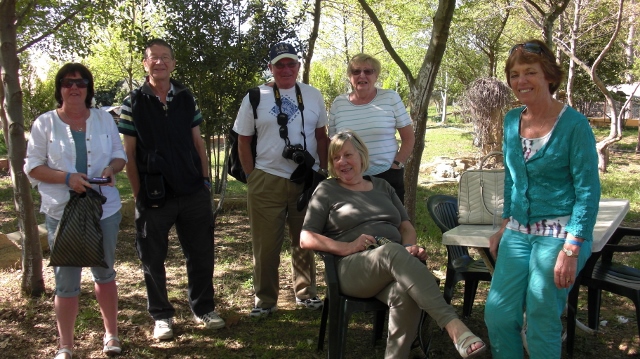
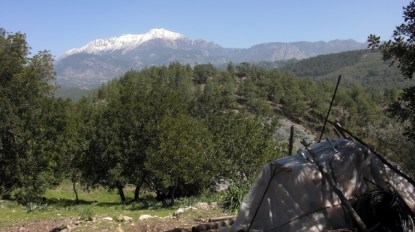
Away we went on a safari to the foothills of the snowy-topped Taurus mountains which had so tantalised me from my hotel bedroom window. For an hour we travelled in our coach, picking up people and waiting in vain for others. Skirting Antalya, the mountains in an arc before us, we reached the wayside café where our jeeps awaited.

Image

“English only!” we cried as we commandeered the leading jeep; but we had to give way to two Iranian matrons who filled the two front seats, while the third provided a buttress for me in the back from trials to come. We motored past orange and lemon groves, pomegranate trees, small fields of corn and many plastic shrouded lines of fruit and veg bound for the export market. There were few animals.

Image

We had our own paparazzi – a man on a motor cycle who whizzed by, then lay in wait to aim his lense at our jeeps as the road degenerated into a serpentine rough track, up and up, narrower and narrower.

Image

We stopped before a humble farm cottage. A white dog smiled a greeting, tail wagging ecstatically.

Image

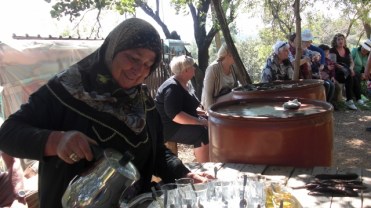
The Grandmother served us Turkish chai in small glasses and we dipped our spoons into delicious bitter-sweet carab juice. The view across to the snow-capped mountains was stupendous. Fancy waking up to that every morning.

Image

Back in our jeeps, our escort with the camera in close attendance, we splashed through one mountain stream and then another; faster and faster until the spray washed up at us. Bouncing through the bumps and swaying round the corners, our Iranian friends shrieked at every splash.

“Vater – vater..” screamed the effervescent tigress in leopard leotard and bouncy tinted locks in the front middle seat, and the driver obliged, drowning us all in dirty spray. We entered into the spirit and amid roars of laughter swayed in our tightly packed open seats in the back, cringing in delight at each deluge, while protecting our cameras. But while we were getting drenched, the termagant was safely sheltered behind the windscreen. The driver grabbed a water bottle at the next scream of “vater!” and upturned it over her bouncing curls. The piercing shrieks of delight rose several pitches. But it did not deter her.

As if we hadn’t had enough water, we stopped to gaze at a waterfall trickling down the hillside among mossy rocks. Noisy frogs chorused down-river at those of us who ventured along the boardwalk, planks broken or missing. There was a surprising derth of birds.

Our lunch venue stood on a wooden platform overlooking a sluggish river, the ever-present Taurus Mountains in the distance. Fish, chicken or omelette – we had to state our preferences before entry. The food was “free,” the drinks extra. Fair enough. We admired the view until eventually food was served. My succulent seasoned fresh trout was delicious.

Posted in Travels | Tagged , , , | Comments Off on “Vater – vater!!” A Safari With a Difference