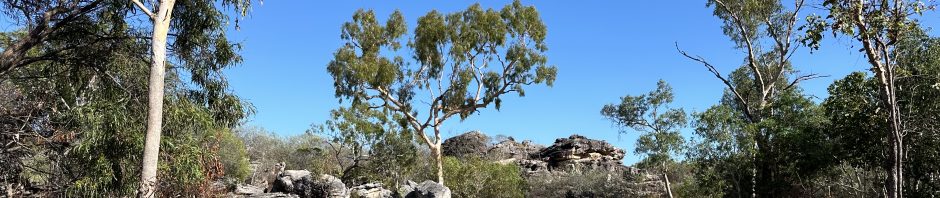
Saturday 31st August, 2024
After a 45-minute dash down the eastern side of the Coburg Peninsular, our classy craft cut its engines and glided onto a pristine beach. But we were warned to look out for crocodiles and hastened up a bank towards stacks of white plastic chairs. No time to sit down, though – it would be getting very hot.
Ian led us on a 4km walk under melaleuca trees (we’d already sprayed our legs and arms with mosquito repellent). He chose to do the tour backwards, ensuring we would visit the cemetery first, then head north in the early, cooler part of the morning under the canopy to halfway point. The whole area of Garig Gunak Barnu National Park requires a valid Permit to enter, and the Victoria Settlement ruins is one of the major Aboriginal owned lands attractions.
These ruins are of former British occupation from 1838-1849, achieved to deter the Indonesian Macassans from trading with the French or Dutch during these times of international colonial rivalry. The site was strategic, the aim military. Not that many rival vessels were accosted during those years – not a gun was fired from the heavily armed shore. No doubt the deterrent was effective.
In increasingly hot, humid conditions, taking frequent sips of water at the many stops, we paused at the few memorial stones, including that of a mother and baby who died, probably of what is now discovered as an even more deadly mosquito disease than the two types of malaria.
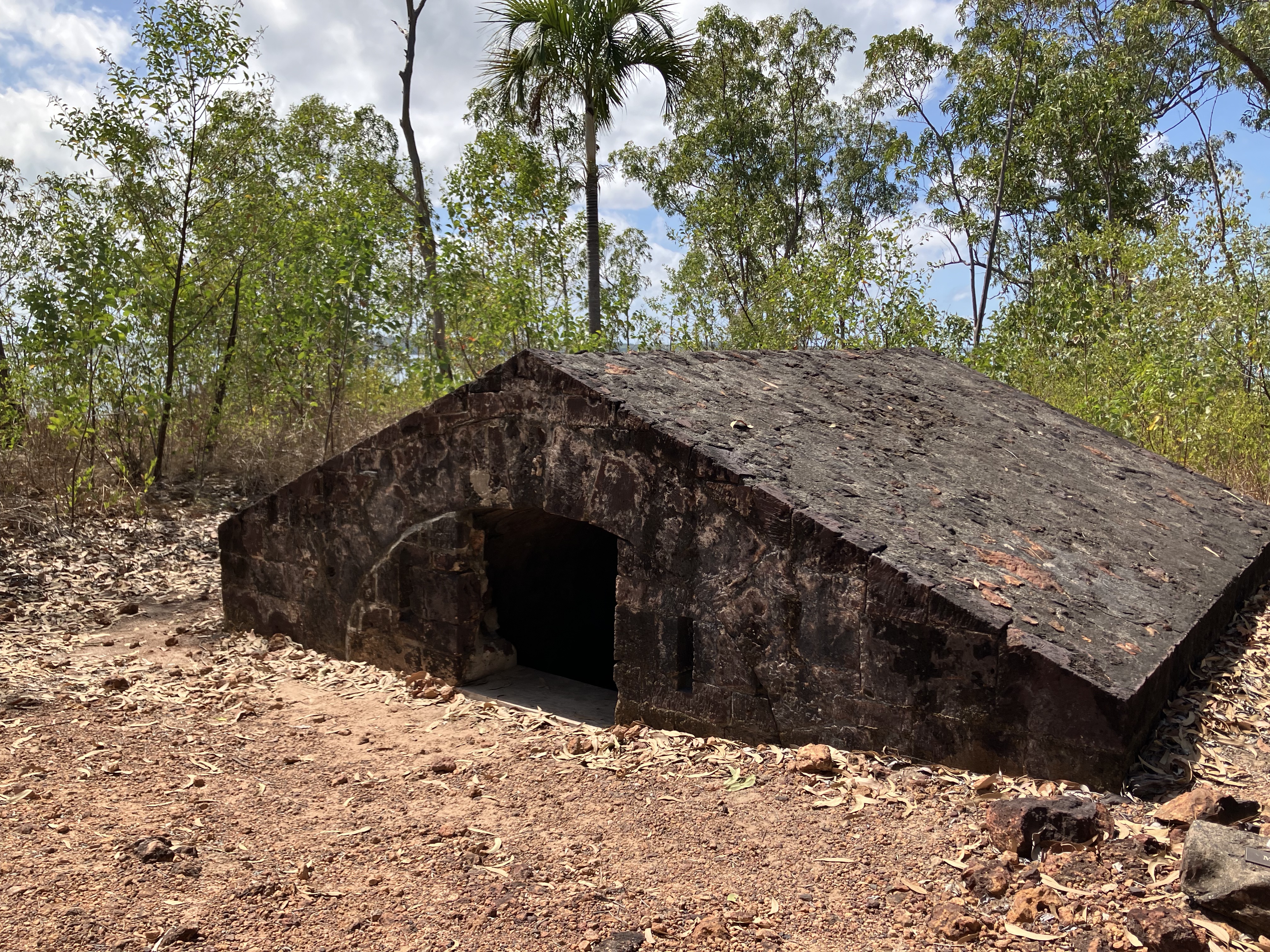
We examined a couple of kilns, identified a quartermaster’s store, and enjoyed some refreshing fruit and muesli bars at Minto Head (halfway). We imagined two people labouring over and under a massive log at the sawpit, reminding me of similar activity when I had climbed Mount Kenya decades ago. We slogged heads down, watching for snags in the path at our feet, past a vast well hole and the remains of an armoury.
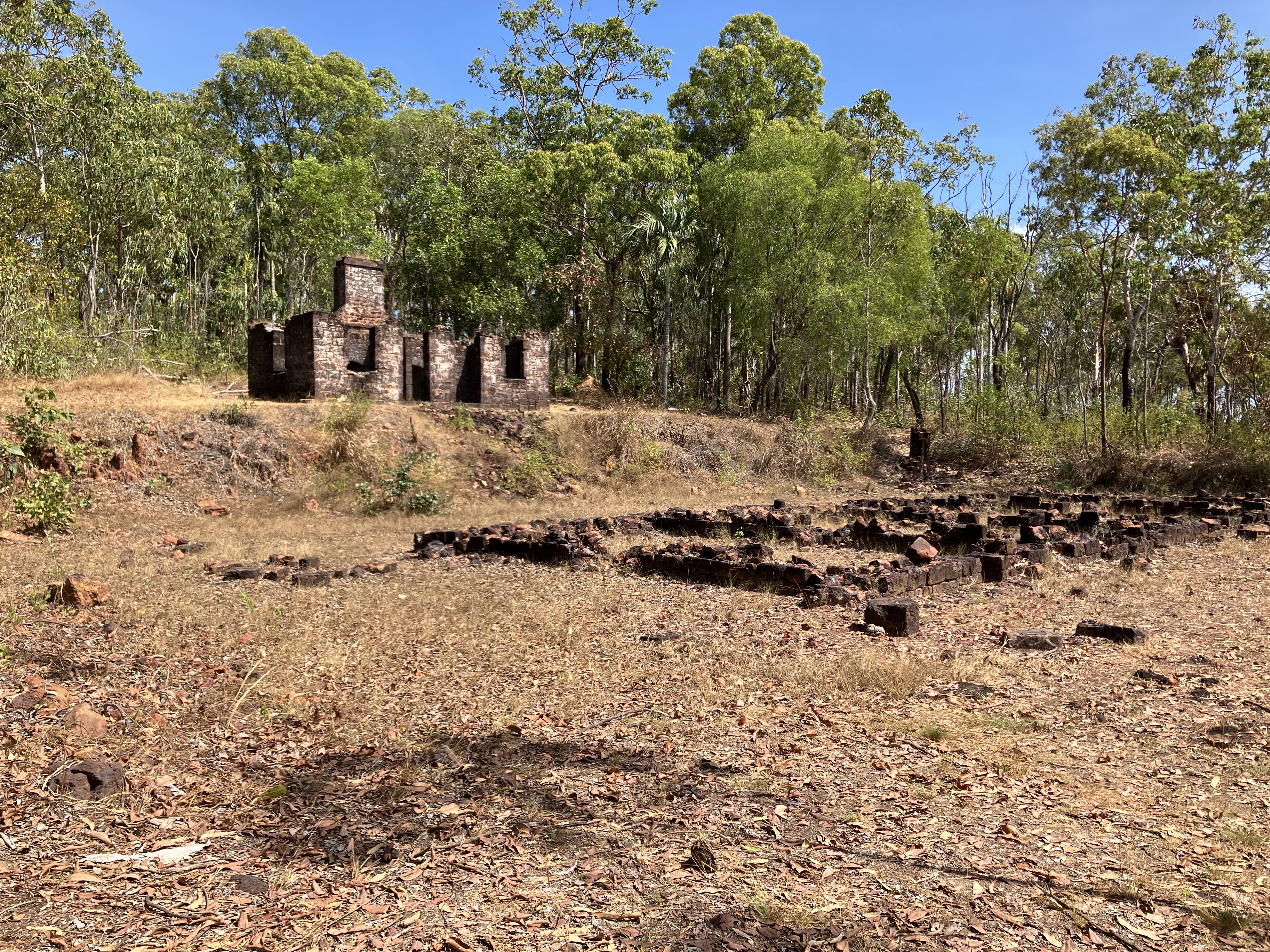
An historic hospital lay at our feet, the doctors’ house on a ridge above. They had brought in prefabricated timber buildings. The brick foundations were all that remained. Only a handful of people, but many problems: dysentery, malaria, a soldier who had his arm primitively sawed off by a surgeon who had never done that before, with the aid of rum to deaden the pain. About four wards, sixteen beds to a ward. Ian, as ever a mine of information, had memorised his spiel from meticulous research.

The married quarters – a strange line of ancient chimneys, each with different designs of mantelpiece were all that remained.
The temperature was rising, our group was beginning to fall apart, people started hustling to the front along the narrow pathway. At every stop, I would trudge past the line, to be near Ian so I could hear what he had to say. After the move-offs, I would give way to the others.
A crumbled jetty broke near the skyline as we thankfully reached the end of our walk and boarded the boat for lunch of more dry bread rolls, muffins, fruit and lots to drink.

We passed Record Point, a strategic lookout, and marvelled at the layered sands and massive tree roots reaching over the edge and into the sea.
I have a strange, strange feeling as I reflect on the Colonial Portuguese ruins at Gedi on Kenya’s coast, dating back to the 10th-17th centuries, which are preserved as a UNESCO World Heritage site by Independent Kenya. The scale of Kenya’s ruined city is more compact than here, but trade was also a factor. Here in 21st century Australia, an historic site of early British occupation is also preserved for posterity, this time by people in their sacred traditional lands. What might the history of Australia record, perhaps, in future centuries – will the resilient Aboriginals finally, in time, come into their own, I wonder?
That afternoon at the hotel, Suzanne had a meltdown when loud machinery disturbed her planned siesta in our remote room. She also complained at the sloppy room service and succeeded in confronting the Manager to tell him how to do his job. I had my own complaints about lack of staff communication, and getting lost between our remote room and main reception because of poor signage, facing only one way.
Our lovely cohesive group, always happy to lend a hand and care about each other, have been lucky not to experience the tribulations of lack of management until this our final stay. I was going to recommend the tour to my family. But perhaps they shouldn’t make immediate plans, and probably go earlier in the season when it won’t be so stinking hot.
 Jane Bwye
thanks Jane – very interesting to read.